8 July 2026 · 3 min read
The 1.8-Billion-Year-Old River That Left Its Pulse in Stone
In the Northern Territory, 1.8-billion-year-old river sediments in the Roper Group preserve the oldest known meandering river channels on Earth—bends frozen in sandstone that record how water moved be
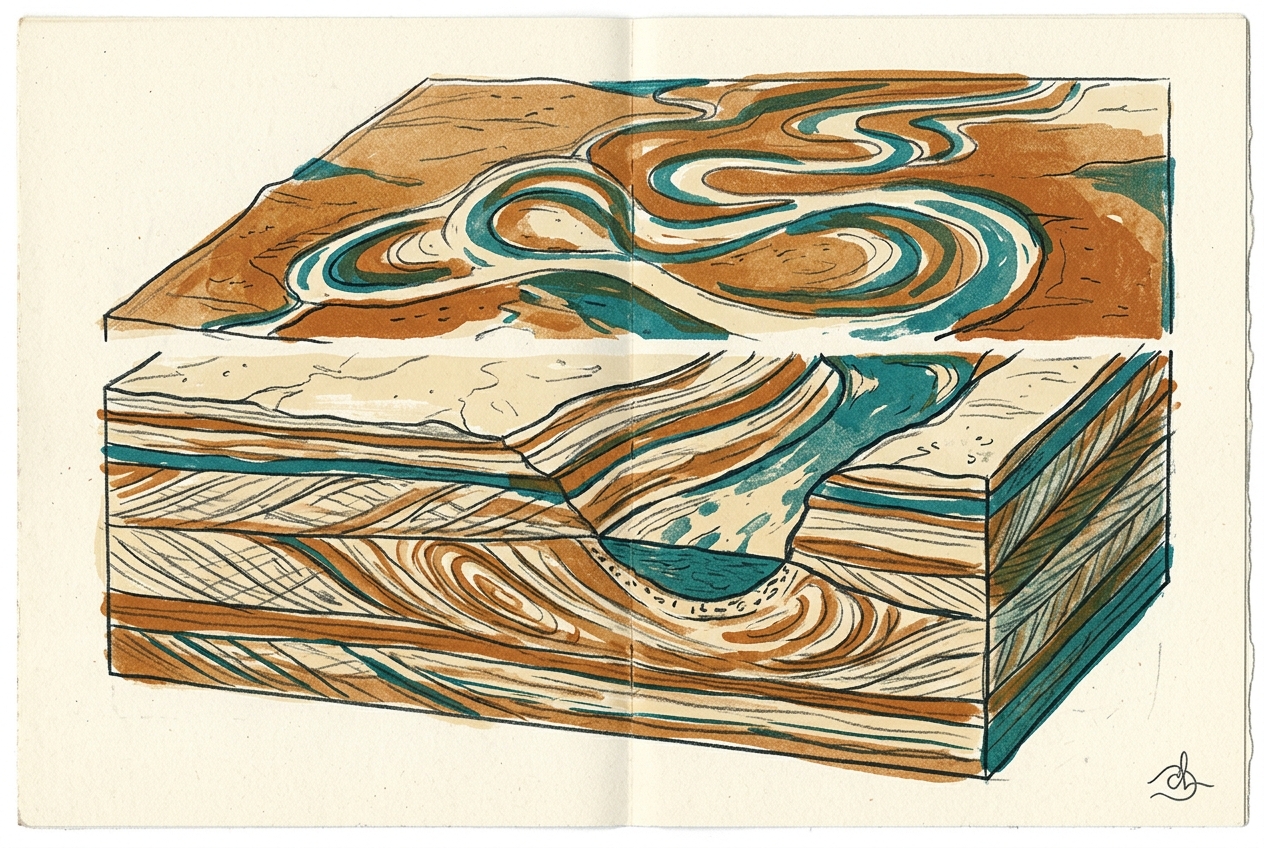
In the remote Northern Territory, south of the Gulf of Carpentaria, a river froze in place 1.8 billion years ago. Not the water itself, but the shape of its channel—a meander bend preserved in sandstone so perfectly that you can still trace the curve where ancient currents once cut into mud. These are the oldest meandering river deposits ever found on Earth.
A River Before Rivers Had Names
The Roper Group is a thick pile of sedimentary rock that accumulated between 1.8 and 1.4 billion years ago in a shallow inland sea. But within that sequence, geologists have identified something unexpected: sinuous sandstone bodies that record the paths of ancient rivers. These are not the braided, shallow streams typical of the early Earth. They are meandering channels—deep, single-threaded rivers that curved across a floodplain much like the Mississippi does today.
The discovery was made in the Limmen National Park area, where erosion has cut into the ancient sediments and exposed cross-sections of the old river channels. The sandstone bodies show inclined layers—point bars—that accumulate on the inside of a meander bend as the river migrates sideways. The geometry is unmistakable. These rivers curved, migrated, and deposited sediment in exactly the same way modern rivers do.
What makes this remarkable is the age. For most of Earth's history, geologists assumed, rivers were shallow and wide—braided systems that spread across barren landscapes without vegetation to bind the banks. The Roper meanders prove otherwise.
The Missing Glue
A meandering river requires banks that hold. Without rooted plants or microbial mats to stabilize sediment, a river's edges erode too quickly to form tight curves. The Roper meanders therefore raise a puzzle: what held the banks together 1.8 billion years ago, when land plants did not yet exist?
The answer may lie in microbial mats—layers of cyanobacteria and other microbes that once coated the ancient landscape. These living films can bind sediment, creating a tough, rubbery surface that resists erosion. In the Roper Group, geologists have found ripple marks and desiccation cracks that suggest the sediment surface was indeed stabilized by something biological. The riverbanks were likely held in place by a living skin.
A river without banks is just a flood. The oldest meanders on Earth required life to hold the line.
This changes how we imagine the Proterozoic world. Not a barren, rocky desert, but a landscape where microbial communities shaped the very form of the land—controlling where rivers ran and how they moved.
A Continent That Would Not Stay Still
The Roper sediments also record the slow dance of tectonic plates. The meandering river channels sit within a basin that formed during a period of crustal extension, when the land was pulling apart. The basin filled with sediment for hundreds of millions of years, then was squeezed and folded during later mountain-building events.
Today the old river deposits are exposed in low ridges that run across the savannah country of the Northern Territory. The rocks have been tilted and eroded, but the meander shapes remain readable—cross-sections of ancient channels that geologists can map and measure. Each point bar, each cutbank, is a still frame from a movie of water moving across a landscape that no longer exists.
The Roper Group is also famous for something else: 1.5-billion-year-old microfossils preserved in the same sediments—some of the oldest known eukaryotic cells. The same rivers that cut meanders through the landscape also carried nutrients into the basin, feeding the early evolution of complex life.
What the Bend Tells Us
The oldest meanders on Earth are not just a curiosity. They tell us that the early Earth was more like the modern world than we once thought—that rivers behaved the same way, that life shaped landscapes, and that the basic physics of water moving over sediment has not changed in 1.8 billion years.
They also remind us that the Australian continent preserves some of the best records of the early Earth anywhere on the planet. The Roper meanders are exposed across hundreds of square kilometers, waiting to be studied. Each outcrop is a page in a book that records how water, sediment, and life interacted long before animals appeared.
The river is gone. The water evaporated into an atmosphere that no longer exists. But the shape of its channel remains, etched in sandstone, still holding the curve of a bend it cut into the earth nearly two billion years ago.
More like this
- The 110-Million-Year-Old River That Runs Backwards UndergroundWestern Australia's 110-million-year-old dune system has been slowly dissolving into a labyrinth of caves where an ancient river still flows, carrying the taste of a Cretaceous desert.
- The 5,000-Year-Old Volcanoes That Still Smoke in the SouthIn Victoria's Newer Volcanics Province, 400 volcanic vents erupted as recently as 5,000 years ago—the youngest volcanic field in mainland Australia, where craters still hold blue lakes and scoria cone
- The 560-Million-Year-Old Garden That Never Saw a PredatorIn South Australia's Flinders Ranges, 560-million-year-old Ediacara surfaces preserve entire seafloor communities of fronds, discs, and quilts — a garden of soft-bodied life that flourished before pre