27 June 2026 · 3 min read
The 560-Million-Year-Old Ash That Silhouetted a Garden
How 560-million-year-old volcanic ash in South Australia's Flinders Ranges preserved the Ediacaran biota in astonishing detail—not as fossils, but as casts of soft bodies smothered by sudden ashfall.
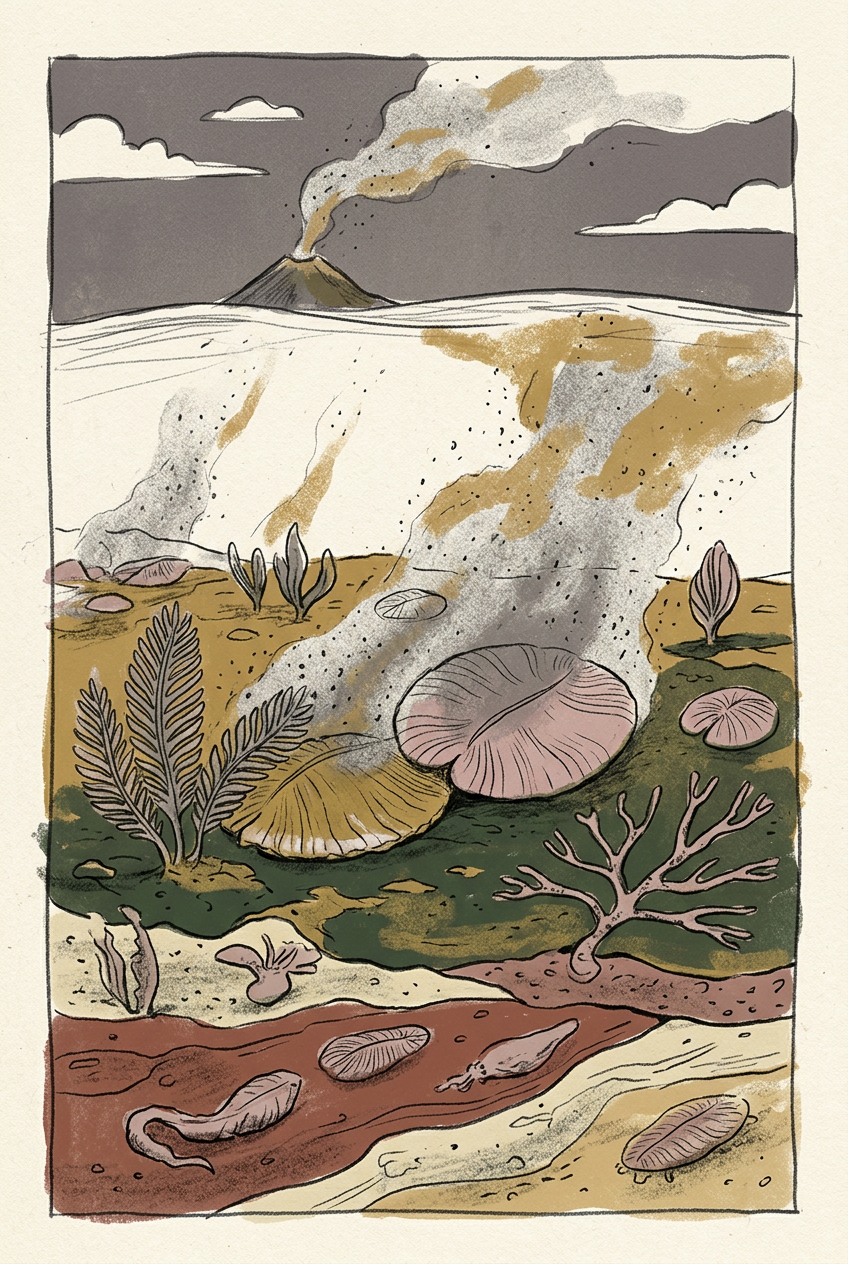
A single ashfall buried an entire garden. At Nilpena Ediacara National Park in South Australia's Flinders Ranges, a thin layer of volcanic ash that fell 560 million years ago does something no other Ediacaran deposit can: it preserves the soft bodies of Earth's first complex organisms not as impressions in sand, but as three-dimensional casts, frozen mid-life by a sudden rain of fine volcanic glass.
The Ash That Cast a Shadow
Most Ediacaran fossils are found on the soles of sandstone beds—the negative impression left when a sandstorm or current draped a microbial mat and the organism beneath it. The Flinders Ranges holds thousands of these. But a small number of beds preserve something rarer: the upper surface of the seafloor, where the organisms lived and died in place, smothered by a layer of volcanic ash so fine it filled every crevice before the body decayed.
The ash came from a distant volcanic arc, perhaps to the east or north, carried by wind or water across a shallow marine shelf. It fell on a quiet seafloor covered by microbial mats—leathery sheets of cyanobacteria that stabilised the sediment and created a firm substrate. The organisms that lived on this mat were not animals in the modern sense. They were fronds, discs, and quilted forms that absorbed nutrients directly from the water.
A Garden Preserved in Three Dimensions
What makes the ash-fall beds extraordinary is the quality of preservation. At the classic Ediacaran sites—Mistaken Point in Newfoundland, the White Sea of Russia—fossils are flattened impressions, their original relief lost to compaction. At Nilpena, the ash hardened around the organisms before they collapsed, creating a cast of their full three-dimensional form.
One specimen of Dickinsonia* preserves the raised rim of its body wall so clearly that researchers could measure its original thickness—a detail invisible in any other deposit.*
The ash also preserved the community exactly as it lived. On a single excavated bed, now called the Alice's Restaurant Bed, researchers have mapped over 1,000 individual fossils in their original positions: large Dickinsonia overlapping smaller ones, Tribrachidium clustered in groups, and the strange, stem-like Funisia standing upright in currents. It is a snapshot of an ecosystem, not a death assemblage swept together by currents.
The Chemistry of Sudden Death
The ash did more than smother. It also altered the local chemistry in ways that prevented decay. Volcanic ash releases silica and other minerals into seawater, and these compounds may have coated the organic tissues with a thin film that slowed bacterial breakdown. The same process—silicification—preserves some of the most exquisite fossils in the rock record, from the Burgess Shale to the Gunflint chert.
At Nilpena, the result is a preservation style unique among Ediacaran deposits. The fossils are not compressed into carbon films, nor are they the sand-filled casts of a buried body. They are something in between: the organism's original shape, cast in volcanic ash that later hardened into claystone, then lifted by erosion into the desert air.
A Window That Closes Slowly
The ash-fall beds are rare even within the Flinders Ranges. Most of the Ediacaran sequence was deposited slowly, grain by grain, over millions of years. The ash events were instantaneous—geological accidents that caught a moment of Precambrian life and froze it. Each ash bed represents hours or days of deposition, not centuries.
Only a handful of these beds have been found. They record a world before predation, before skeletons, before any organism moved more than a few centimetres in its lifetime. The ash that killed them also made them immortal, and the same volcanic fire that built distant mountains left a shadow of a garden on a silent seafloor.
More like this
- The 5,000-Year-Old Volcanoes That Still Smoke in the SouthIn Victoria's Newer Volcanics Province, 400 volcanic vents erupted as recently as 5,000 years ago—the youngest volcanic field in mainland Australia, where craters still hold blue lakes and scoria cone
- The 560-Million-Year-Old Garden That Never Saw a PredatorIn South Australia's Flinders Ranges, 560-million-year-old Ediacara surfaces preserve entire seafloor communities of fronds, discs, and quilts — a garden of soft-bodied life that flourished before pre
- The 300-Million-Year-Old Forest That Died Standing UpIn New South Wales, a 300-million-year-old fossil forest preserves dozens of trees buried upright by a Permian volcanic eruption—an entire ecosystem frozen in ash.