27 June 2026 · 3 min read
The 3.5-Billion-Year-Old Fumes That Almost Strangled Life
How 3.5-billion-year-old volcanic gases in Western Australia's Pilbara recorded the Archaean atmosphere—air so rich in sulfur it nearly poisoned the cradle of life.
On a ridge of red-black chert in Western Australia's Pilbara, a rock that looks like layered jelly preserves the breath of a young Earth. The air was poison. The sky was orange. And the only life that could survive was a film of slime that learned to breathe sulfur.
The Volcano That Breathed Sulfur
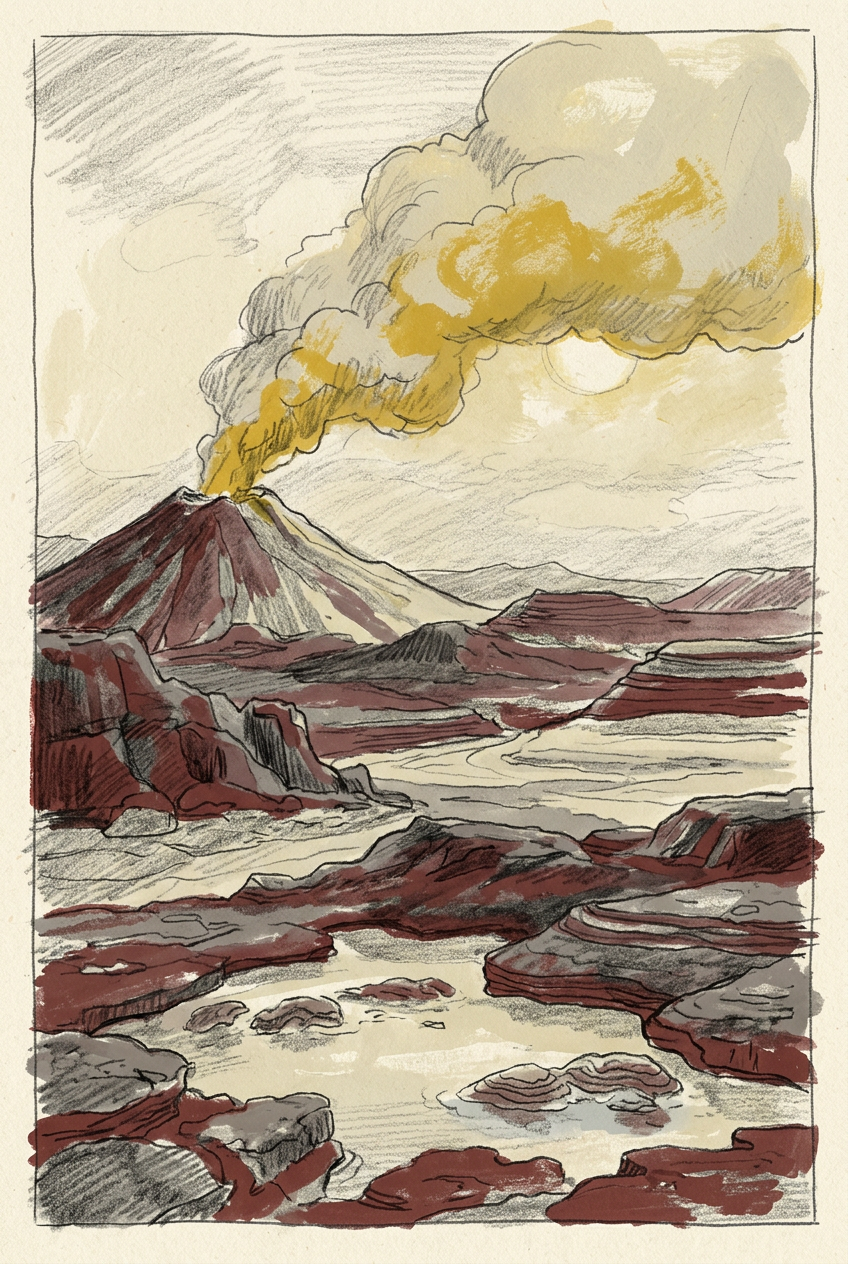
About 3.5 billion years ago, the Pilbara was not a quiet craton of granite domes and tidal flats. It was a volcanic hellscape. A chain of submarine volcanoes—the Coucal Formation—erupted along the eastern margin of what is now the North Pole Dome. These were not the gentle shield volcanoes of Hawaii. They were explosive, gas-rich vents that belched a cocktail of hydrogen sulfide, sulfur dioxide, and carbon dioxide into an ocean that had barely any free oxygen.
The eruptions built mounds of black chert and barite, a dense sulfate mineral that precipitated directly from the hydrothermal fluids. Today those mounds sit exposed in the North Pole region, about 100 kilometres south of Port Hedland. They are the oldest known volcanic vents on Earth that preserve direct evidence of the gases they released.
The Air That Almost Killed Everything
What makes these rocks extraordinary is what they contain: microscopic bubbles of ancient gas trapped inside barite crystals. In 2015, geochemists at the University of Tasmania crushed samples of the 3.5-billion-year-old barite and analysed the gases released. They found sulfur isotopes with a signature that has never been seen in any younger rock—a mass-independent fractionation that only occurs when the atmosphere has no ozone layer and very low oxygen.
The bubbles record an atmosphere where sulfur dioxide from volcanoes lingered for years instead of days, because there was no oxygen to react with. The air was a toxic haze of volcanic fumes. For any early life that relied on photosynthesis, this was a problem: the same gases that made the sky orange also blocked the ultraviolet radiation that would have sterilised the surface. Life survived only because the volcanoes both poisoned and protected it.
The same volcanoes that nearly choked the first cells also built the chemical scaffolding that let them evolve.
The Bubbles That Rewrote a Timeline
Before these barite crystals were analysed, the oldest direct sample of Earth's atmosphere came from 2.7-billion-year-old rocks in South Africa. The Pilbara barite pushed that record back by 800 million years. It also settled a long debate about when the atmosphere became oxidised. The sulfur isotope signature in the barite proves that the Archaean atmosphere was still essentially anoxic at 3.5 billion years—and that the Great Oxidation Event, which would eventually rust the continents, was still more than a billion years away.
The bubbles also hint at something stranger. The isotope ratios suggest that the volcanic gases were not just from Earth's mantle. Some of the sulfur may have come from the photochemical breakdown of atmospheric sulfur dioxide by ultraviolet light—meaning the atmosphere itself was being chemically processed by sunlight, with no ozone to stop it.
The Ridge That Still Holds the Secret
Today the Coucal Formation is a low ridge of dark chert and white barite, surrounded by spinifex grass and red dust. The rocks are crumbly and veined with quartz. To the untrained eye, they look like any other Pilbara outcrop. But the barite crystals, no bigger than a fingernail, are time capsules of the most poisonous air Earth has ever known.
Geologists still return to the North Pole Dome to sample those crystals. Each fresh fracture releases a faint whiff of hydrogen sulfide—the same gas that filled the Archaean sky, trapped for 3.5 billion years in a mineral tomb. It is the smell of a world that almost never let life begin.
More like this
- The 110-Million-Year-Old River That Runs Backwards UndergroundWestern Australia's 110-million-year-old dune system has been slowly dissolving into a labyrinth of caves where an ancient river still flows, carrying the taste of a Cretaceous desert.
- The 5,000-Year-Old Volcanoes That Still Smoke in the SouthIn Victoria's Newer Volcanics Province, 400 volcanic vents erupted as recently as 5,000 years ago—the youngest volcanic field in mainland Australia, where craters still hold blue lakes and scoria cone
- The 560-Million-Year-Old Garden That Never Saw a PredatorIn South Australia's Flinders Ranges, 560-million-year-old Ediacara surfaces preserve entire seafloor communities of fronds, discs, and quilts — a garden of soft-bodied life that flourished before pre