27 June 2026 · 3 min read
The 550-Million-Year-Old Garden That Still Waits for Rain
How the Ediacara biota of South Australia's Flinders Ranges were preserved by microbial mats that held the seafloor together—a vanished world that left its ghost in sand.
On a slab of quartz-rich sandstone in the Flinders Ranges, a frond lies frozen in stone. It looks like a leaf pressed in a book, but it is not a leaf. The organism that made it lived 550 million years ago, on a seafloor that had no predators, no burrowers, and no hard parts—a garden of soft quilts and ferns that stood anchored to a living carpet.
That carpet was the key. Without it, nothing would have survived.
The Living Floor
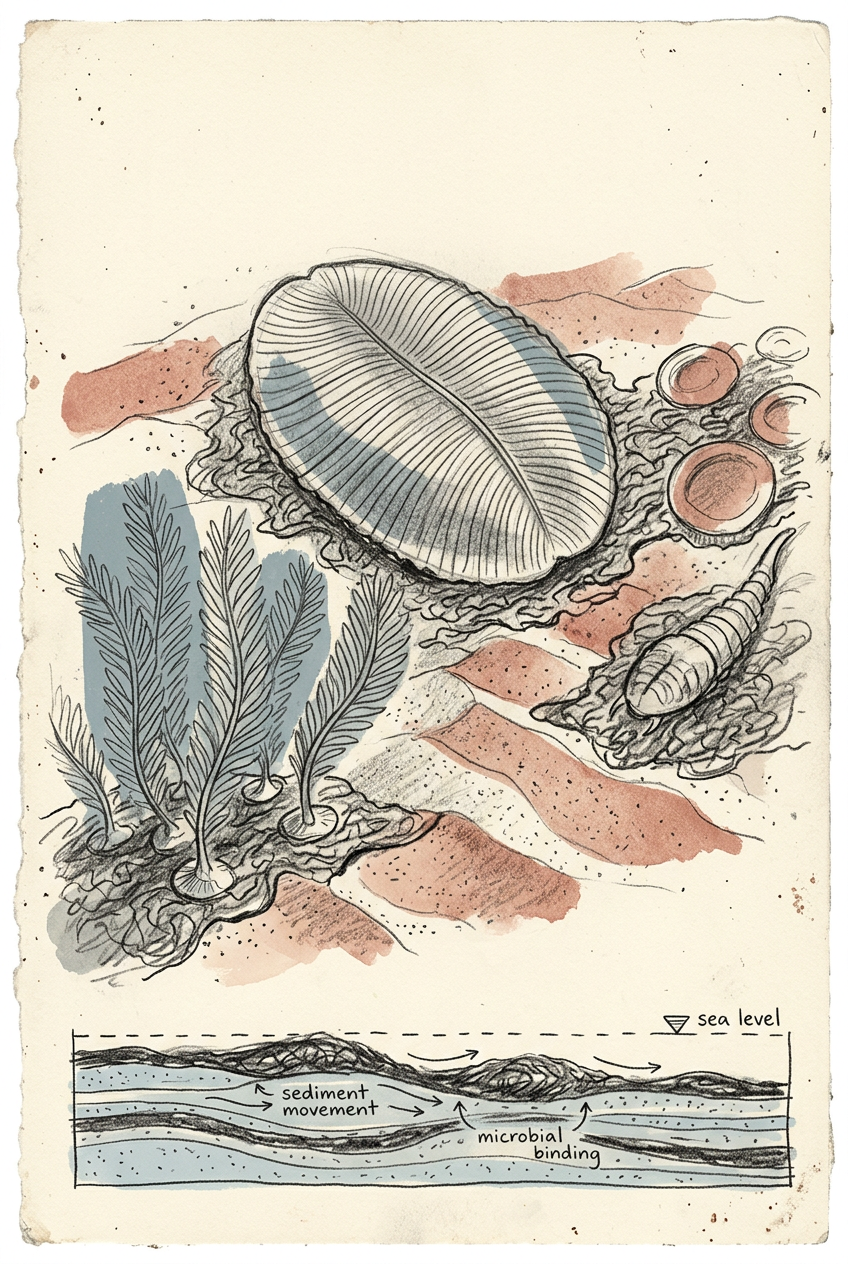
The Ediacaran seafloor was not sand and mud as we know them. It was bound together by microbial mats—dense communities of bacteria and algae that grew as a leathery skin across the sediment. These mats were tough, elastic, and sticky. They held the seafloor still.
In younger oceans, burrowing animals churn the sediment, mixing it with water and destroying any fine detail. But the Ediacaran world had no burrowers. The first animals, the Ediacara biota, lived on top of the mat rather than inside it. When they died, the mat sometimes grew over them, preserving their bodies as moulds in the microbial skin.
The organisms were not buried by sediment. They were entombed by the living floor beneath them.
Later, sand washed in and filled the moulds. The sand hardened to quartzite, and the organic matter decayed away. What remains is a cast—a sandstone replica of a body that was never mineralised in life.
The Frond and the Quilt
The most famous of these casts belong to the rangeomorphs, fractal-like organisms that grew as branching fronds. The largest, Fractofusus, could span a metre. They had no mouth, no gut, no organs. They absorbed nutrients directly from the water through their quilted surfaces.
Other Ediacarans were different. Dickinsonia was a ribbed oval that grew by adding segments, like a living air mattress. It could move—slowly—by contracting its body. Trackways show that it crept across the microbial mat, digesting the biofilm as it went. It was the first mobile grazer.
Then there was Tribrachidium, a three-lobed disc that sat on the seafloor like a pinwheel. Its symmetry is unlike anything alive today. It may have been a filter feeder, or it may have been something else entirely—a body plan that evolution tried once and abandoned.
The Slab That Holds a World
The finest Ediacaran fossils are found in the Nilpena Ediacara National Park, about 600 kilometres north of Adelaide. Here, the Rawnsley Quartzite is exposed as a series of bedding planes, each one a snapshot of the ancient seafloor. Palaeontologists have excavated more than 300 square metres of these surfaces, mapping the position of every fossil like an archaeological dig.
What they have found is extraordinary. The fossils are not scattered randomly. They are arranged in communities, with different species occupying different zones. Fractofusus grew in dense thickets. Dickinsonia wandered freely. Tribrachidium clustered in groups. The Ediacaran seafloor had its own ecology, its own geography, its own rules.
Then came the Cambrian explosion. Burrowing animals evolved, and the microbial mats were broken apart. The living carpet that had held the seafloor together for 30 million years vanished. The Ediacara biota vanished with it.
The Ghost in the Sandstone
The Ediacaran fossils are not bones, shells, or teeth. They are impressions—the negative space left by bodies that had no hard parts at all. They are preserved only because the seafloor was held still by a microbial mat, and because sand later filled the moulds before the bodies decayed.
It is a narrow window of preservation, and it closed forever when the first burrowers evolved. The Ediacara biota survives only because it lived in a world that could not yet digest its dead.
More like this
- The 560-Million-Year-Old Garden That Never Saw a PredatorIn South Australia's Flinders Ranges, 560-million-year-old Ediacara surfaces preserve entire seafloor communities of fronds, discs, and quilts — a garden of soft-bodied life that flourished before pre
- The 300-Million-Year-Old Forest That Died Standing UpIn New South Wales, a 300-million-year-old fossil forest preserves dozens of trees buried upright by a Permian volcanic eruption—an entire ecosystem frozen in ash.
- The 1.75-Billion-Year-Old Reef That Outranks the BarrierA 1.75-billion-year-old microbial reef in the Kimberley is the largest biological structure ever built by a single species, preserving a world without predators.