26 June 2026 · 3 min read
The 555-Million-Year-Old Bed That Holds Earth's First Footprints
Fossilised burrows in South Australia's Flinders Ranges preserve the earliest known evidence of animal locomotion—trackways made by Ediacaran organisms 555 million years ago.
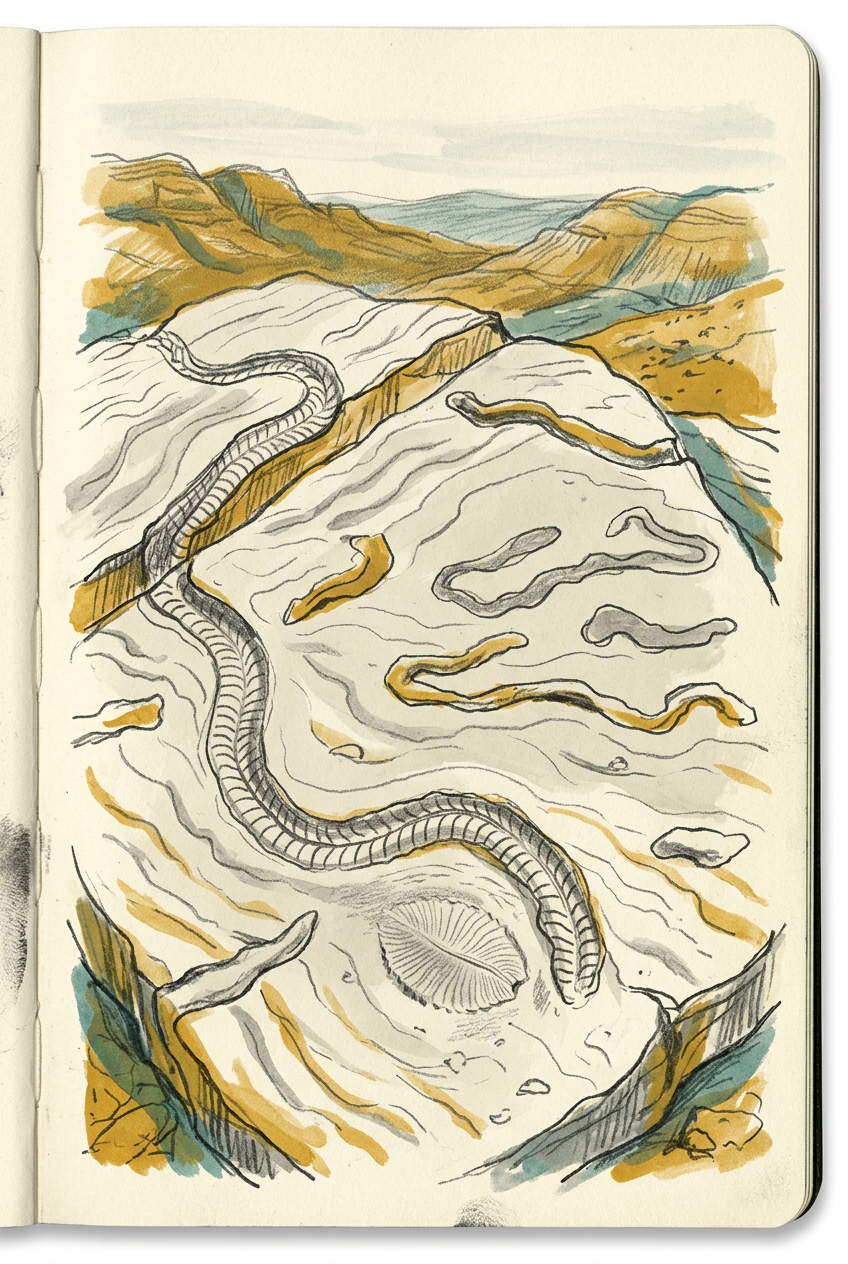
On a bedding plane in South Australia's Flinders Ranges, there are marks that look like someone dragged a finger through wet cement. They are not human. They are not even Cambrian. These are the oldest known animal footprints on Earth—trails left by something that moved across the seafloor 555 million years ago, long before legs, shells, or eyes had evolved.
The Nilpena Ediacara Fossil Site
The tracks come from the Nilpena Ediacara National Park, about 450 kilometres north of Adelaide. The site preserves a slice of the Ediacaran period (roughly 575 to 539 million years ago), when the first complex, soft-bodied organisms appeared in the oceans. The fossils are preserved in fine-grained sandstone beds that were originally sandy seafloor, smothered suddenly by sheets of sediment—probably from storms—that froze the organisms in place.
What makes Nilpena extraordinary is the quality of preservation. Not just the bodies of these ancient creatures, but their behaviour. Feeding traces. Resting impressions. And, most remarkably, trackways. The footprints are small—a few millimetres wide—and arranged in paired rows, suggesting an animal with bilateral symmetry and some kind of appendage, perhaps a muscular foot, that could push against the sediment.
These are not the footprints of a simple blob. They are the record of a creature that knew where it was going.
What Made the Tracks?
The organism that left these prints has no name—no body has been found attached to the trails. Palaeontologists call it an "undescribed bilaterian": an animal with a left and right side, a front and back, and the ability to move in a directed way. The tracks suggest it was about the size of a fingernail, creeping across the microbial mats that carpeted the Ediacaran seafloor.
Earlier Ediacaran fossils—the frond-like Dickinsonia and the quilted Spriggina—were mostly stationary or drifted with currents. The Nilpena trackways mark a shift. Something had evolved that could hunt, or at least search. The prints are associated with small pits and probes, as if the animal was testing the sediment for food. It may have been a grazer, or perhaps a scavenger. Either way, it was the first creature on Earth to leave a deliberate trail.
A Window into the Ediacaran World
The Flinders Ranges preserve the world's most complete record of Ediacaran life. The fossils sit between two great ice ages: the Sturtian glaciation (about 717 to 660 million years ago) and the Marinoan (about 650 to 635 million years ago). The Ediacaran biota emerged in the warm, oxygen-rich seas that followed. They were the first experiments in complex multicellular life—and they all died out before the Cambrian explosion.
But the tracks survived. They were buried by sand, turned to stone, and then lifted by the same tectonic forces that raised the Flinders Ranges over the last 100 million years. Today, they lie exposed on the surface, waiting for a careful eye.
What the Footprints Mean
The Nilpena trackways push back the date of directed animal locomotion by at least 30 million years. Before their discovery, the oldest accepted footprints came from the early Cambrian, about 525 million years ago. The Ediacaran prints show that complex behaviour—searching, moving with purpose, perhaps even stalking—evolved well before the Cambrian explosion.
They also raise a question. If an animal this sophisticated existed 555 million years ago, why did it leave no descendants? The Ediacaran biota vanished at the end of the period, replaced by the hard-shelled, fast-moving animals of the Cambrian. The track-maker may have been a dead end, a lineage that failed. Or it may have been an early ancestor of something that survives today—a mollusc, perhaps, or a worm. Without a body fossil, we cannot know.
For now, the footprints remain a mystery pressed into stone: the first steps of an animal that walked the Earth and then disappeared, leaving only its tracks behind.
More like this
- The 560-Million-Year-Old Garden That Never Saw a PredatorIn South Australia's Flinders Ranges, 560-million-year-old Ediacara surfaces preserve entire seafloor communities of fronds, discs, and quilts — a garden of soft-bodied life that flourished before pre
- The 300-Million-Year-Old Forest That Died Standing UpIn New South Wales, a 300-million-year-old fossil forest preserves dozens of trees buried upright by a Permian volcanic eruption—an entire ecosystem frozen in ash.
- The 1.75-Billion-Year-Old Reef That Outranks the BarrierA 1.75-billion-year-old microbial reef in the Kimberley is the largest biological structure ever built by a single species, preserving a world without predators.