25 June 2026 · 2 min read
The 180-Million-Year-Old Volcano That Carved a Canyon
How a 180-million-year-old volcanic eruption in Queensland's Toowoomba region created the continent's only known fossilised lava tree moulds—and a canyon that still holds the forest's ghost.
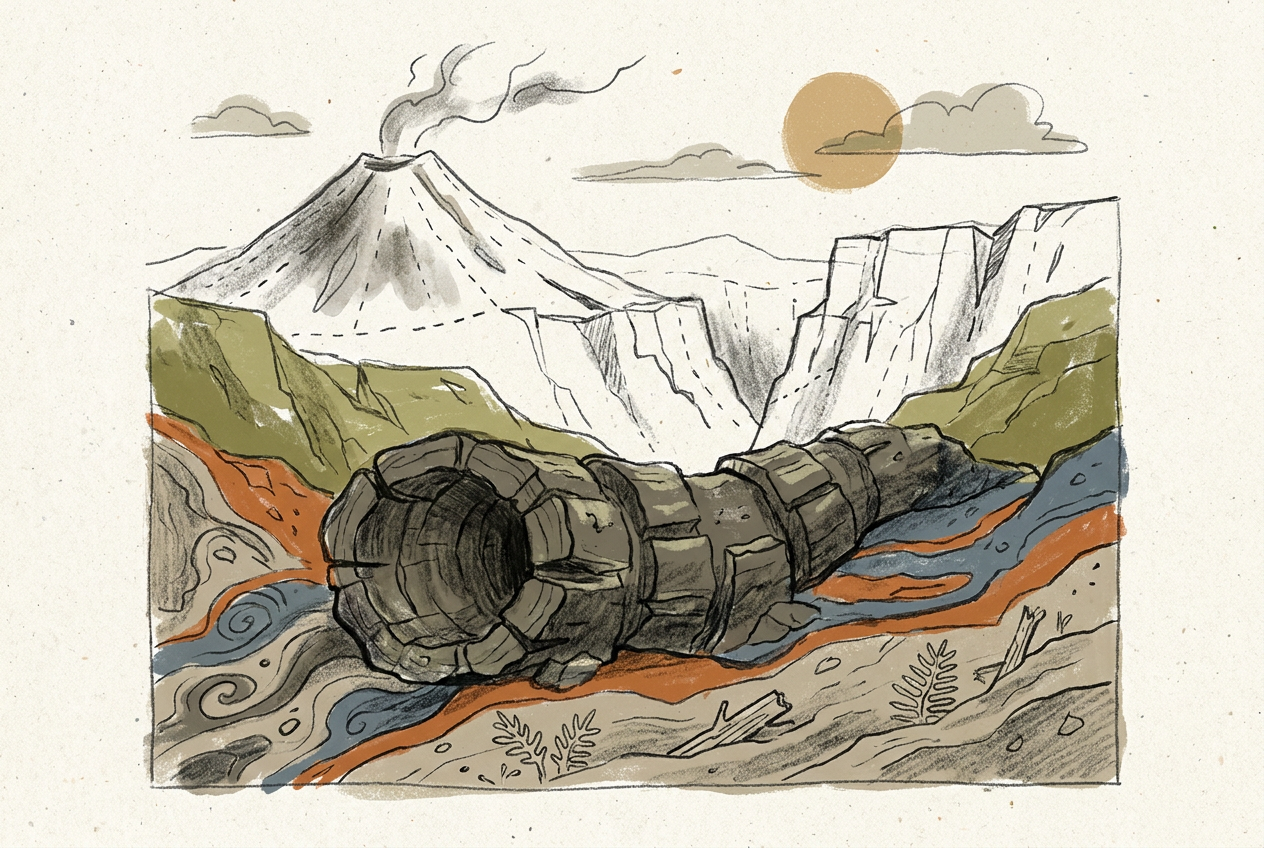
Deep in the Main Range, west of Brisbane, a canyon cuts through volcanic rock that once flowed as liquid basalt 180 million years ago. The cliffs hold something strange: vertical pipes, some as tall as a man, that are the casts of ancient tree trunks—the only known lava tree moulds on the Australian continent.
The Lava That Found a Forest
In the early Jurassic, eastern Queensland was a landscape of active volcanoes and conifer forests. A flood of basalt lava—fluid enough to travel kilometres—poured across the land at temperatures around 1,100 °C. As the molten rock advanced, it engulfed standing trees, wrapping around their trunks like a slow, burning tide.
The wet wood flashed to steam. But the basalt cooled quickly against the bark, forming a rigid shell. When the tree decayed and vanished, it left a hollow vertical mould in the solid rock—a perfect negative of the trunk, complete with bark texture.
These tree moulds survive today in the cliffs of Main Range National Park, near the town of Toowoomba. The tallest reach four metres. Some show the branching of roots. A few preserve the impression of bark ridges and insect borings, recording details of a forest that vanished before the first flowering plants evolved.
Reading the Ghost Forest
The moulds are not fossils of wood, but fossils of space—the void left where a tree once stood.
The Main Range lava tree moulds tell us about the Jurassic climate and ecology. The trees were likely conifers related to modern araucarias—hoop pine and bunya pine—which still grow in Queensland's rainforests. The moulds' vertical orientation and depth suggest the lava advanced slowly enough for trees to remain standing, rather than being flattened by a fast-moving flow.
Geologists have dated the overlying and underlying basalt flows using radiometric methods, placing the eruption at roughly 180 million years old. That puts the forest in the early Jurassic, when Australia was still connected to Antarctica and Gondwana was beginning to split apart.
The Canyon That Opened a Window
Over millions of years, the Goomburra Creek cut down through the stacked basalt flows, exposing the tree moulds in cross-section. The canyon now known as The Head, or Goomburra Valley, is part of the Main Range volcanic province, a region shaped by repeated eruptions between 190 and 170 million years ago.
The moulds are fragile. Exposed to rain and frost, they slowly widen and crumble. But new ones are still being discovered as the canyon deepens, each revealing another tree that stood in the path of a Jurassic lava flow.
Fewer than twenty sites worldwide preserve lava tree moulds. Hawaii has thousands. Argentina has a famous Jurassic forest. But Australia's only examples are here, in this quiet valley west of Brisbane, where a 180-million-year-old volcanic flood left a forest's ghost in stone.
More like this
- The 110-Million-Year-Old River That Runs Backwards UndergroundWestern Australia's 110-million-year-old dune system has been slowly dissolving into a labyrinth of caves where an ancient river still flows, carrying the taste of a Cretaceous desert.
- The 5,000-Year-Old Volcanoes That Still Smoke in the SouthIn Victoria's Newer Volcanics Province, 400 volcanic vents erupted as recently as 5,000 years ago—the youngest volcanic field in mainland Australia, where craters still hold blue lakes and scoria cone
- The 560-Million-Year-Old Garden That Never Saw a PredatorIn South Australia's Flinders Ranges, 560-million-year-old Ediacara surfaces preserve entire seafloor communities of fronds, discs, and quilts — a garden of soft-bodied life that flourished before pre