6 July 2026 · 3 min read
The 550-Million-Year-Old Seafloor That Learned to Breathe
How 550-million-year-old Ediacaran seafloor mats in the Flinders Ranges preserve the moment when microbial colonies began building rigid structures, hinting at the dawn of skeletonization.
In the Flinders Ranges of South Australia, the Brachina Gorge road cuts through a 550-million-year-old seafloor that was once soft enough to hold a footprint. But what you find in the rock is not a footprint. It is a wrinkled, pustular surface—a microbial mat that turned to stone before any animal had evolved a skeleton.
The Mat That Held the Seafloor Together
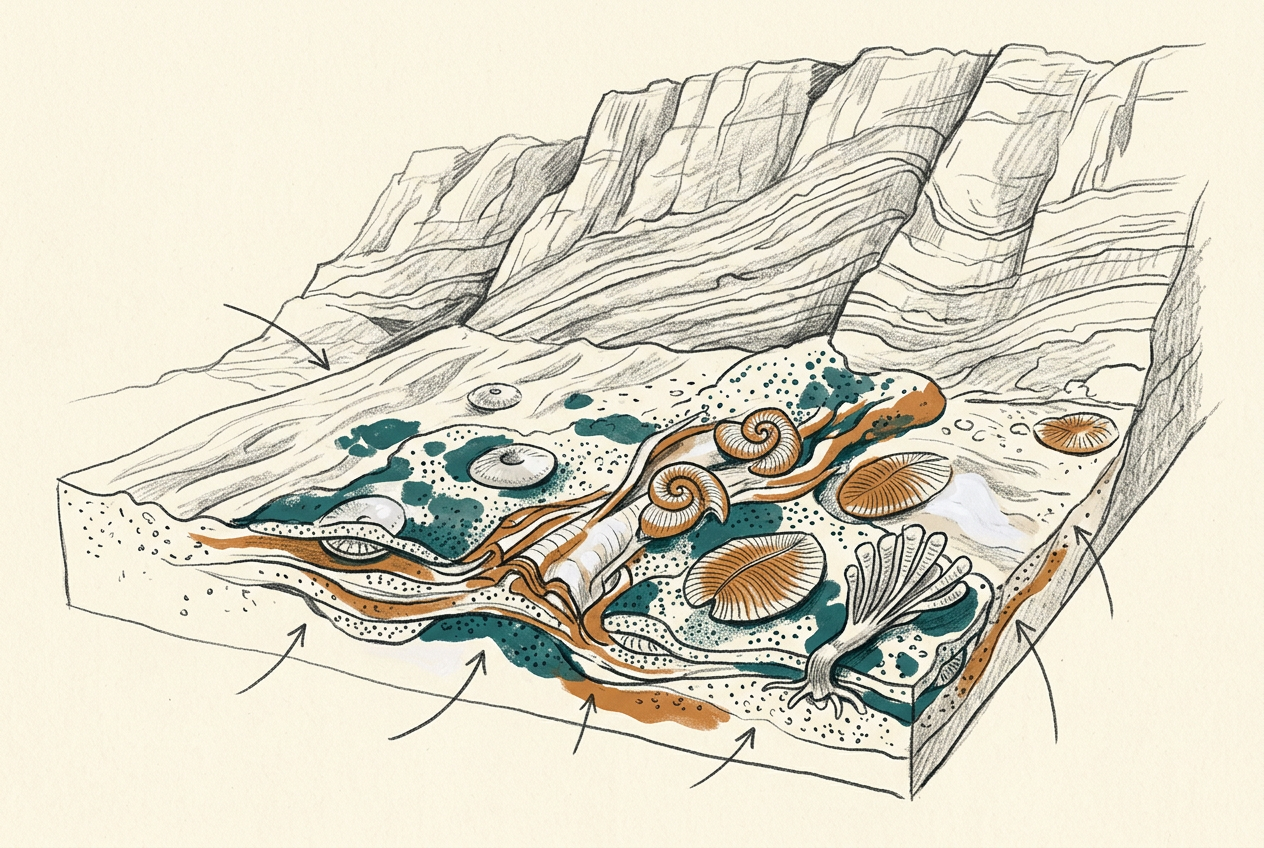
Before shells, before bones, before teeth, the seafloor was held together by microbes. Ediacaran seas were not sandy or muddy in the modern sense. The bottom was a tough, leathery skin—a microbial mat built by photosynthetic bacteria that secreted sticky polymers and bound sediment grains into a cohesive sheet.
These mats covered the shallow seafloor of the Adelaide Rift Complex, a basin that stretched across what is now South Australia between 635 and 541 million years ago. The mats were so resilient that when storms swept across the seafloor, they did not erode the sediment. They peeled it. Storm currents ripped up sheets of mat like tarpaulins, rolled them into cigar-shaped folds, and dropped them in younger sediment layers. You can see these rolled mat fragments in the Brachina Formation today—dark, wavy clasts embedded in pale sandstone.
When the Mats Learned to Stand
Most Ediacaran fossils are flat impressions, pressed into the mat surface like a leaf in mud. But in the Flinders Ranges, some formations preserve something stranger: structures that stood upright.
The genus Funisia—a frond-like organism named after the Latin for "rope"—grew as a rigid, branching stalk that projected above the seafloor. Its stem was reinforced by a protein called collagen, one of the earliest biomineralised tissues in the fossil record. Funisia did not build a shell, but it built a body stiff enough to resist the currents that flattened its neighbours. It was a middle step between the soft mat and the hard skeleton.
The first animal to build a rigid body did not use calcium carbonate. It used the same protein that holds your tendons together.
Nearby, in the Nilpena Ediacara National Park, paleontologists have excavated bedding planes covered with Dickinsonia—oval organisms that grew up to a metre long, their bodies segmented like a quilt. For decades, no one could agree whether Dickinsonia was an animal, a fungus, or a lichen. In 2018, researchers extracted organic molecules from a Dickinsonia fossil and found cholesterol, a biomarker exclusive to animals. The soft-bodied quilt was an animal. It fed by absorbing nutrients through its underside, grazing on the microbial mat that held the world together.
The Moment Before the Shell
The Ediacaran mats did not vanish when the Cambrian explosion began. They were the foundation on which the first shells were built. The earliest mineralised skeletons in the fossil record—tiny cones and tubes of calcium carbonate—appear in the same shallow-water settings where microbial mats had dominated for 30 million years.
Animals that could secrete a shell had an advantage: they could lift themselves off the mat, filter water, and resist predators. But the mat itself made that evolution possible. It stabilised the seafloor, concentrated nutrients, and kept oxygen levels high enough for animal metabolism. The first skeleton was not a breakthrough. It was an upgrade to an existing surface.
At the top of the Brachina Formation, a 2-metre-thick bed of dolomite marks the boundary between the Ediacaran and the Cambrian. Below it: the world of mats, fronds, and soft bodies. Above it: trilobites, burrows, and the first reefs. The transition took less than 10 million years—an instant in geological time.
The mats did not disappear. They were buried, compacted, and turned into the shale and sandstone that now outcrops in the Flinders Ranges. But their legacy is written in every animal that carries a skeleton. The rigid body began as a leathery skin on a 550-million-year-old seafloor, and it is still with us.
More like this
- The 560-Million-Year-Old Garden That Never Saw a PredatorIn South Australia's Flinders Ranges, 560-million-year-old Ediacara surfaces preserve entire seafloor communities of fronds, discs, and quilts — a garden of soft-bodied life that flourished before pre
- The 300-Million-Year-Old Forest That Died Standing UpIn New South Wales, a 300-million-year-old fossil forest preserves dozens of trees buried upright by a Permian volcanic eruption—an entire ecosystem frozen in ash.
- The 1.75-Billion-Year-Old Reef That Outranks the BarrierA 1.75-billion-year-old microbial reef in the Kimberley is the largest biological structure ever built by a single species, preserving a world without predators.