6 July 2026 · 3 min read
The 1.7-Billion-Year-Old Sea That Left Its Bones in the Barkly
How 1.7-billion-year-old microfossils in the McArthur Basin—the oldest complex cells on Earth—record the moment life crossed the threshold from prokaryote to eukaryote.
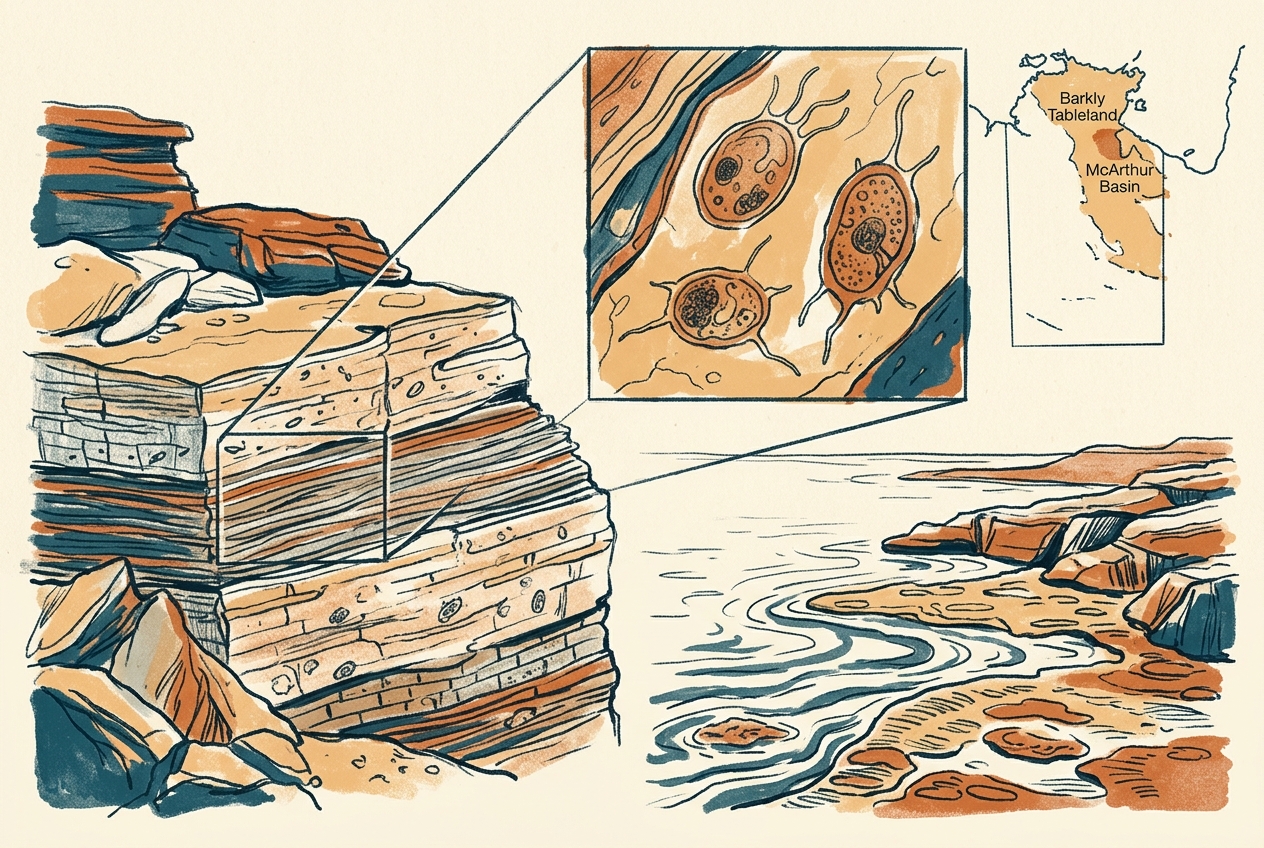
On the southern edge of the Gulf of Carpentaria, a low escarpment of black dolomite rises from the buffalo grass of the Barkly Tableland. The rock is unremarkable at a distance—dull grey, fractured, crusted with white lichen. But split a slab open, and the stone glitters with the oldest complex cells ever found on Earth.
The Sea That Left No Bones
The Barney Creek Formation, in the McArthur Basin of the Northern Territory, was deposited 1.7 billion years ago in a deep, stagnant sea. The water was stratified—oxygen-rich at the surface, anoxic and sulphidic below. No fish swam there. No shells littered the bottom. Nothing with bones, or teeth, or even a cell nucleus had yet evolved.
What lived in that sea was invisible to the naked eye: single-celled organisms so tiny that a thousand of them could line the edge of a coin. But they were doing something unprecedented. These cells had begun to organise their genetic material inside a membrane-bound nucleus. They were eukaryotes—the lineage that would eventually produce every plant, animal, fungus, and protist on Earth.
The oldest known fossils of these cells were found here, in the black shales and dolomites of the McArthur Basin. They are called Grypania and Shuiyousphaeridium, and they look like flattened carbon discs under a microscope. But their size and structure reveal a biological revolution.
The Revolution Inside a Single Cell
Before eukaryotes, life was prokaryotic—bacteria and archaea that float their DNA loose in the cell. For two billion years after life first appeared, this was the only game on Earth. Then, around 1.8 billion years ago, something changed. One prokaryote swallowed another, and instead of digesting it, kept it alive inside itself. The captive cell became a mitochondrion—a power plant that burned oxygen for energy.
That energy surplus made everything else possible. Complex genomes. Sexual reproduction. Multicellular bodies. The fossils in the Barney Creek Formation capture this transition: they are large, ornamented, and structurally complex in ways that prokaryotes cannot achieve. The cells are 50 to 200 micrometres across—ten times larger than a typical bacterium. Their walls show regular patterns of bumps and spines that required a cytoskeleton to construct.
The McArthur fossils are not animals. They are not plants. They are the ancestors of every visible living thing—caught in the act of becoming complex.
A Fossil Library in Black Dolomite
The McArthur Basin is one of the best-preserved Proterozoic sedimentary sequences on Earth. The rocks have never been deeply buried or metamorphosed, so the organic-walled microfossils remain intact. Palaeontologists have extracted them by dissolving the dolomite in hydrofluoric acid, leaving behind carbonaceous films that float in water.
The assemblage includes at least a dozen distinct species. Some are spherical, some are sausage-shaped, some look like crumpled paper bags. All of them lived in the water column of that stagnant sea, drifting in the dim light of a Sun that was 20 percent fainter than today.
The Barney Creek Formation also preserves something rarer: acritarchs—organic-walled microfossils of unknown affinity, probably the cysts of ancient plankton. These appear suddenly in the McArthur sequence and then persist for another billion years, evolving slowly into the elaborate spiny forms that mark the approach to the Ediacaran.
The Long Wait
From these first eukaryotes, it would take another 1.2 billion years before the first animals appeared. That immense gap—the "boring billion," geologists once called it—was not a period of stasis. Oxygen levels were rising and falling. Continents were assembling and breaking apart. Glaciers advanced and retreated.
But evolution was stuck at the single-celled level. The eukaryotes of the McArthur Basin diversified into many forms, but none grew larger than a grain of sand. They had unlocked the nucleus, but they had not yet learned to cooperate into multicellular bodies.
That would require another accident—a second symbiosis, in which a eukaryotic cell swallowed a photosynthetic cyanobacterium and kept it alive. That event, which gave rise to chloroplasts, happened sometime after the McArthur fossils were buried. It set the stage for algae, then plants, then everything else.
The black dolomite of the Barkly Tableland does not look like a monument to the origin of complexity. It is a flat, fly-blown country where the horizon wobbles in heat haze and the only sound is the creak of windmills pumping bore water for cattle. But split the stone, and you hold the beginning of every animal that ever walked, swam, or flew.
More like this
- The 560-Million-Year-Old Garden That Never Saw a PredatorIn South Australia's Flinders Ranges, 560-million-year-old Ediacara surfaces preserve entire seafloor communities of fronds, discs, and quilts — a garden of soft-bodied life that flourished before pre
- The 300-Million-Year-Old Forest That Died Standing UpIn New South Wales, a 300-million-year-old fossil forest preserves dozens of trees buried upright by a Permian volcanic eruption—an entire ecosystem frozen in ash.
- The 1.75-Billion-Year-Old Reef That Outranks the BarrierA 1.75-billion-year-old microbial reef in the Kimberley is the largest biological structure ever built by a single species, preserving a world without predators.