27 June 2026 · 3 min read
The 550-Million-Year-Old Scar That Records the First Predator
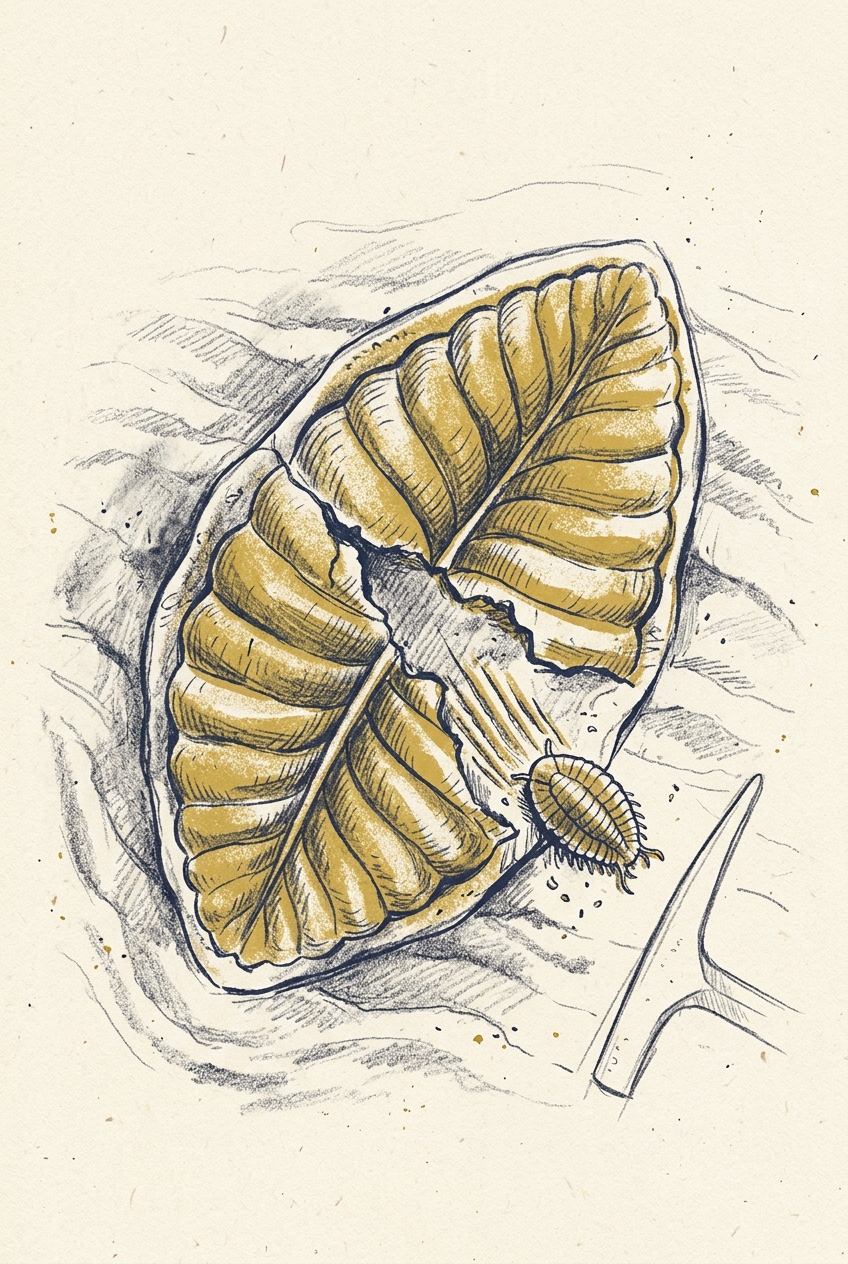
A 550-million-year-old fossil from South Australia's Nilpena Ediacara National Park preserves the only known Ediacaran predator–prey interaction—a wounded quilted organism attacked by a rasping grazer
Ediacaran fossils look like nothing alive today. They were fronds, discs, and quilts—soft-bodied experiments that vanished half a billion years ago. But at Nilpena Ediacara National Park in South Australia, one fossil bed contains something stranger still: the only known predator from that vanished world, captured in the act of killing.
The Fossil That Changed a Narrative
For decades, palaeontologists assumed the Ediacaran biota were passive creatures—filter-feeders or algae that drifted with currents. Then, in 2022, researchers re-examined a specimen from the 550-million-year-old Ediacara Member of the Rawnsley Quartzite. The fossil, named Quaestio simpsonorum, shows a clear wound: a crescent-shaped tear on the left side of its quilted body. The injury had begun to heal, proving the animal was alive when attacked.
The wound matches the feeding trace of Kimberella, a bilaterian that grazed the seafloor by rasping microbial mats with a toothed organ.
Kimberella was already known as an early grazer. But this is the first evidence that it preyed on other Ediacaran organisms—not just microbes. The scar is a fossilised interaction, a moment of predation locked in stone 550 million years ago.
A Seafloor of Delicate Encounters
The Nilpena fossil bed preserves an entire benthic community smothered by repeated sand events—likely storm deposits that buried the seafloor in successive layers. Each layer captures a snapshot: frond-like Rangea standing upright, disc-shaped Dickinsonia gliding across the sediment, and Quaestio with its crescent scar. The preservation is so fine that individual quilts and growth lines are visible.
Palaeontologists excavated the slab containing the wounded fossil using GPS mapping and 3D photogrammetry. The scar is not a random crack; it follows the contour of a feeding trace left by Kimberella's radula-like organ. The wound morphology matches experimental feeding traces in modern microbial mats, where a grazing animal leaves a furrow as it scrapes.
This places Kimberella as the earliest known predator in the fossil record—a creature that could actively seek and consume other animals, not just the microbial film. The Ediacaran world was not serene. It was a place where death arrived with a rasping mouth.
What the Wound Reveals
Quaestio belongs to the Proarticulata, a group of Ediacaran organisms with a distinctive quilted body plan and a glide-reflection symmetry (like mirroring a word across a line). Its body was divided into repeating units, each acting as a hydrostatic skeleton. The wound is limited to one side, suggesting Kimberella attacked from the left, and that the prey could not escape.
The healing tissue indicates Quaestio survived the attack initially, then died shortly after—likely from the sand event that buried it. This is the only known example of Ediacaran predation with both predator and prey preserved in the same interaction. The slab sits in the South Australian Museum, a single stone that rewrites our understanding of early food webs.
A New View of the Ediacaran
The Nilpena site has yielded over a thousand fossil specimens, but the wounded Quaestio is unique. It shows that by 550 million years ago, complex ecological relationships—including predation—were already established. The Ediacaran biota were not simple placozoan-like forms awaiting the Cambrian explosion. They lived in a world of eaters and eaten, of scars and healing.
This shifts the narrative of early animal evolution. The drive to hunt and the need to defend did not arise suddenly in the Cambrian. They were present in the Ediacaran, etched into the soft bodies of organisms that left no hard parts—only a single wound, healed but not forgotten.
More like this
- The 560-Million-Year-Old Garden That Never Saw a PredatorIn South Australia's Flinders Ranges, 560-million-year-old Ediacara surfaces preserve entire seafloor communities of fronds, discs, and quilts — a garden of soft-bodied life that flourished before pre
- The 300-Million-Year-Old Forest That Died Standing UpIn New South Wales, a 300-million-year-old fossil forest preserves dozens of trees buried upright by a Permian volcanic eruption—an entire ecosystem frozen in ash.
- The 1.75-Billion-Year-Old Reef That Outranks the BarrierA 1.75-billion-year-old microbial reef in the Kimberley is the largest biological structure ever built by a single species, preserving a world without predators.