14 July 2026 · 3 min read
The 550-Million-Year-Old Quilt That Learned to Move
In South Australia's Flinders Ranges, 550-million-year-old Dickinsonia fossils preserve the oldest known mobile animals—soft-bodied creatures that fed by absorbing nutrients through their quilted surf
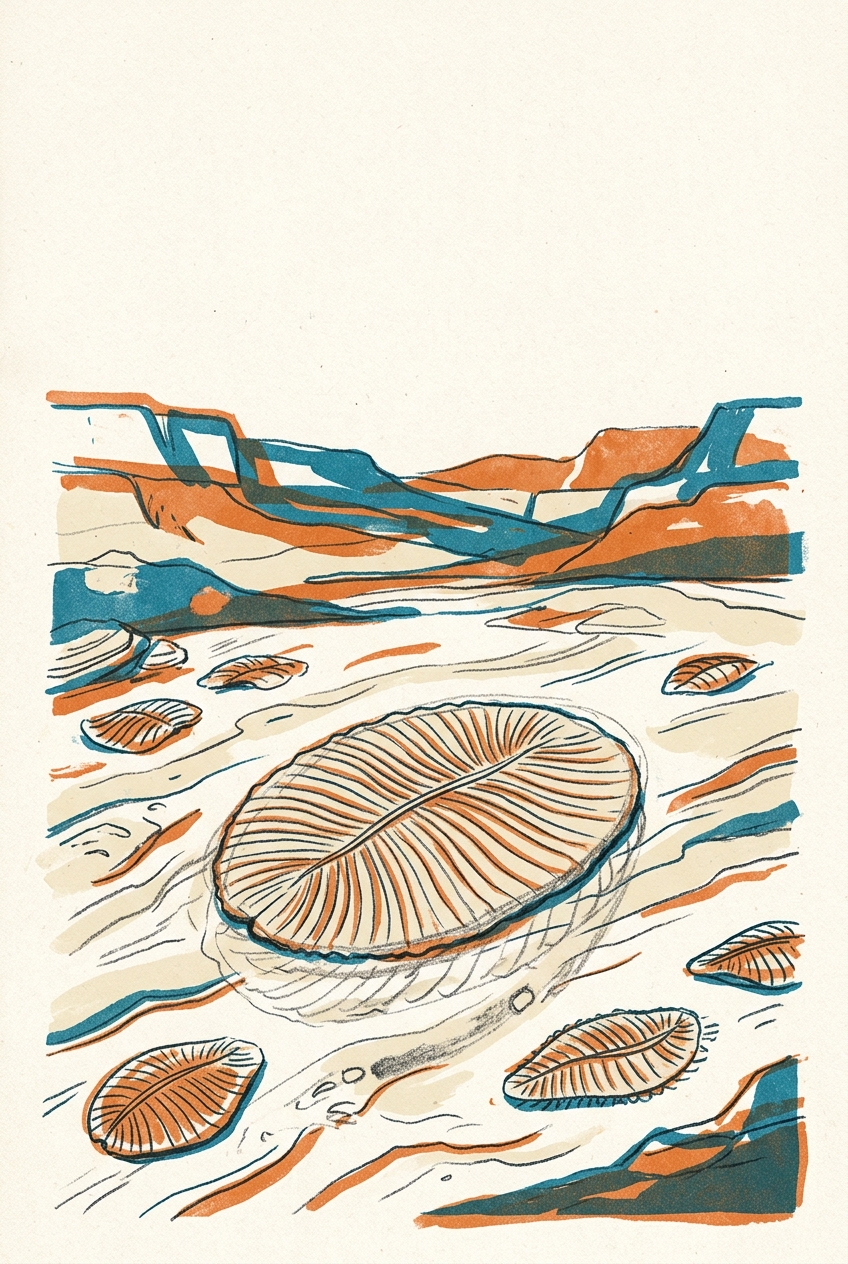
On a slab of grey siltstone in the Flinders Ranges, a creature the size of a dinner plate left no bones, no teeth, no shell—only the impression of its body, ribbed like a quilt, pressed into the mud half a billion years before the first dinosaur drew breath.
The fossils of the Ediacara Hills, discovered in 1946 by geologist Reg Sprigg, remain the oldest known record of complex multicellular life. Among them, Dickinsonia stands out as the first animal that could move.
The Creature That Ate Without a Mouth
Dickinsonia was an oval, segmented organism that grew up to 1.4 metres long. Its body was divided into repeated rib-like units radiating from a central axis, like a flattened frond or a quilt folded in half. It had no head, no gut, no limbs—nothing we recognise as animal anatomy.
For decades, paleontologists debated what Dickinsonia was. A lichen? A fungus? A protozoan the size of a coffee table?
The breakthrough came from molecular fossils. In 2018, a team led by Ilya Bobrovskiy extracted cholesterol molecules from Dickinsonia fossils preserved in ancient seafloor sediments. Cholesterol is a hallmark of animal cell membranes. The result was unambiguous: Dickinsonia was an animal, one of the earliest on Earth.
But how did it eat without a mouth? The answer lies in its quilted body. The ribbed surface had an enormous area relative to its volume. Dickinsonia absorbed dissolved organic matter directly through its skin, like a flatworm or a living sponge spread thin across the seafloor.
It did not hunt. It did not graze. It simply lay on the microbial mats of the Ediacaran seafloor and let the world seep in.
The Traces of the First Movement
The most remarkable Dickinsonia fossils are not the bodies themselves but the tracks they left behind.
On bedding planes in the Flinders Ranges, paleontologists have found Dickinsonia fossils preserved at the end of long furrows—grooves in the sediment where the creature appears to have slowly crawled. The furrows are the oldest evidence of animal locomotion on Earth.
The movement was agonisingly slow. Dickinsonia likely crept by contracting its body muscles in waves, a form of peristalsis similar to how an earthworm moves today. But at 550 million years ago, no animal had ever done this before. The first steps were taken not by a walking creature but by a feeding quilt that dragged itself across the mud.
These trace fossils, found in the Ediacara Member of the Rawnsley Quartzite, date to roughly 555 million years ago. They sit in the rock just below the Cambrian boundary, where animal life would explode into shells, eyes, and predators.
A World Without Predators
Dickinsonia lived in a world that was gentler than anything that came after. The Ediacaran seafloor was covered in thick microbial mats—layers of bacteria and algae that stabilised the sediment like living carpet. There were no burrowing animals to churn the mud, no jaws to tear flesh, no eyes to spot prey.
The quilted body plan made sense in this context. Without predators, there was no need for armour, speed, or escape. An animal that could lie still and absorb food from the mat beneath it had a stable, low-energy existence.
That world ended with the Cambrian Explosion, around 541 million years ago. Animals evolved guts, mouths, and hard parts. The microbial mats were grazed into oblivion. Dickinsonia and its Ediacaran kin vanished, replaced by the armoured, burrowing, swimming fauna that would dominate the Phanerozoic.
The Flinders Ranges today preserve these fossils in sandstone beds that were once the seafloor of a shallow Ediacaran sea. The same hills that hold the first evidence of animal movement now rise above arid plains, eroded from the same rock that once held the imprints of the world's quietest pioneers.
More like this
- The 500-Million-Year-Old Sponge That Grew a Glass SkeletonIn South Australia's Flinders Ranges, 500-million-year-old hexactinellid sponges built skeletons of silica glass, recording the moment when life learned to mine the sea for minerals.
- The 650-Million-Year-Old Glaciers That Scratched a ContinentIn the Flinders Ranges, 650-million-year-old glacial deposits record the Sturtian Snowball Earth, with striated pavements and dropstones that prove Australia once lay under kilometres of ice near the
- The 500-Million-Year-Old Mud That Turned to GlassIn the Flinders Ranges, 500-million-year-old Cambrian mudstone preserves the earliest known trilobite eyes—compound lenses made of calcite that still function as optics half a billion years later.