14 July 2026 · 2 min read
The 700,000-Year-Old Meteorites That Rose From Limestone
The Nullarbor Plain's slow-eroding limestone surface concentrates meteorites over millions of years—a natural archive of the solar system.
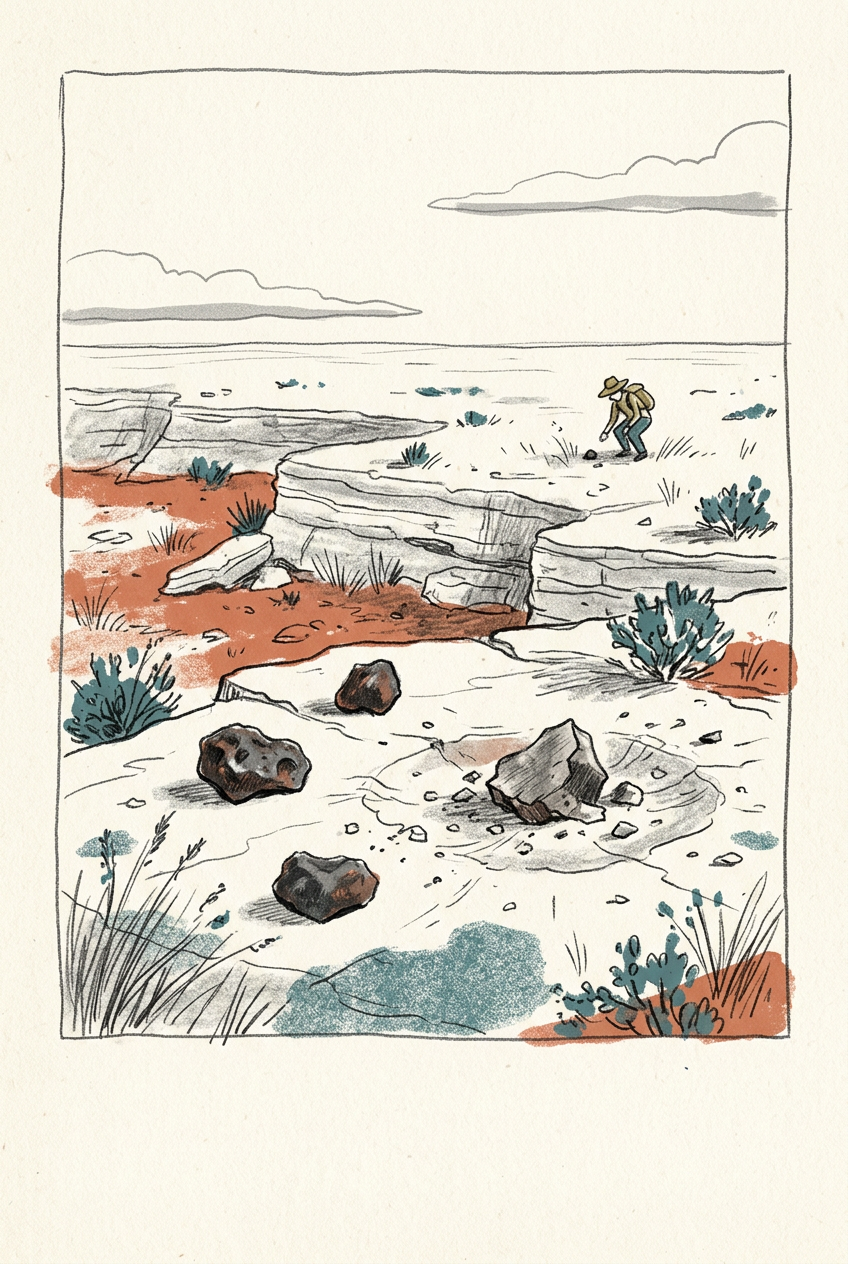
More than 1,200 glassy, black, and bronze meteorites have been found scattered across the Nullarbor Plain. No other place on Earth concentrates them so densely, and the reason lies not in the sky but in the limestone underfoot.
The Slowest Conveyor Belt
The Nullarbor is a karst landscape — a vast, flat sheet of limestone deposited when Australia still sat near Antarctica, about 25 million years ago. For the past two million years, the plain has been rising at an imperceptible rate, a few centimetres per millennium. As it rises, the limestone dissolves from above and below, inch by inch. The surface erodes away, leaving behind whatever foreign stones were resting on it.
This is the mechanism that concentrates meteorites. On the Nullarbor, a meteorite that fell a million years ago has not been buried and lost. It has simply sat on the surface, slowly lowered as the limestone around it dissolved. The plain acts as a slow conveyor belt, delivering ancient falls to the present-day surface.
In some Nullarbor collection zones, meteorite densities reach one per square kilometre — a thousand times the global average.
A Clock Without Moving Parts
The Nullarbor meteorites also carry a record of time. When a meteorite sits on the surface, its iron-nickel alloy acquires a steady accumulation of cosmic-ray exposure — neutrons and muons that penetrate the outer millimetres and produce rare isotopes like beryllium-10 and aluminium-26. By measuring these, geochemists can tell how long the stone has lain exposed to the sky.
Results from collected Nullarbor meteorites show surface exposure ages ranging from a few thousand years to more than 700,000 years. The oldest ones fell before the first modern humans left Africa. They have waited through ice ages and interglacials, through the rise of the Great Barrier Reef and the extinction of Australia's megafauna, all while sitting on the same patch of limestone, slowly sinking as the rock dissolved beneath them.
Where the Sky Falls on Earth
Most Nullarbor meteorites are ordinary chondrites — the common rubble of the asteroid belt. But a significant fraction are rare types: carbonaceous chondrites that carry organic compounds, irons that preserve the metallic cores of shattered planetesimals, and achondrites that originated on Mars or the Moon. The Nullarbor delivers a sampling of the solar system, cleaned and sorted by the slow patience of limestone.
This collection is not infinite. The plain erodes at roughly one metre per million years, and the meteorites themselves weather. Iron-rich stones rust and crumble after a few hundred thousand years on the surface. Stony meteorites crack and disaggregate. The Nullarbor's bounty is a fragile archive, and it is vanishing at the same rate it appears.
More like this
- The 650-Million-Year-Old Glaciers That Scratched a ContinentIn the Flinders Ranges, 650-million-year-old glacial deposits record the Sturtian Snowball Earth, with striated pavements and dropstones that prove Australia once lay under kilometres of ice near the
- The 1.1-Billion-Year-Old Meteorite That Left No CraterIn the Amadeus Basin, 1.1-billion-year-old impact melt rock preserves the oldest known meteorite impact in central Australia—a collision that left no crater, only a scattered field of shocked sandston
- The 1.2-Billion-Year-Old Lake That Still Burns UndergroundIn the Stuart Shelf, 1.2-billion-year-old sedimentary rocks contain the world's oldest preserved groundwater, still chemically active and capable of generating hydrogen from radioactive decay.