14 July 2026 · 3 min read
The 500-Million-Year-Old Mud That Turned to Glass
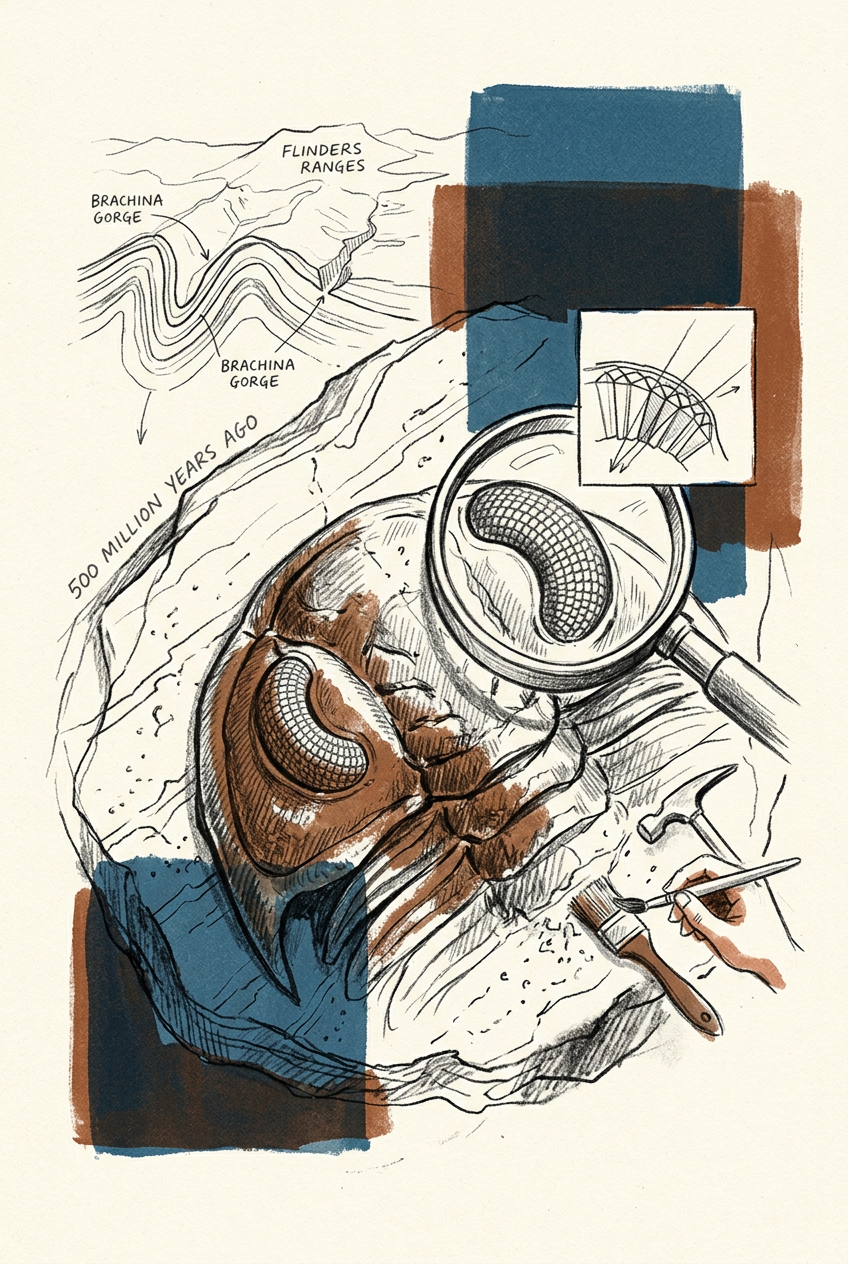
In the Flinders Ranges, 500-million-year-old Cambrian mudstone preserves the earliest known trilobite eyes—compound lenses made of calcite that still function as optics half a billion years later.
In the Flinders Ranges of South Australia, a 500-million-year-old slab of grey mudstone holds the earliest known eyes in the fossil record. They belong to a trilobite called Redlichia takooensis, and they still work as lenses.
The eyes are made of calcite, the same mineral that forms limestone and sea shells. But in these Cambrian arthropods, calcite was grown as single crystals — optically perfect, rigid, and transparent. Each compound eye contained hundreds of tiny lenses, each one a precisely oriented crystal that focused light onto the retina below.
The Cambrian Lensmaker
Trilobites appeared in the early Cambrian, around 521 million years ago, during the great burst of animal diversity known as the Cambrian explosion. Their eyes were among the first complex visual systems on Earth. Before them, most animals could only sense light and dark. Trilobites could see images.
The lenses of Redlichia takooensis were not made of soft tissue, like our own. They were inorganic — grown from calcium carbonate that the animal secreted and controlled with remarkable precision. Each lens was a single crystal of calcite with its optical axis aligned exactly along the direction of incoming light. Misalign it by a few degrees, and the image would blur. The trilobite got it right, every time, across hundreds of lenses per eye.
Some compound eyes contained over 15,000 individual lenses, each one a tiny window of perfect calcite.
Later trilobites evolved even more sophisticated optics. Some species developed doublet lenses — two crystals of different refractive indices bonded together — that corrected for chromatic aberration. They solved a problem that human lensmakers would not crack until the 18th century.
What the Mud Preserved
The Emu Bay Shale, where these fossils are found, is a Konservat-Lagerstätte — a deposit that preserves soft tissues alongside hard parts. The mud was fine-grained and oxygen-poor, which slowed decay and prevented scavengers from disturbing the carcasses. In this quiet anoxic seabed, trilobite eyes survived as they were in life: calcite lenses still attached to the head, still optically clear, still capable of forming an image.
Fossilised eyes are rare. Most Cambrian trilobites are known only from their moulted exoskeletons. But at Emu Bay, the mud was so fine that it preserved the delicate cuticle of the eye surface, the arrangement of individual lenses, and even the internal structure of the optic nerve in some specimens.
A Vision That Outlasted Its Owner
The calcite that forms a trilobite eye is the same mineral that builds cave stalactites and marine shells. But it has one unusual property: it does not recrystallise easily. Over 500 million years of burial, heating, and tectonic stress, most biological structures are destroyed or replaced. Calcite can survive. The lenses remain calcite, not a cast or a replacement, but the original mineral, with its original optical properties.
Scientists have extracted lenses from Cambrian trilobites and measured their light transmission. They still focus light. They still form an image. The animal that built them vanished 250 million years ago, but its eyes still see.
The Emu Bay Shale continues to yield new specimens each year. Quarry operations at Kangaroo Island, where the formation crops out, have uncovered trilobites with antennae, legs, and gut contents preserved. But the eyes remain the most remarkable feature — not because they are ancient, but because they are still functional. A 500-million-year-old camera, made of mud and light and crystal, waiting in the rock for something to look at.
More like this
- The 500-Million-Year-Old Sponge That Grew a Glass SkeletonIn South Australia's Flinders Ranges, 500-million-year-old hexactinellid sponges built skeletons of silica glass, recording the moment when life learned to mine the sea for minerals.
- The 650-Million-Year-Old Glaciers That Scratched a ContinentIn the Flinders Ranges, 650-million-year-old glacial deposits record the Sturtian Snowball Earth, with striated pavements and dropstones that prove Australia once lay under kilometres of ice near the
- The 1.1-Billion-Year-Old Meteorite That Left No CraterIn the Amadeus Basin, 1.1-billion-year-old impact melt rock preserves the oldest known meteorite impact in central Australia—a collision that left no crater, only a scattered field of shocked sandston