14 July 2026 · 3 min read
The 2.7-Billion-Year-Old Lava Tubes That Still Run Along a Scarp
The Darling Scarp in Western Australia preserves a 2.7-billion-year-old chain of Archaean lava tubes, the oldest known volcanic plumbing system on Earth.
Just south of Perth, a line of 2.7-billion-year-old lava tubes runs for more than a hundred kilometres along the Darling Scarp. They are the oldest known volcanic plumbing system on Earth—a network of conduits that once fed eruptions across the Yilgarn Craton, now exposed in cross-section by two billion years of erosion.
The Oldest Pipes
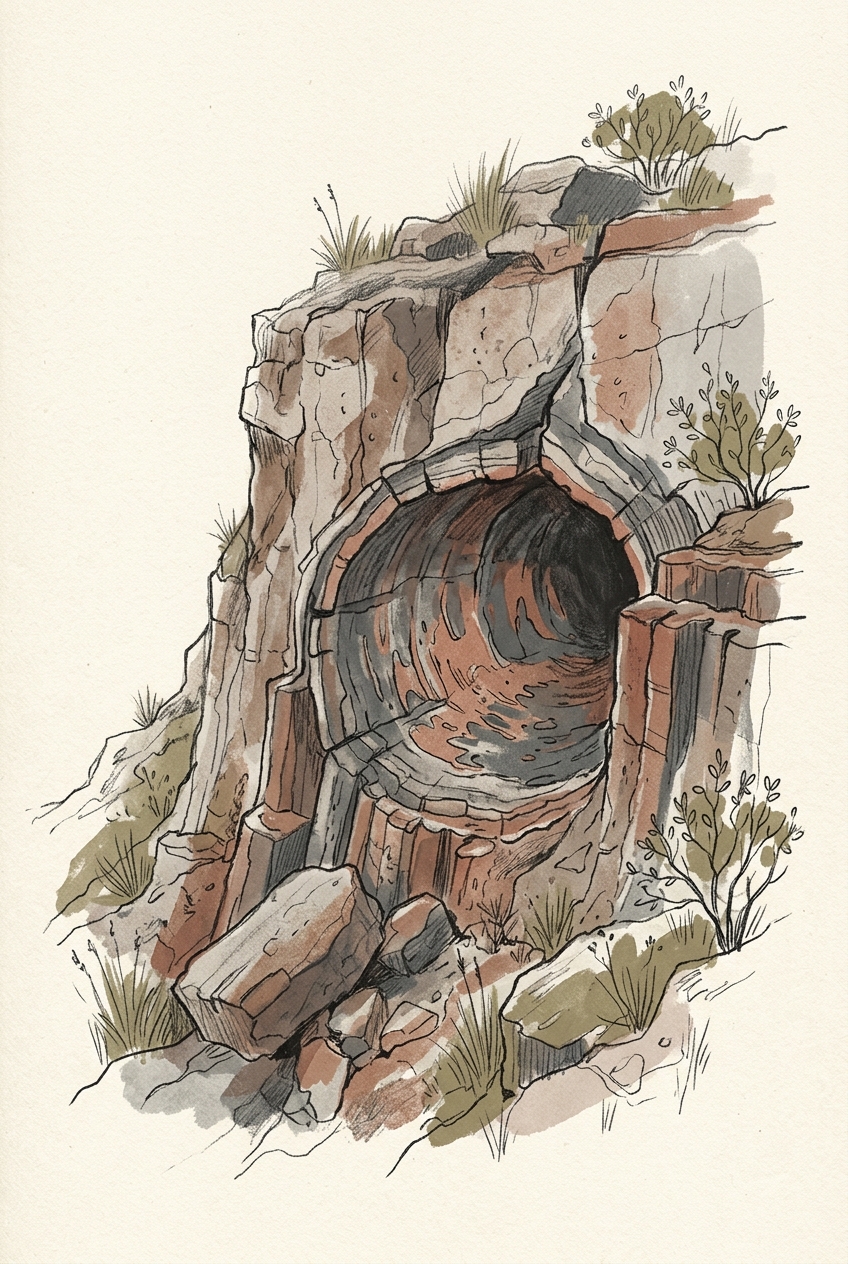
The tubes belong to the Mafic-ultramafic suite of the Youanmi Terrane, a slice of the Yilgarn Craton that formed during the Archaean, between 2.8 and 2.7 billion years ago. At that time, the Earth's interior was significantly hotter, and the mantle beneath what is now southwestern Australia produced vast volumes of magnesium-rich magma. This lava did not erupt explosively; it poured out in thick, sluggish flows that cooled from the outside in, forming a solid crust while the interior remained molten. When the eruption waned, the still-liquid core drained away, leaving a cylindrical void—a lava tube.
What makes the Darling Scarp tubes exceptional is their preservation. Most Archaean volcanic conduits have been deformed, metamorphosed, or simply eroded away. Here, the tubes remain intact, their original shapes still visible in road cuts and quarry faces. The largest exceed twenty metres in diameter, and the full chain stretches from near Bunbury in the south to north of Toodyay. They are not isolated features but a coherent network, a fossilised magma distribution system.
A Window into an Archaean Volcano
The tubes reveal how Archaean volcanoes worked. The magma that flowed through them was komatiitic—an ultramafic lava that does not exist on Earth today because the mantle has cooled too much to produce it. Komatiite flows reached temperatures above 1,600 °C, hot enough to melt the underlying crust and erode channels into the rock beneath. The Darling Scarp tubes show this erosion clearly: their lower margins are irregular, cut into the surrounding granite-greenstone terrain, while the upper surfaces are smooth and arched.
The magma that filled these tubes was so hot it could dissolve the rock it touched.
Within the tubes, geologists have found layered cumulate textures—crystals of olivine and pyroxene that settled out of the cooling magma, recording the changing chemistry of the flow. These layers are the only surviving record of how Archaean magmas differentiated as they moved toward the surface. Without the tubes, we would have only the erupted lavas, which represent only the final, fractionated melt.
Why They Survived
The Yilgarn Craton is one of the most stable pieces of continental crust on the planet. Since its formation, it has experienced no major mountain-building events, no deep burial, no significant metamorphism. The craton has simply sat, slowly eroding, for more than two billion years. That erosion is what exposed the tubes: the overlying volcanic pile weathered away, leaving the harder, silica-rich conduits standing as low ridges along the scarp.
This stability also preserved the tubes' internal structures. In younger lava tube systems—such as those in Hawaii or Iceland—the conduits collapse quickly after eruption. The Darling Scarp tubes remained intact because they were filled with late-stage mineralisation, including quartz and carbonate veins that cemented the walls. In places, the tubes now contain secondary copper and nickel minerals, evidence that the same conduits later acted as pathways for hydrothermal fluids.
The Living Landscape
Today, the tubes form a subtle but persistent feature of the Darling Scarp. They are not dramatic cliffs or gorges; they are low, rounded outcrops that catch the morning light, often marked by lines of marri and jarrah trees that find purchase in the fractured rock. Walkers on the Bibbulmun Track cross them without knowing. Quarry operators have cut into them for road aggregate, exposing cross-sections that show the tube interiors as clearly as a cut pipe.
Archaean lava tubes have been found elsewhere—in the Barberton Greenstone Belt of South Africa, in the Abitibi Belt of Canada—but nowhere else in a single, continuous, accessible chain. The Darling Scarp tubes offer a direct look at the plumbing of the oldest volcanoes on Earth, preserved not in a museum or a thin section but as a landscape feature you can walk along.
More like this
- The 650-Million-Year-Old Glaciers That Scratched a ContinentIn the Flinders Ranges, 650-million-year-old glacial deposits record the Sturtian Snowball Earth, with striated pavements and dropstones that prove Australia once lay under kilometres of ice near the
- The 3.5-Billion-Year-Old Crust That Never Got RecycledIn the Pilbara, 3.5-billion-year-old volcanic crust escaped destruction because it was too buoyant to subduct—preserving the only surviving fragment of Earth's primordial surface.
- The 1.1-Billion-Year-Old Salt That Collapsed a ContinentIn the Amadeus Basin, 1.1-billion-year-old evaporite beds dissolved beneath Central Australia, triggering the collapse that formed the MacDonnell Ranges and opened pathways for mineral deposits.