14 July 2026 · 3 min read
The 500-Million-Year-Old Sponge That Grew a Glass Skeleton
In South Australia's Flinders Ranges, 500-million-year-old hexactinellid sponges built skeletons of silica glass, recording the moment when life learned to mine the sea for minerals.
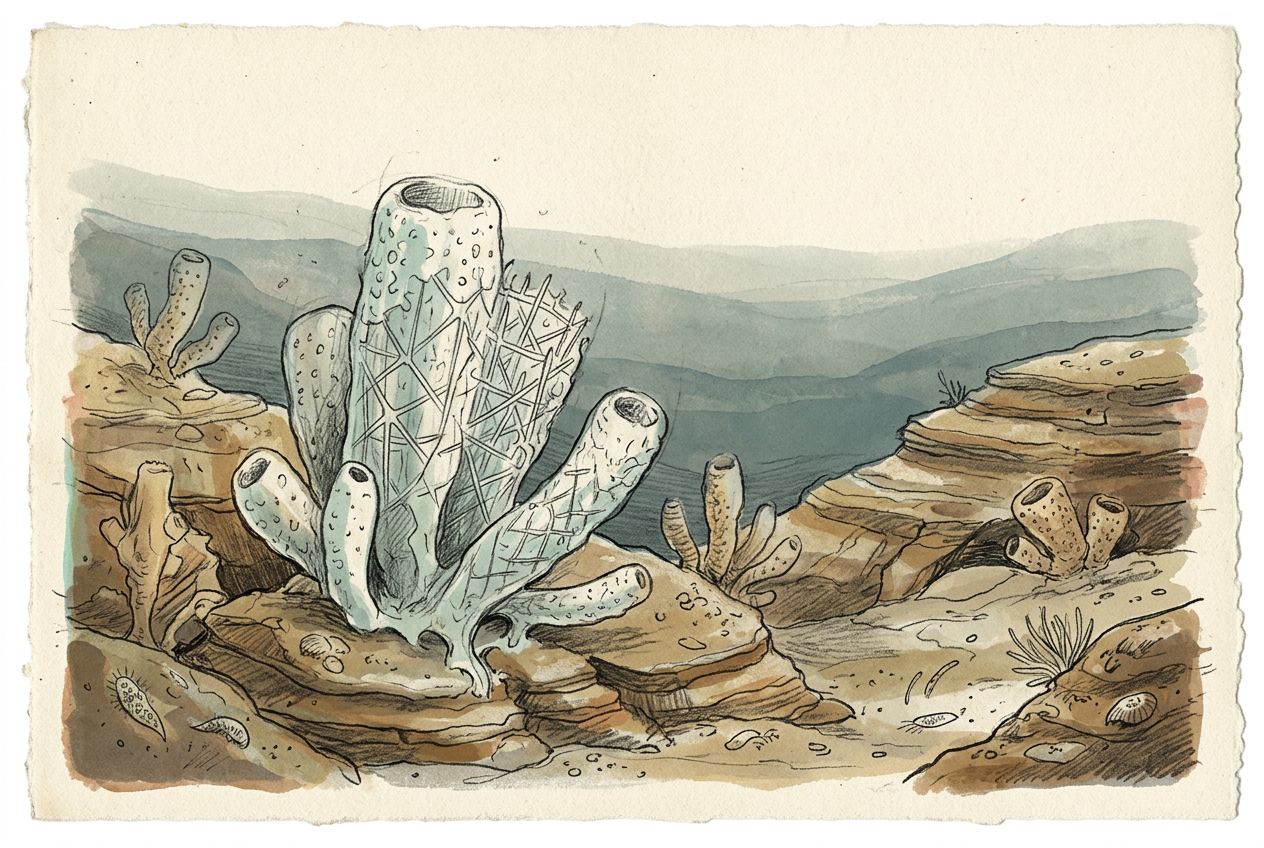
Half a billion years ago, in a quiet sea that covered what is now South Australia, an animal learned to build with glass. It had no mouth, no gut, no nerves. It was a sponge, and its skeleton was made of silica—the same material that forms opal, quartz, and the sharp edge of an obsidian blade.
The Cambrian Glassworks
The Cambrian Period, which began about 541 million years ago, was a time of experimental anatomy. Animals were trying on skeletons for the first time—calcite shells, chitinous armour, phosphate plates. But one group of sponges, the hexactinellids, chose a different material: silica.
These are not the soft bath sponges most people recognise. Hexactinellids build their bodies from six-pointed spicules of amorphous silica, arranged into a lattice as precise as a crystal. The spicules are secreted from dissolved silicic acid in seawater, and the sponge constructs them cell by cell, layer by layer, until it has raised a glass cage around its own flesh.
In the Flinders Ranges, the same rocks that yield the famous Ediacaran fossils also preserve these Cambrian sponges. The Bucatoola Formation, laid down about 500 million years ago in a deep marine basin, contains bedding planes studded with the delicate skeletons of Palaeophragmodictya and related forms—sponges that anchored themselves to the muddy seafloor and filtered plankton from the dark water.
What the Glass Preserves
The fossils are not mere impressions. Because the spicules are made of silica, they survive as the original mineral—a ghost of the animal's own architecture. Under a microscope, the six-pointed symmetry is unmistakable. Each ray emerges from a central point at exactly 60 degrees, arranged like a three-dimensional snowflake.
This is not the sort of preservation that happens by accident. Most soft-bodied animals decay before they can fossilise. But silica is stubborn. It resists dissolution, and once the organic matter of the sponge rots away, the glass skeleton remains. In the Flinders Ranges, these glass sponges are so well preserved that palaeontologists can count the individual spicules and reconstruct the shape of the whole animal.
The sponges also tell a chemical story. Seawater in the Cambrian contained far more dissolved silica than modern oceans—a legacy of intense continental weathering before the rise of silica-secreting organisms. These sponges were the first miners of that marine silica, and they drew it down in such quantities that they may have permanently altered ocean chemistry.
The first glassmakers were not human. They were sponges, working in the dark, half a billion years before Venice.
A Lost World of Filterers
The Flinders Ranges sponges lived in a community unlike any that exists today. The Cambrian seafloor was a place of mud and microbial mats, with no burrowing animals to churn the sediment. The sponges stood upright on stalks, their glass bodies rising above the ooze like tiny chandeliers.
They shared this world with trilobites, brachiopods, and the first arthropods. But the sponges were the engineers. By filtering particles from the water, they clarified the sea and created local currents that shaped the distribution of food and oxygen. They were, in a quiet way, the architects of their ecosystem.
The hexactinellids survive today, mostly in deep cold waters where silica is abundant. In the fjords of Norway and the canyons of the Pacific, glass sponges still build their structures, some forming reefs that rival coral in size. But the Cambrian species were different. They were pioneer animals, testing a material that no life had used before, in a world where the rules of biology were still being written.
The Silica Archive
The Bucatoola Formation is not a famous fossil site. It does not draw tourists or museum exhibits. But its bedding planes contain something rare: a direct record of how life learned to manipulate inorganic chemistry. The sponges did not just absorb silica from seawater; they organised it, shaped it, and turned it into architecture. This is the first known instance of biologically controlled mineralisation—the same process that later produced bones, teeth, shells, and eventually human tools made from flint and obsidian.
When you hold a piece of Cambrian chert from the Flinders Ranges, you are holding the remains of those glass skeletons, compressed and recrystallised over hundreds of millions of years. The sponges are gone, but their glass remains—still sharp, still translucent, still bearing the six-pointed geometry of their builders.
They made glass before we did. They made it better. And they made it without fire.
More like this
- The 650-Million-Year-Old Glaciers That Scratched a ContinentIn the Flinders Ranges, 650-million-year-old glacial deposits record the Sturtian Snowball Earth, with striated pavements and dropstones that prove Australia once lay under kilometres of ice near the
- The 500-Million-Year-Old Mud That Turned to GlassIn the Flinders Ranges, 500-million-year-old Cambrian mudstone preserves the earliest known trilobite eyes—compound lenses made of calcite that still function as optics half a billion years later.
- The 1.1-Billion-Year-Old Meteorite That Left No CraterIn the Amadeus Basin, 1.1-billion-year-old impact melt rock preserves the oldest known meteorite impact in central Australia—a collision that left no crater, only a scattered field of shocked sandston