25 June 2026 · 3 min read
The 550-Million-Year-Old Graveyard That Holds Earth's First Wounds
How 550-million-year-old fossilised burrows in South Australia's Flinders Ranges reveal that Ediacaran animals were stalked by predators—the earliest evidence of hunting on Earth.
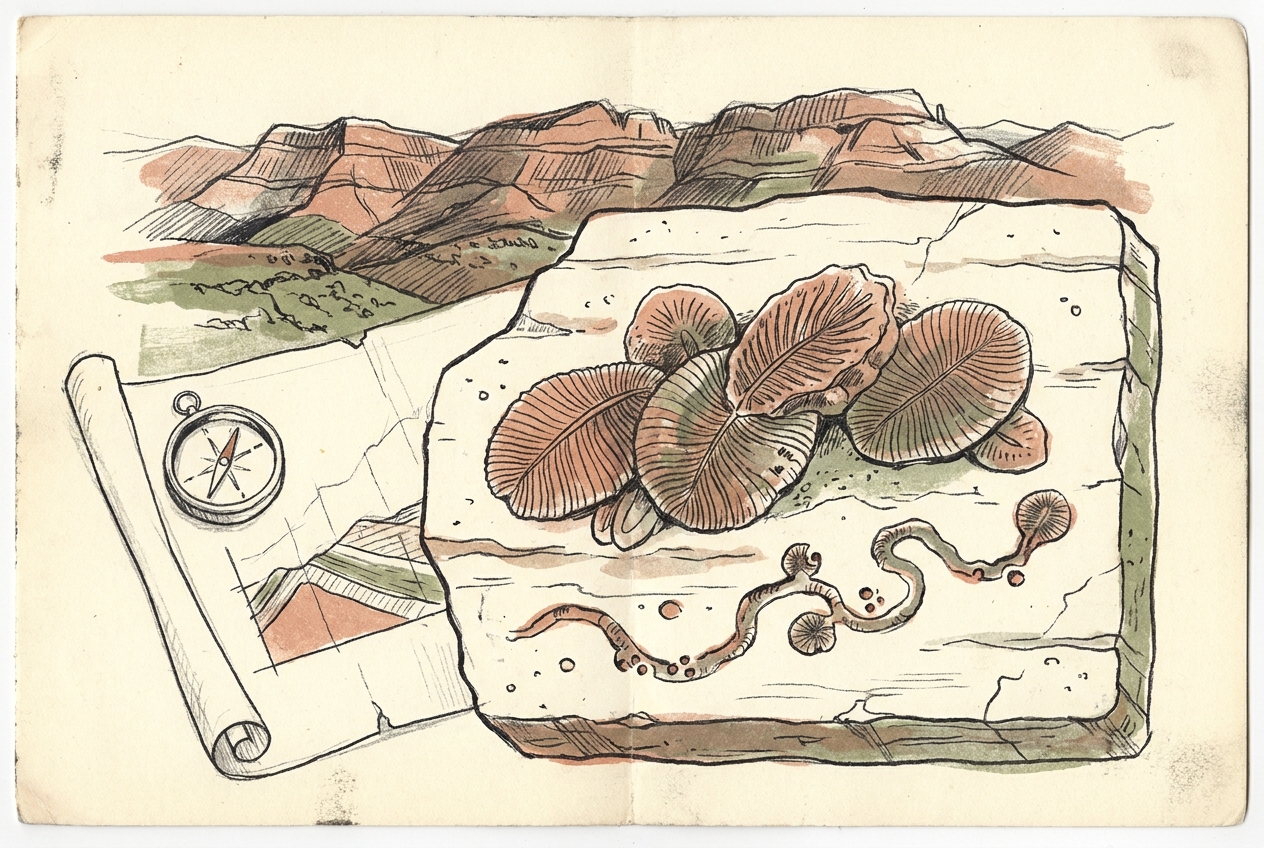
A slab of sandstone from the Flinders Ranges holds a trace no older than a fingernail: a tiny burrow, drilled at an angle, then abruptly abandoned. The animal that made it never finished. Something stopped it—something that left a different mark altogether, a faint collapse in the sediment that records the moment a predator struck. This is the oldest evidence of predation on Earth, and it lies preserved in 550-million-year-old rock.
The Burrow That Stopped
The Ediacara Member of South Australia's Rawnsley Quartzite, exposed in the Flinders Ranges north of Adelaide, preserves a world before hard shells. Here the first complex organisms—frond-like Rangea, quilted Dickinsonia, the slug-like Kimberella—drifted and crawled across a shallow seafloor around 555 million years ago. For decades, palaeontologists assumed these soft-bodied creatures lived in peace. No jaws, no claws, no shells: a garden, not a battlefield.
But in 2020, researchers from the South Australian Museum described a trace fossil that changed that picture. The specimen, catalogued as Helminthoidichnites, is a simple horizontal burrow about two millimetres wide. Then it turns upward, as if the burrower surfaced. And there the trace ends—replaced by a star-shaped collapse, the signature of something grasping from above.
What bit? The only candidate large enough, and common enough, in those same beds is Kimberella, a bilaterian animal with a rasp-like feeding organ. At other Ediacaran sites, Kimberella is known to have grazed microbial mats, leaving scratch marks. But here it appears to have hunted.
A World Without Armour
The seafloor of the Ediacaran was a soft experiment: no skeletons, no shells, no armour. Predation had to find another way.
If Kimberella was the hunter, its prey was almost certainly a worm-like organism—something that burrowed through the sand to escape. The burrower had no hard parts either. The only defence available was speed, or depth. Neither was enough.
The Flinders Ranges fossils capture a transitional moment in the history of life. The first predators were not sharp-toothed monsters but soft-bodied animals that learned to tear, rasp, or envelop. Their prey evolved the first escape behaviours: burrowing deeper, moving faster, growing larger. This arms race, fought without a single bone or tooth, set the stage for the Cambrian explosion—when shells, carapaces, and spines suddenly appear in the fossil record, almost certainly as a response to predation that had already been happening for millions of years.
The Evidence in the Sand
The key fossil is not a body but a behaviour, frozen in sandstone. The burrow was carved into a microbial mat that stabilised the Ediacaran seafloor—a tough, leathery surface that preserved fine details. When the predator struck, the mat ruptured, and sediment collapsed into the cavity, creating a distinct three-dimensional structure that survives today.
Other trace fossils from the same formation show what look like escape burrows—sudden sharp turns, increased speed, deeper digging. One specimen even shows a burrow that zigzags frantically, then stops. The pattern is consistent with attack.
Critics have argued that the collapse structures could be non-biological—gas escape, or simple sediment slumping. But the orientation is wrong for gas, and the shape too consistent. The burrows angle upward toward the sediment surface, as if the worm was trying to emerge, and the collapse radiates from the point of interruption. It is hard to explain without a living attacker.
The Long Shadow of the First Bite
The Flinders Ranges fossils are not the only evidence of Ediacaran predation. In Russia's White Sea region, Kimberella fossils are sometimes found with Dickinsonia—a larger, quilted organism that may have been a slow-moving grazer. Some specimens show what appear to be bite marks. But the Australian trace fossil is the clearest: a single moment of contact, preserved because the burrow was abandoned mid-dig.
This changes how we think about the Ediacaran world. These were not passive fronds waiting to be fossilised. They were animals that moved, fed, and died in ways we are only beginning to read. The first predator was soft-bodied, blind, and small—but it was enough to set evolution on a new course.
Today, the Flinders Ranges remain one of the few places on Earth where you can walk across a 550-million-year-old seafloor and see, in a slab of rock, the moment one living thing first ate another. The wound is still there.
More like this
- The 560-Million-Year-Old Garden That Never Saw a PredatorIn South Australia's Flinders Ranges, 560-million-year-old Ediacara surfaces preserve entire seafloor communities of fronds, discs, and quilts — a garden of soft-bodied life that flourished before pre
- The 300-Million-Year-Old Forest That Died Standing UpIn New South Wales, a 300-million-year-old fossil forest preserves dozens of trees buried upright by a Permian volcanic eruption—an entire ecosystem frozen in ash.
- The 1.75-Billion-Year-Old Reef That Outranks the BarrierA 1.75-billion-year-old microbial reef in the Kimberley is the largest biological structure ever built by a single species, preserving a world without predators.