25 June 2026 · 3 min read
The 100-Million-Year-Old Volcano That Filled a Lake with Sapphire
How a 100-million-year-old volcanic eruption in eastern Queensland created the Anakie sapphire fields—not in molten rock but in a quiet lake where gems crystallised from cooling ash.
A hundred million years ago, a volcano in central Queensland did not erupt with fire. It erupted with sapphire.
Today, the Anakie gem fields cover 650 square kilometres of low scrubland west of Emerald. Prospectors dig shallow pits into weathered clay, sluicing gravel through sieves. What they find are blue and green and parti-coloured sapphire crystals—some of the finest on Earth—that grew not in blazing magma but in the quiet chemistry of a volcanic lake.
The Lake That Held a Gem Factory
The eruption that built the Anakie sapphires began like any other. Deep below the crust of eastern Australia, a pocket of magma rose through the lithosphere, carrying fragments of mantle rock as it climbed. But this magma was unusual: it was alkaline, rich in sodium and potassium, and it contained dissolved aluminium and titanium—the raw ingredients for corundum, the mineral that becomes sapphire.
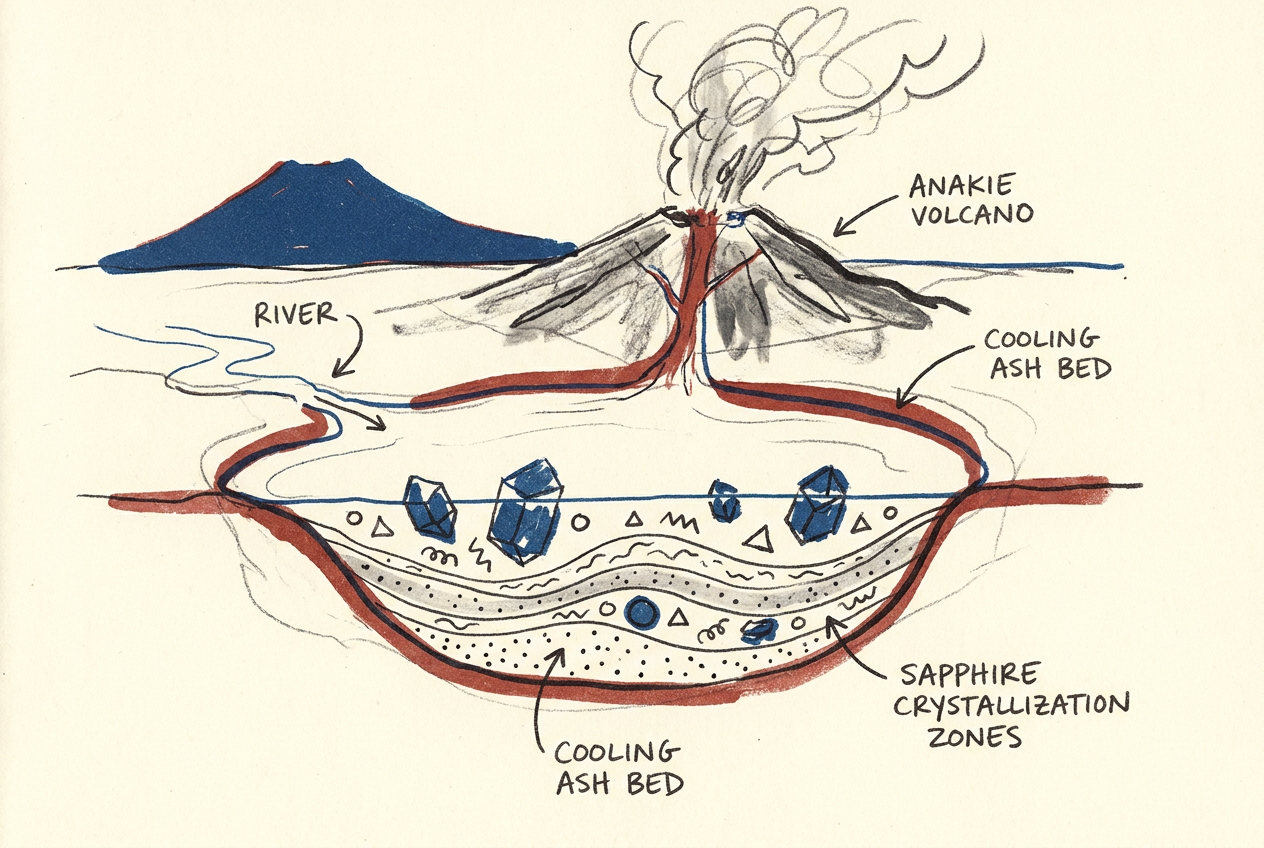
When the magma reached the surface, it did not build a cone. It blasted through water-saturated sediment, creating a maar—a broad, shallow crater that immediately filled with groundwater. The result was a lake, perhaps a kilometre across, sitting directly on top of a volcanic vent.
As the lake sat, hot volcanic ash and gas bubbled up through its floor. The alkaline water, heated by the cooling magma below, began to dissolve the aluminium-rich ash and reprecipitate it as corundum crystals. This process—called hydrothermal alteration—took tens of thousands of years. The sapphires grew slowly, atom by atom, in the warm, still water of the lake.
The Colour in the Clay
What makes a sapphire blue? Trace amounts of iron and titanium, substituting for aluminium in the crystal lattice, absorb yellow and green light and transmit blue. The Anakie stones contain these elements in just the right proportions, inherited from the mantle rocks that fed the original magma.
But not all Anakie sapphires are blue. Some are green, some yellow, some a rare parti-coloured mix of blue and green in a single crystal. The colour zones are sharp and angular, reflecting changes in the chemistry of the lake water as the crystals grew. A single crystal can record months or years of shifting conditions, frozen in stone.
The sapphires grew slowly, atom by atom, in the warm, still water of a volcanic lake.
Most of the crystals are small—a few carats at most. But they are unusually clear. Unlike sapphires from metamorphic deposits, which are often clouded by inclusions, the Anakie stones grew in open water where impurities could settle out. The result is a gem that needs no heat treatment, no chemical enhancement. It comes out of the ground ready for the cutter's wheel.
The Slow Work of Weathering
The volcanic lakes that created the Anakie sapphires have long since dried. The craters have eroded, the ash beds have weathered to clay, and the gems have been released into the surrounding soil. Over millions of years, the slow movement of water through the landscape has concentrated the crystals in ancient drainage channels and creek beds.
Miners follow these paleochannels, digging through up to 15 metres of overburden to reach the gem-bearing gravel. The sapphires are dense and hard—9 on the Mohs scale—so they resist the abrasion that destroys softer minerals. They tumble downstream, bumping against quartz pebbles and basalt cobbles, but they do not break. They simply accumulate, waiting.
The weathering has also created the distinctive "rind" that many Anakie stones carry. A thin, frosted outer layer, it is the result of long exposure to acidic groundwater. Cutters remove it to reveal the clear crystal within—a process that, in a sense, reverses millions of years of geological patience.
The Quiet of the Gem Fields
Today, the Anakie fields are quiet. Most of the big operations have moved on. What remains are small family claims, hand-dug pits, and the occasional tourist with a sieve and a bucket of water. The land has healed over the craters. The volcanic lakes are gone. But every time a miner pulls a blue crystal from the clay, the 100-million-year-old lake speaks again.
More like this
- The 5,000-Year-Old Volcanoes That Still Smoke in the SouthIn Victoria's Newer Volcanics Province, 400 volcanic vents erupted as recently as 5,000 years ago—the youngest volcanic field in mainland Australia, where craters still hold blue lakes and scoria cone
- The 300-Million-Year-Old Forest That Died Standing UpIn New South Wales, a 300-million-year-old fossil forest preserves dozens of trees buried upright by a Permian volcanic eruption—an entire ecosystem frozen in ash.
- The 1.85-Billion-Year-Old Caldera That Still Feeds the FurnaceIn South Australia's Middleback Ranges, a 1.85-billion-year-old volcanic caldera collapsed and later became one of the world's richest iron ore deposits.