25 June 2026 · 3 min read
The 100,000-Year-Old Storm That Built a Mountain of Opal
How 100,000-year-old weathering in South Australia's Stuart Range created the world's largest known opal deposit—a gemstone born not from fire but from slow desert rain.
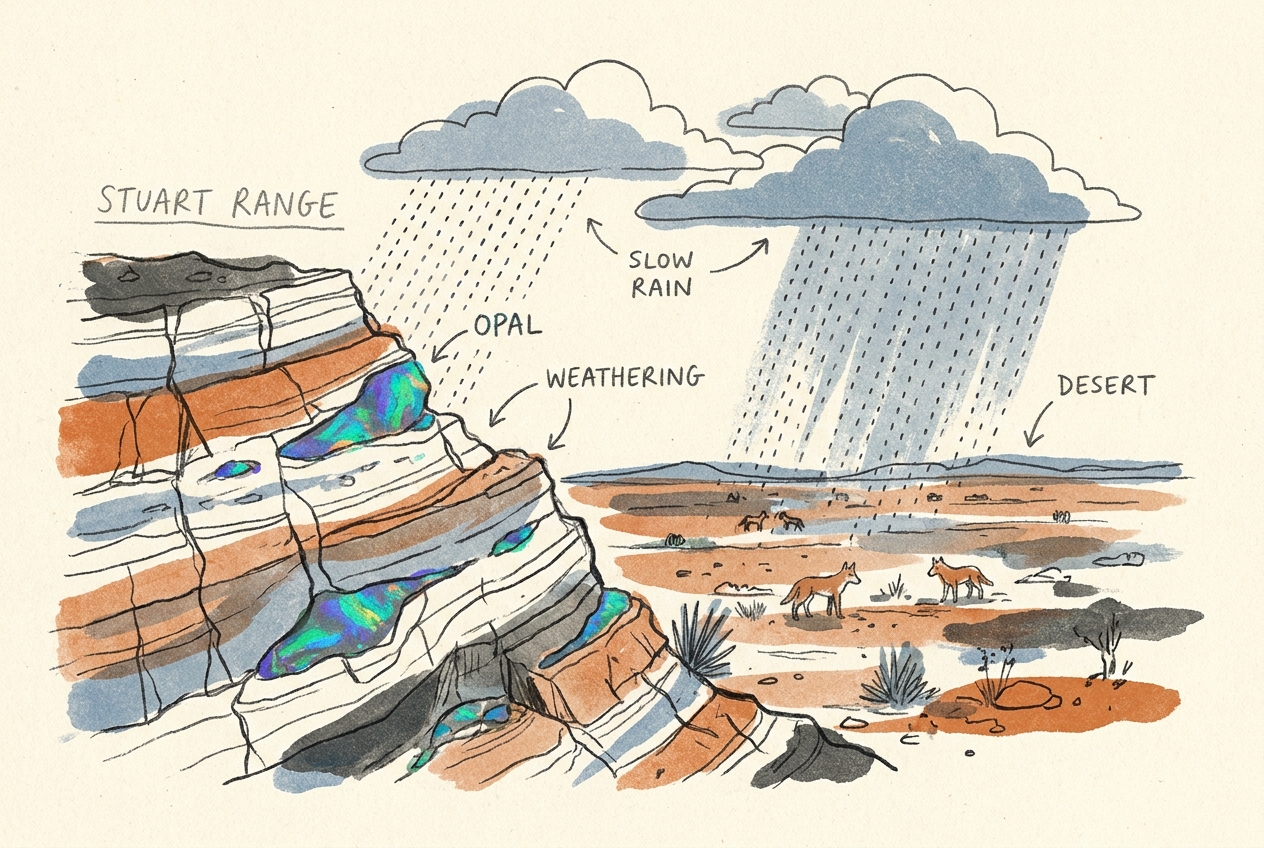
In the dry heart of South Australia, a low escarpment of white sandstone holds more opal than anywhere else on Earth. Coober Pedy—the name means 'white man in a hole' in the local Aboriginal language—sits above a 100,000-year-old secret: a gemstone that formed not in volcanic heat or deep metamorphic pressure, but in the slow drip of desert groundwater through ancient seabed.
The Inland Sea That Left a Desert of Silica
Ninety million years ago, during the Cretaceous, a shallow sea covered much of central Australia. The seafloor accumulated the skeletons of countless microscopic organisms made of silica—diatoms, radiolarians, sponges. When the sea retreated, it left behind a layer of marine sediment up to 300 metres thick, now called the Bulldog Shale.
Over the next 80 million years, the climate of central Australia swung between wet and dry, forest and desert. The Bulldog Shale weathered. Rainwater carrying dissolved silica seeped down through cracks and joints in the rock. In the dry spells, that water evaporated, concentrating the silica into a gel that slowly hardened.
That gel became opal.
Why Desert Rain Makes the Best Opal
Opal is not a mineral in the strict sense—it is a hydrated amorphous silica, with a water content between 3 and 21 percent. The play-of-colour that makes precious opal shimmer comes from microscopic silica spheres packed in a regular grid, diffracting white light into its constituent wavelengths.
The conditions required to form precious opal are so narrow that the gem has been found in significant quantities in only a handful of places on Earth.
Coober Pedy sits at the intersection of three rare factors. First, a silica-rich host rock—the Bulldog Shale. Second, an arid climate with seasonal rainfall, allowing slow dissolution and reprecipitation. Third, a stable tectonic setting: the Stuart Range has not been folded or faulted for millions of years, leaving the opal-bearing cracks undisturbed.
The result is a gemstone that forms at surface temperatures, within metres of the ground, in geological time measured in tens of thousands of years—not millions.
The Opal That Came from Nothing
The opal of Coober Pedy is unique in another way. Most of the world's opal occurs as nodules or seams within ironstone concretions. But in the Stuart Range, the opal fills veins and cavities in the sandstone itself, often as thin, horizontal bands that trace the original bedding planes of the Cretaceous seafloor.
Miners follow these bands by digging vertical shafts through 5 to 30 metres of overburden, then tunnelling horizontally along the 'opal dirt.' The richest finds occur where ancient tree roots or marine fossils created cavities in the shale—the opal fills these voids, sometimes preserving the original shape of a shell or a piece of wood.
These opalised fossils are among the rarest in the world. Complete skeletons of plesiosaurs and ichthyosaurs have been found, their bones replaced atom-for-atom by opal, preserving the fine structure of the original bone in shimmering blues and greens.
The Slow Rain That Built a Town
Coober Pedy produces about 70 percent of the world's opal. Yet the entire deposit formed in a blink of geological time—perhaps 100,000 years of alternating wet and dry cycles during the late Pleistocene, when central Australia was wetter than today.
Since then, the climate has dried further. The opal veins that formed in that brief window have been preserved by the very aridity that ended their formation. No new opal is forming in the Stuart Range today. The desert has locked the gemstone in a state of suspended animation, waiting for someone to dig it out.
More like this
- The 110-Million-Year-Old River That Runs Backwards UndergroundWestern Australia's 110-million-year-old dune system has been slowly dissolving into a labyrinth of caves where an ancient river still flows, carrying the taste of a Cretaceous desert.
- The 560-Million-Year-Old Garden That Never Saw a PredatorIn South Australia's Flinders Ranges, 560-million-year-old Ediacara surfaces preserve entire seafloor communities of fronds, discs, and quilts — a garden of soft-bodied life that flourished before pre
- The 1.75-Billion-Year-Old Reef That Outranks the BarrierA 1.75-billion-year-old microbial reef in the Kimberley is the largest biological structure ever built by a single species, preserving a world without predators.