27 June 2026 · 3 min read
The 2.7-Billion-Year-Old Fissure That Still Bleeds Gold
How 2.7-billion-year-old volcanic fissures in Western Australia's Yilgarn Craton created the Golden Mile—the richest square mile of gold on Earth.
A single square mile of earth has yielded more gold than any other piece of ground on the planet. The Golden Mile at Kalgoorlie-Boulder, in Western Australia's Yilgarn Craton, has produced over 60 million ounces of the metal—roughly 1,900 tonnes. Its wealth was not deposited by some extraordinary accident. It was the product of a 2.7-billion-year-old volcanic system that built, broke, and rebuilt the same crust until the gold had nowhere left to hide.
A Fissure That Would Not Heal
Two billion seven hundred million years ago, the Yilgarn Craton was not a stable block of ancient crust. It was a volcanic arc, similar to today's Indonesia, where oceanic plates were being shoved beneath a growing continent. Magma rose through the overlying rock, erupting as basalts and andesites on the seafloor. But the crust here was thin and brittle, and as the arc stretched, it tore open along a set of parallel fractures known as the Boulder-Lefroy Fault system.
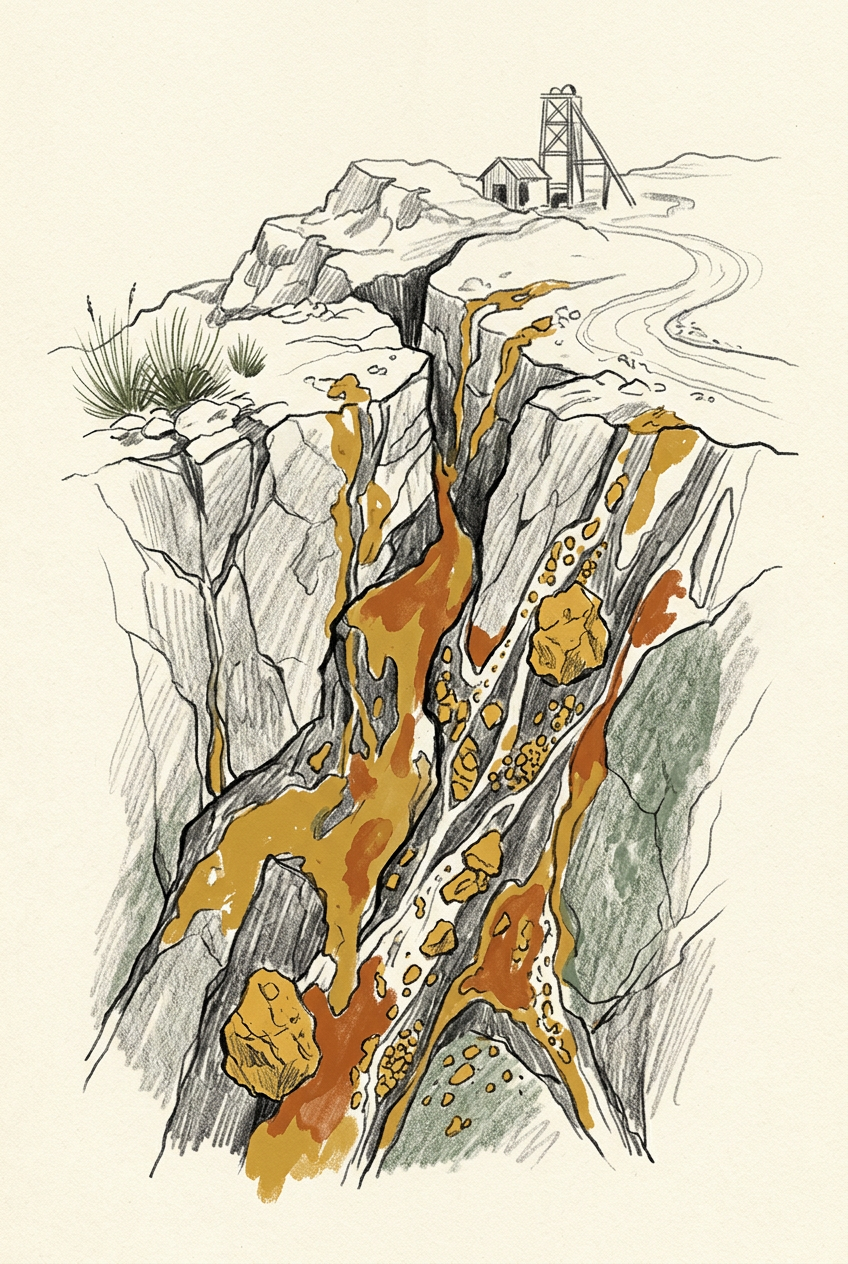
These fissures did not merely vent lava. They became conduits for hot, metal-rich fluids that percolated up from deeper magma chambers. The gold arrived dissolved in hydrothermal brines at temperatures around 400 degrees Celsius, carried as a complex of sulfur and chloride ions. When these fluids hit the fractured basalt, they cooled, reacted with iron-rich wall rocks, and dumped their load of gold into the cracks.
The Shearing That Concentrated the Prize
Had the story ended there, the Golden Mile would have been a modest goldfield—rich enough to attract prospectors, but not enough to build a city. The crucial step came later, when the tectonic regime changed from extension to compression. The same fault system that had once opened as a rift was now being squeezed sideways, shearing the rocks into a fine-grained fabric known as the Golden Mile Dolerite.
This dolerite sill, 2.7 billion years old itself, was the ideal chemical trap. It had been injected as magma into the older basalt, cooling slowly into a dark, iron-rich rock. When the shearing began, the dolerite fractured along thousands of microscopic planes, creating an immense surface area for gold to precipitate. The gold did not arrive in a single event. Multiple pulses of hydrothermal fluid over tens of millions of years stacked ore shoots on top of each other, each one richer than the last.
The Golden Mile is not a vein. It is a three-dimensional network of fractures, each one a capillary through which an ancient hydrothermal system bled its cargo.
The Depth That Still Keeps Giving
Modern mining at Kalgoorlie has followed the Golden Mile down more than 1,600 metres below the surface, and the ore body shows no sign of pinching out. The deepest workings are still cutting through the same sheared dolerite, still encountering the same quartz-pyrite veins that carry visible gold. The geological system that built the deposit was so efficient that it leached gold from a volume of crust many times larger than the deposit itself, concentrating it into a vertical pipe of mineralised rock.
The Yilgarn Craton has been eroded by nearly 2.7 billion years of weathering, stripping away kilometres of overburden. What remains at the surface is the root zone of an ancient volcanic arc—a plumbing system laid bare. The Golden Mile is not a freak occurrence. It is the predictable outcome of a specific sequence: a volcanic arc, a stretching crust, a reactive wall rock, and a long history of compressive shearing. Every element was necessary. None was sufficient alone.
More like this
- The 5,000-Year-Old Volcanoes That Still Smoke in the SouthIn Victoria's Newer Volcanics Province, 400 volcanic vents erupted as recently as 5,000 years ago—the youngest volcanic field in mainland Australia, where craters still hold blue lakes and scoria cone
- The 300-Million-Year-Old Forest That Died Standing UpIn New South Wales, a 300-million-year-old fossil forest preserves dozens of trees buried upright by a Permian volcanic eruption—an entire ecosystem frozen in ash.
- The 1.85-Billion-Year-Old Caldera That Still Feeds the FurnaceIn South Australia's Middleback Ranges, a 1.85-billion-year-old volcanic caldera collapsed and later became one of the world's richest iron ore deposits.