9 July 2026 · 4 min read
The 380-Million-Year-Old Reef That Preserved a Fish's Last Meal
The Gogo Formation in the Kimberley preserves 380-million-year-old fish, jellyfish, and embryos in three-dimensional phosphate — the finest soft-tissue fossils of the Devonian anywhere on Earth.
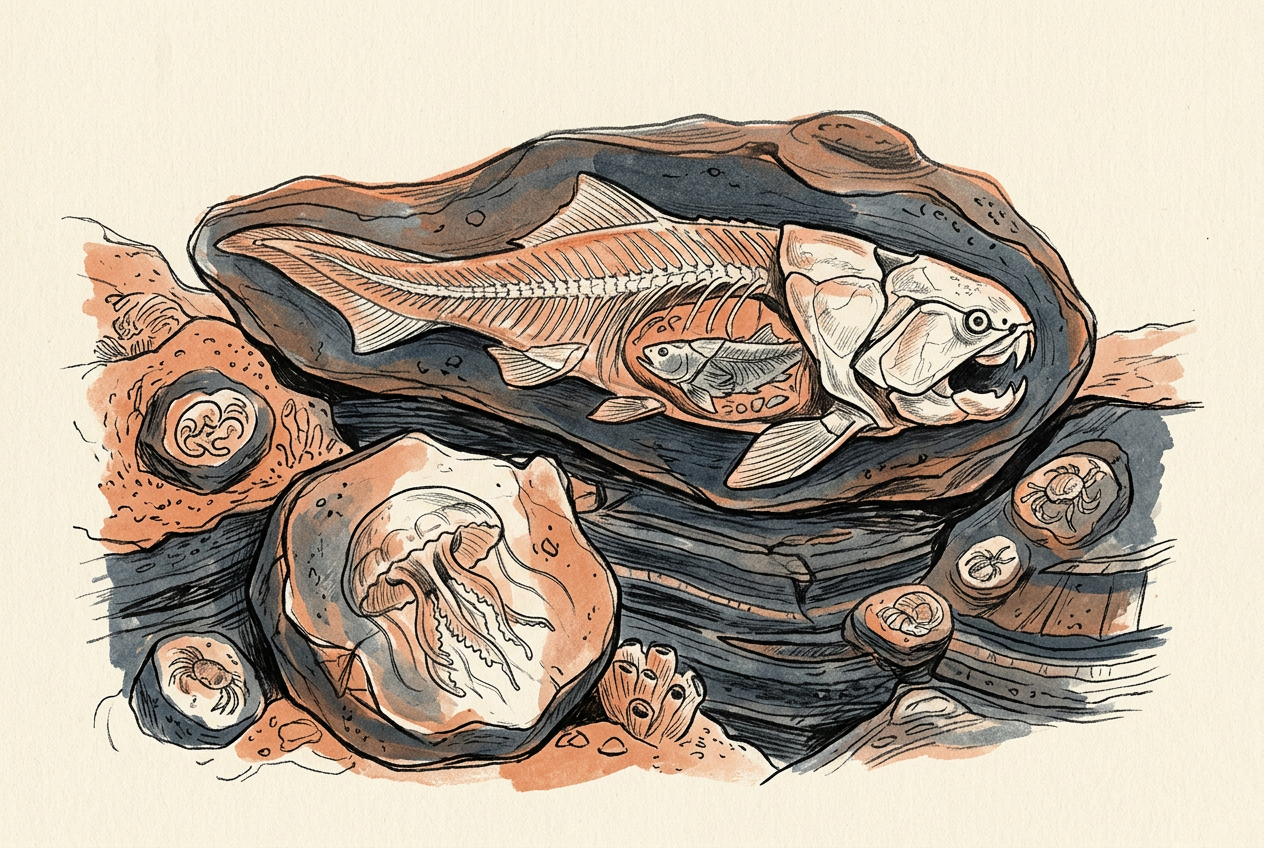
In 1972, a geologist in the Kimberley region cracked open a lump of grey limestone and found something that should not exist: a perfectly preserved jellyfish, its bell and tentacles stamped in stone, 540 million years after the last Ediacaran death. The Gogo Formation of Western Australia is one of the few places on Earth where soft-bodied animals from the Devonian period — not just their skeletons, but their actual bodies — have survived as fossils.
The Reef That Became a Coffin
The Gogo Formation began as a reef. During the Devonian, around 380 million years ago, the Kimberley sat under a shallow tropical sea. A barrier reef system — comparable in scale to today's Great Barrier Reef — grew along the continental shelf, built by stromatoporoids, tabulate corals, and calcareous algae. Behind the reef, in a quiet lagoon, fine-grained muds accumulated on the seafloor.
That lagoon became the coffin. The muds were rich in calcium carbonate but poor in oxygen. When fish and other animals died and sank into these bottom waters, bacterial decay was suppressed. Scavengers could not reach them. Their soft tissues were not eaten or eroded — they were slowly replaced by calcium phosphate, molecule by molecule, preserving the three-dimensional shape of muscles, gills, and even stomach contents.
The result is a Lagerstätte — a mother lode of exceptional preservation. The Gogo fish are not flattened into the paper-thin films common to most fossil deposits. They are preserved in the round, often with their scales, fins, and internal organs intact.
The Fish That Had Sex and Gave Birth
Among the Gogo fossils are the earliest known examples of internal fertilisation and live birth in vertebrates. The placoderm Materpiscis attenboroughi — named for Sir David Attenborough — was a 30-centimetre-long armoured fish that gave birth to live young. One specimen contains the fossilised remains of a single embryo, still connected by a mineralised umbilical cord.
The Devonian has been called the Age of Fishes. The Gogo Formation shows us that these were not primitive fish — they were complex animals with advanced reproductive strategies, parental care, and social behaviours.
Another placoderm, Eastmanosteus calliaspis, preserves the oldest known evidence of a live birth in a vertebrate. A third, Incisoscutum ritchiei, contains embryos in both ovaries. These fossils push the origin of vertebrate viviparity back by 200 million years, from the Jurassic to the Devonian.
The Tentacles That Refuse to Decay
The Gogo Formation's most famous soft-bodied fossils are not fish but jellyfish. The medusae of Essexella and related genera are preserved as three-dimensional casts in nodules of limestone. Their bells measure up to 20 centimetres across. Their tentacles trail behind them in sweeping arcs, as if they were still pulsing through the Devonian sea.
These jellyfish were buried by sudden sediment flows — storm events or turbidity currents that smothered them before decay could begin. The same flows also preserved worms, crustaceans, and what appear to be ctenophores, or comb jellies. Together, they represent a complete ecosystem: the predators, the prey, and the scavengers that lived among them.
The Phosphatic Miracle
The key to Gogo's preservation is phosphate. The lagoon sediments were rich in phosphorus, leached from the surrounding reef and concentrated by microbial activity. When an animal died, bacteria in the sediment began to break down its tissues, releasing phosphorus into the surrounding pore water. The phosphorus combined with calcium from the seawater to form calcium phosphate — the same mineral that makes up our own bones and teeth.
This process is called phosphatisation. It is rare in the fossil record because it requires a precise balance of conditions: low oxygen, high phosphorus, and rapid burial. When these conditions align, the result is a faithful, three-dimensional copy of soft tissues in a mineral that is stable over geological time.
The Gogo Formation is the finest example of phosphatisation in the world. No other deposit of Devonian age preserves soft tissues with such fidelity.
The Window That Almost Closed
Most of the Gogo Formation is not exposed at the surface. The fossils are found in limestone nodules that weather out of the hills around Fitzroy Crossing, a small town in the central Kimberley. The nodules are collected by splitting them with hammers — a slow, laborious process that has yielded thousands of specimens since the 1960s.
The formation is under threat. The Western Australian government has granted mining leases for the extraction of limestone and dolomite in the area. Conservationists argue that the fossil deposits are irreplaceable and that mining would destroy the only known window into the soft-tissue biology of the Devonian.
For now, the Gogo Formation remains the best-preserved record of Devonian life anywhere on Earth — a reef that became a coffin, and a coffin that became a museum.
More like this
- The 560-Million-Year-Old Garden That Never Saw a PredatorIn South Australia's Flinders Ranges, 560-million-year-old Ediacara surfaces preserve entire seafloor communities of fronds, discs, and quilts — a garden of soft-bodied life that flourished before pre
- The 300-Million-Year-Old Forest That Died Standing UpIn New South Wales, a 300-million-year-old fossil forest preserves dozens of trees buried upright by a Permian volcanic eruption—an entire ecosystem frozen in ash.
- The 1.75-Billion-Year-Old Reef That Outranks the BarrierA 1.75-billion-year-old microbial reef in the Kimberley is the largest biological structure ever built by a single species, preserving a world without predators.