25 June 2026 · 3 min read
The 540-Million-Year-Old Reef That Never Saw the Sun
How 540-million-year-old archaeocyathid sponge reefs in South Australia's Flinders Ranges—among the first animal-built structures on Earth—grew in deep, dark waters before the Cambrian explosion
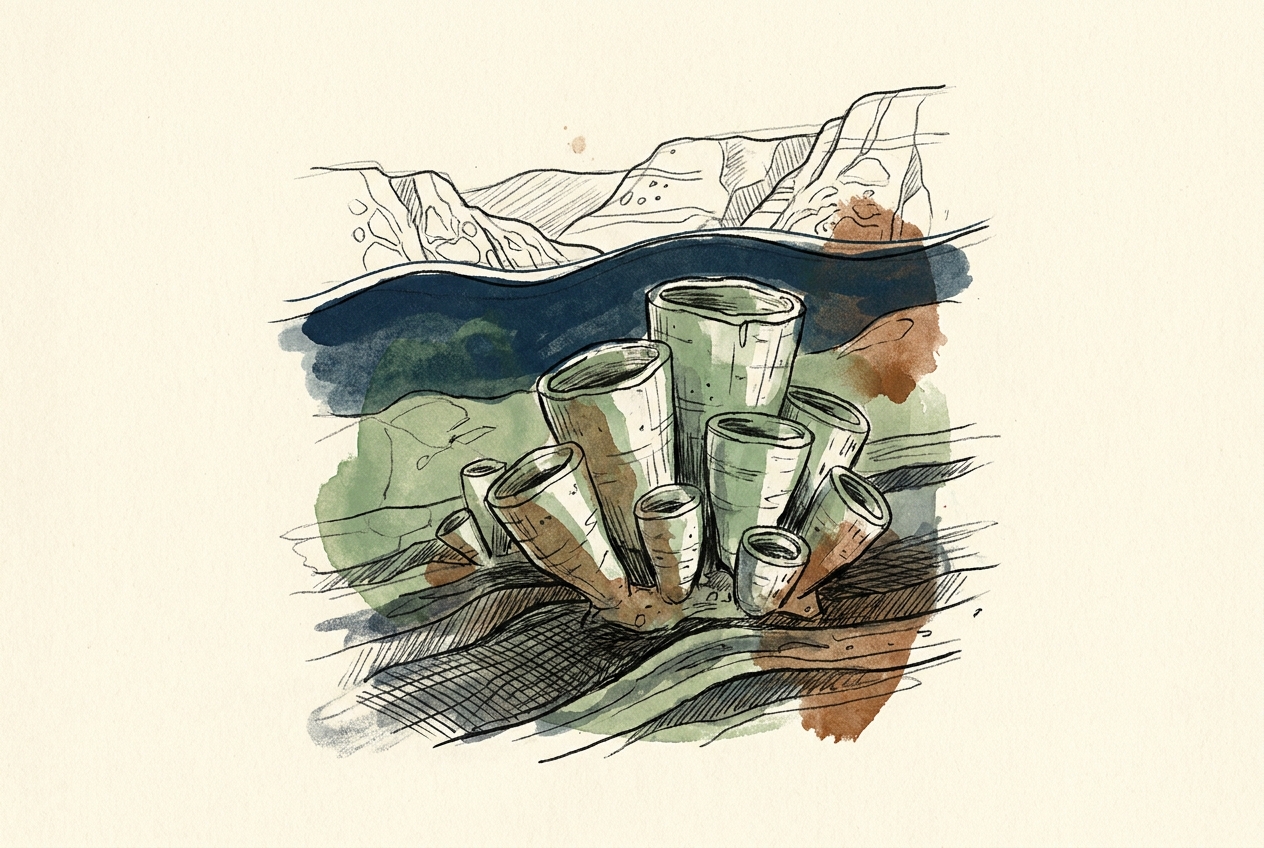
Half a billion years ago, before trilobites crawled and before any fish swam, a city of sponges rose from a dark seafloor in what is now South Australia's Flinders Ranges. These were archaeocyathids—cone-shaped animals that built the first reefs on Earth. Their skeletons still stand in the limestone cliffs of the Ajax Limestone, tilted by mountain-building but otherwise intact, a frozen moment from 540 million years ago.
The First Reef Builders
Archaeocyathids were filter feeders, related to sponges, that grew as paired calcareous cones—an inner and outer wall connected by vertical partitions. They lived only during the Early Cambrian, roughly 540 to 520 million years ago, and then vanished entirely. No group before them had built rigid, wave-resistant structures from biological minerals.
The Ajax Limestone near Beltana preserves these reefs in exceptional detail. Individual cups sit upright in the rock, their porous walls still visible. Some colonies formed mounds several metres across. The limestone itself is their debris—broken skeletons cemented into a grainstone that records the constant collapse and regrowth of living reef fronts.
What makes these reefs strange is where they grew. Chemical analysis of the surrounding sediments suggests the water was deep, possibly hundreds of metres below the surface, in dim or entirely dark conditions. Modern reef-building corals depend on symbiotic algae that need sunlight. Archaeocyathids built their reefs in the dark.
A World Without Predators
The Ajax reefs grew during a brief interval between the Ediacaran soft-bodied biota and the full Cambrian explosion. The first burrowing animals had appeared, but the arms races of predation and skeletonisation were just beginning. Archaeocyathids may have been among the first organisms to secrete a mineralised skeleton as defence.
Their sudden appearance and equally sudden extinction bracket a 20-million-year window when the rules of animal life were still being written.
The reefs hosted a sparse community: small shelly fossils, primitive molluscs, and the first arthropods. Nothing yet grazed on the reef itself. The archaeocyathids stood undisturbed, filtering particles from the cold Cambrian sea.
A Climate Signal in Stone
The Ajax Limestone contains another clue. Its carbon isotope ratios record a sharp global shift—the so-called Cambrian carbon isotope excursion—linked to a pulse of volcanic activity and warming that may have triggered the diversification of animal life. The archaeocyathid reefs grew during the warm phase, then collapsed as conditions changed.
Their extinction around 520 million years ago coincided with a drop in sea level and a shift to cooler, more oxygenated waters. The sponges that replaced them were simpler, unmineralised forms. The experiment of reef-building would not resume until the Ordovician, when entirely different groups—stromatoporoids and tabulate corals—independently reinvented the architecture.
What the Tilted Cliffs Reveal
Today the Ajax Limestone forms low ridges and tilted slabs in the arid Flinders Ranges. The same rocks that once lay at the bottom of a deep Cambrian sea now bake under the South Australian sun, their sponge skeletons weathering out as white oval forms against grey limestone. Prospectors in the 19th century mistook them for fossils of unknown creatures; the local Adnyamathanha people had long known the ridges held the bones of an ancient sea.
The reefs are small by modern standards—a few metres thick, tens of metres across. But they represent a threshold. Before them, Earth's only biological structures were microbial mats and stromatolites. After them, animals would build the frameworks that shape marine ecosystems to this day.
More like this
- The 110-Million-Year-Old River That Runs Backwards UndergroundWestern Australia's 110-million-year-old dune system has been slowly dissolving into a labyrinth of caves where an ancient river still flows, carrying the taste of a Cretaceous desert.
- The 5,000-Year-Old Volcanoes That Still Smoke in the SouthIn Victoria's Newer Volcanics Province, 400 volcanic vents erupted as recently as 5,000 years ago—the youngest volcanic field in mainland Australia, where craters still hold blue lakes and scoria cone
- The 560-Million-Year-Old Garden That Never Saw a PredatorIn South Australia's Flinders Ranges, 560-million-year-old Ediacara surfaces preserve entire seafloor communities of fronds, discs, and quilts — a garden of soft-bodied life that flourished before pre