25 June 2026 · 3 min read
The 250-Million-Year-Old Sapphire That Grew in Clay: Queensland's Rubyvale
How 250-million-year-old volcanic activity in central Queensland created sapphires not in molten rock but in ancient clay beds, producing the distinct blue-green gems of the Rubyvale fields.
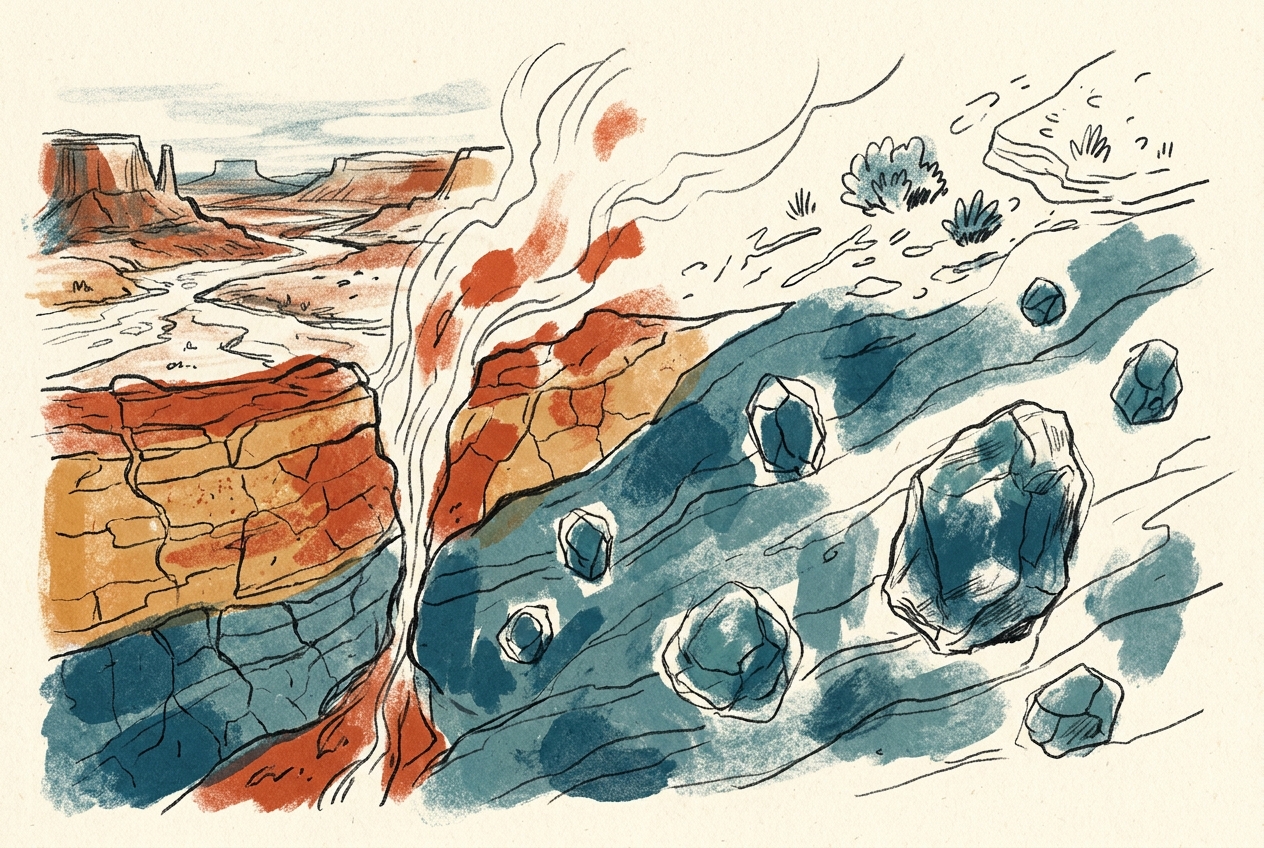
Deep beneath central Queensland's iron-red soil, a 250-million-year-old volcanic pipe punches through layers of marine clay. Most sapphires form in molten rock, but the gems of the Rubyvale fields grew in something stranger: a fossilised mudflat that once lay at the bottom of an inland sea.
The Volcano That Missed Its Mark
Around 250 million years ago, during the Permian-Triassic transition, a cluster of volcanic vents erupted through what is now the Anakie region. But these were not ordinary volcanoes. The magma that rose through the pipes was a type called lamproite, rich in potassium and magnesium but low in silica. As it neared the surface, the molten rock encountered a thick layer of waterlogged clay — the remains of an ancient delta system that had drained into the Bowen Basin.
Instead of blasting through to form a conventional lava flow, the lamproite stalled. It spread sideways into the clay beds, baking them into a hard, porcelain-like rock called buchite. The heat was intense but uneven: some patches reached 1,200 degrees Celsius while adjacent clay barely warmed. In the zones where temperature and chemistry aligned, the aluminium-rich clay began to crystallise into corundum — the mineral that produces both sapphire and ruby.
This is why Rubyvale sapphires look different from those found elsewhere. They contain trace amounts of iron and titanium that give them a distinctive blue-green tone, unlike the deeper blues of Sri Lanka or the pale pastels of Montana. The clay also trapped tiny inclusions of rutile and zircon, creating a subtle silk that gives some stones a velvety sheen.
The Fossil Forest That Became a Gemfield
The clay beds that hosted the sapphires also preserved something extraordinary: a Permian fossil forest. When miners dig through the overburden at Rubyvale, they regularly uncover upright tree stumps, fossilised leaves, and the bones of ancient amphibians that lived in the delta's swamps. The same volcanic event that created the sapphires entombed and preserved these remains.
The sapphires of Rubyvale are not volcanic crystals that happened to weather out of lava. They are metamorphic gems, born when clay met fire, that only later were washed into the creeks where miners find them today.
For tens of millions of years, the sapphire-bearing buchite lay buried under younger sediments. Then, during the Eocene epoch, about 50 million years ago, the Australian plate began to drift northward. The landscape uplifted and eroded. Creeks cut down through the soft clay, freeing the hard corundum crystals and concentrating them in gravel beds. Aboriginal people had been collecting these gems for thousands of years before European settlers arrived in the 1850s.
The Wash That Never Runs Out
Rubyvale has been mined continuously since 1875, yet the gemfields still produce. The reason is geological: the sapphires are not confined to a single hard rock layer but are scattered through a sequence of weathered clay, gravel, and soil that can extend 20 metres deep. Modern miners use heavy machinery to strip the overburden, then wash the material through screens and jigs. The sapphires, being among the hardest natural minerals, survive this process intact while the surrounding rock dissolves into slurry.
Most stones are small — under one carat — but the fields occasionally yield crystals over 100 carats. The largest ever found at Rubyvale weighed 1,156 carats, though it was heavily included and never cut. The value lies not in individual gems but in volume: the Anakie region has produced over 300 million carats of sapphire since mining began, making it one of the world's largest sapphire provinces.
A Geology That Refuses to Be Simple
The Rubyvale sapphires defy easy classification. They are not primary igneous crystals, not alluvial placer deposits in the usual sense, and not metamorphic gems in the classic high-pressure sense. They formed in a narrow window of temperature and composition, inside a volcanic pipe that never erupted, hosted by clay that once held the roots of a Permian forest. Every stone carries this layered history: the delta, the intrusion, the baking, the long erosion, and the brief moment when a miner's shovel turns it to the light.
More like this
- The 110-Million-Year-Old River That Runs Backwards UndergroundWestern Australia's 110-million-year-old dune system has been slowly dissolving into a labyrinth of caves where an ancient river still flows, carrying the taste of a Cretaceous desert.
- The 5,000-Year-Old Volcanoes That Still Smoke in the SouthIn Victoria's Newer Volcanics Province, 400 volcanic vents erupted as recently as 5,000 years ago—the youngest volcanic field in mainland Australia, where craters still hold blue lakes and scoria cone
- The 300-Million-Year-Old Forest That Died Standing UpIn New South Wales, a 300-million-year-old fossil forest preserves dozens of trees buried upright by a Permian volcanic eruption—an entire ecosystem frozen in ash.