5 July 2026 · 3 min read
The 540-Million-Year-Old Reef That Never Grew in Sunlight
How 540-million-year-old archaeocyathan sponge reefs in South Australia's Flinders Ranges—built in deep, murky waters—record the world's first animal-built structures before the Cambrian explosion.
On the eastern flank of the Flinders Ranges, near a dry creek bed called Bunyeroo Gorge, the limestone cliffs hold shapes that should not exist. They look like cups, funnels, and stacked bowls, each one the size of a thimble to a teacup, packed so densely that the rock itself seems to have grown them. These are archaeocyathan reefs—the world's first animal-built structures—and they appeared half a billion years ago in water so deep that no sunlight ever reached them.
The First Architects
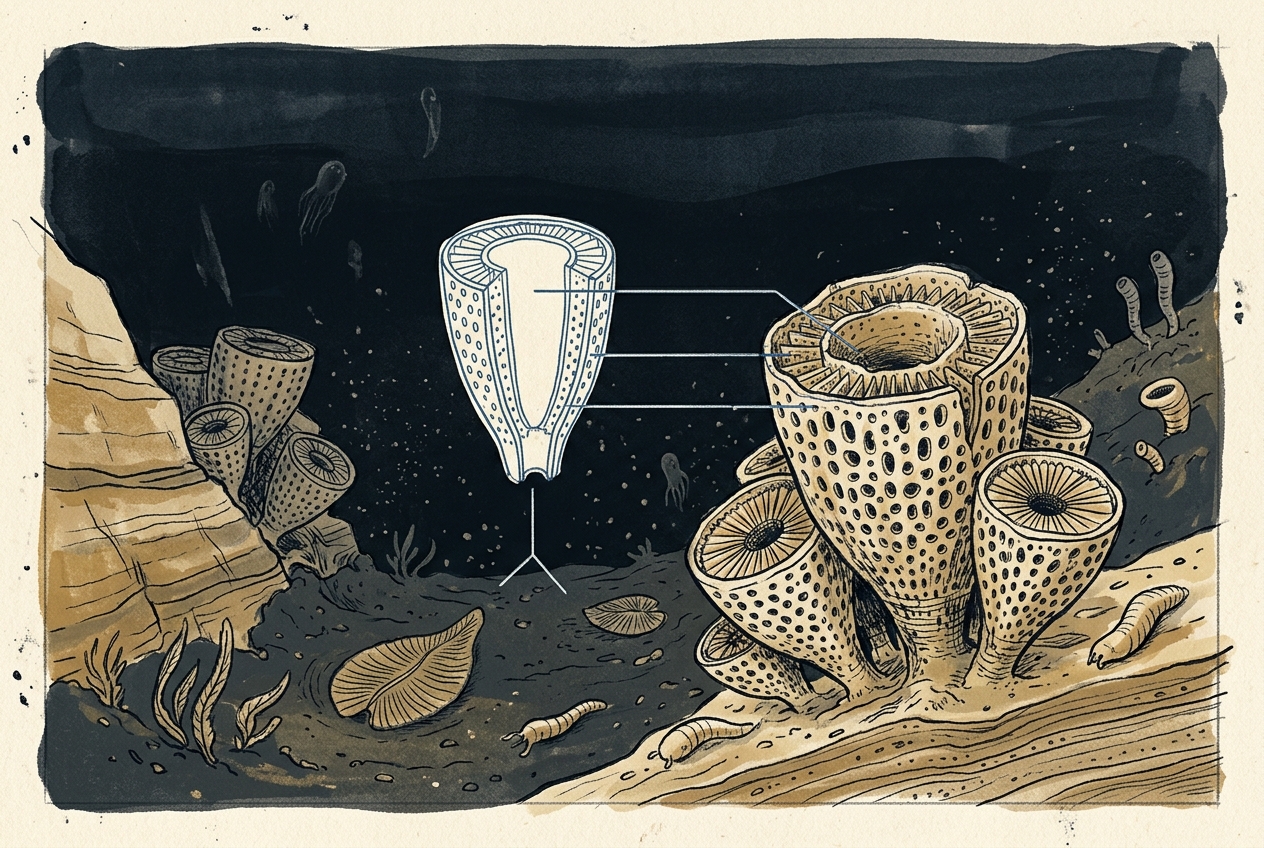
Archaeocyaths were not corals, though they built the first reefs. They were filter-feeding sponges, vase-shaped organisms with double walls perforated by tiny pores. Seawater flowed in through the outer wall, passed through a central cavity, and out the top, leaving behind any organic particles small enough to fit.
The animals themselves were modest—most stood no taller than a finger. But they lived in colonies of millions, and their calcium carbonate skeletons stacked and interlocked into structures that stretched for kilometres across the seafloor. The Flinders Ranges preserve some of the most extensive of these early reefs, exposed today in the limestone of the Wilkawillina Formation, dated to roughly 540 million years old.
What makes these reefs strange is where they grew. Modern coral reefs need shallow, sunlit water because they depend on symbiotic algae that photosynthesise. The archaeocyaths had no such partners. Their reefs formed on the continental slope, in water hundreds of metres deep, where the only light was the faint blue glow of the open ocean above.
A Reef Without Sun
The evidence is written in the rock itself. The limestone that holds the archaeocyaths is fine-grained and dark, the kind that forms in quiet, deep water far from wave action. There are no signs of algal mats or photosynthetic bacteria—those require sunlight. Instead, the reefs grew in the dim twilight zone of the early Cambrian ocean, anchored to a muddy slope that slanted down into the abyss.
They thrived there because the water was rich in dissolved calcium and bicarbonate, the raw materials for their skeletons. The Cambrian seas were a chemical soup, charged with minerals that had accumulated during the long Precambrian. The archaeocyaths were the first organisms to exploit that abundance on a massive scale, pulling calcium from the water and locking it into stone.
In places, the reef complexes reached 50 metres in thickness. Individual colonies grew as domes, cones, and branching forms, creating a three-dimensional framework that trapped sediment and provided surfaces for other organisms to attach. These were true ecological reefs, not mere clusters of individuals—complex habitats that altered the seafloor around them.
The Ghost of a Lost World
The archaeocyath reefs did not last long. By the middle Cambrian, roughly 510 million years ago, they had vanished completely. No one knows why. Changing ocean chemistry may have made it harder to build skeletons. New predators—trilobites, molluscs, and other mobile animals—may have grazed them away. Or perhaps competition from true corals, which appeared later in the Cambrian, simply outbuilt them.
Whatever the cause, the extinction was total. Not a single archaeocyath species survived into the Ordovician. They left no descendants. Their entire lineage—the first animals to build structures visible from space—rose and fell within a geological instant of about 30 million years.
In the cliffs of Bunyeroo Gorge, the cups and funnels are still there, packed so tightly that a single hand-sized block may hold a hundred individual skeletons.
Today, the archaeocyathan reefs of the Flinders Ranges are among the best-preserved examples on Earth. They sit in limestone that was once the deep seafloor of a vanished ocean, now uplifted into arid hills where only the occasional wedge-tailed eagle passes overhead. The reef builders are gone, but the shapes they made remain—the first architecture on a planet that would eventually build cathedrals, bridges, and cities from the same calcium carbonate that once filled the pores of a sponge.
More like this
- The 560-Million-Year-Old Garden That Never Saw a PredatorIn South Australia's Flinders Ranges, 560-million-year-old Ediacara surfaces preserve entire seafloor communities of fronds, discs, and quilts — a garden of soft-bodied life that flourished before pre
- The 300-Million-Year-Old Forest That Died Standing UpIn New South Wales, a 300-million-year-old fossil forest preserves dozens of trees buried upright by a Permian volcanic eruption—an entire ecosystem frozen in ash.
- The 1.75-Billion-Year-Old Reef That Outranks the BarrierA 1.75-billion-year-old microbial reef in the Kimberley is the largest biological structure ever built by a single species, preserving a world without predators.