5 July 2026 · 3 min read
The 17,000-Year-Old Craters That Still Hold Their Shape
In the remote Kimberley, a 17,000-year-old volcanic field of cinder cones and maar craters records the youngest eruptions on the Australian continent.
In the remote far north of Western Australia, on the edge of the Kimberley plateau, lies a volcanic field so young that the craters still hold their shape—a landscape where the last eruptions happened within the memory of the continent's first people.
The Youngest Volcanoes on the Continent
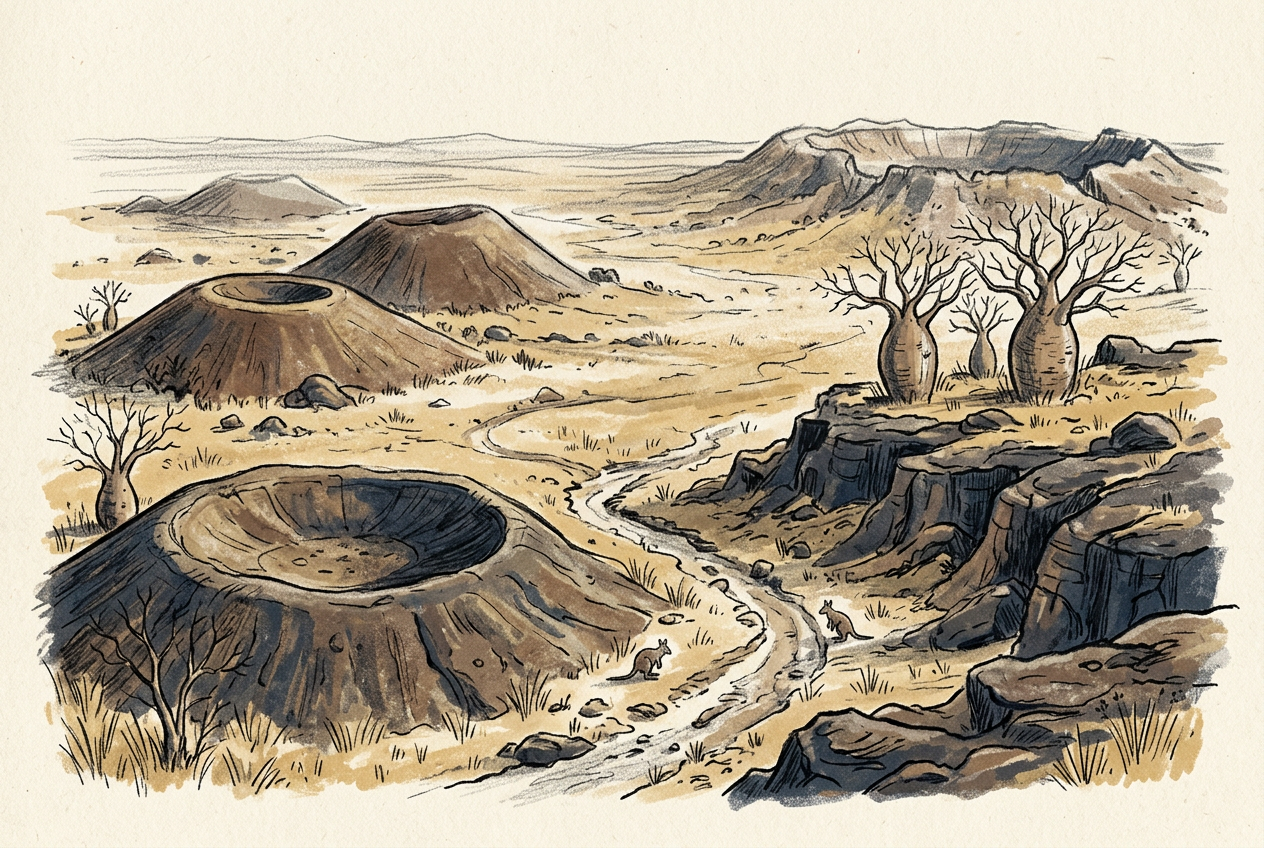
The Kimberley volcanic field is not one volcano but dozens: a scatter of cinder cones, lava flows, and maar craters spread across 4,000 square kilometres of savannah and sandstone. Unlike the ancient Archaean lavas of the Pilbara—3.5 billion years old and folded into gneiss—these eruptions are geologically recent. Potassium-argon dating places the youngest flows at around 17,000 to 20,000 years old. That is yesterday in deep time. Some Aboriginal oral traditions may describe these eruptions directly.
The volcanoes cluster around the towns of Kununurra and Wyndham, near the border with the Northern Territory. The most prominent is Mount Manifest, a 60-metre-high scoria cone with a breached crater. Nearby, the Bungle Bungle Range—famous for its striped beehive domes—is made of Devonian sandstone, 350 million years older, and has nothing to do with the volcanism. The contrast is stark: the ancient, eroded sandstone towers sit beside fresh black basalt flows that still look as if they cooled last season.
What the Lava Reveals
The Kimberley volcanics are intraplate basalts—magma that rose not from a subduction zone or a mid-ocean ridge, but from a deep mantle plume that punched through the continent's thick crust. The lava is alkali basalt, rich in sodium and potassium, carrying xenoliths of mantle rock—green peridotite nodules that rode up from 50 kilometres down. These nodules tell geologists that the magma rose fast, without stalling in the crust, preserving a direct sample of the mantle beneath northern Australia.
At the Packsaddle Creek flow, the basalt is fresh enough to show columnar jointing—hexagonal pillars formed as the lava cooled and contracted. The columns are vertical, indicating a flat-lying flow that pooled in an ancient river valley. Overlying the basalt are sediments from the Ord River, which has since incised a new channel through the lava. The river, not the volcano, shaped the final landscape.
The youngest lava flows in Australia are so recent that they sit on top of soils that contain the charcoal of Aboriginal firesticks.
A Landscape of Craters
Some of the Kimberley volcanoes are maar craters—broad, shallow depressions formed when rising magma hit groundwater and exploded. Lake Argyle, one of the largest artificial reservoirs in the Southern Hemisphere, flooded several of these craters when the Ord River Dam was built in the 1970s. Before the dam, the craters were dry, grass-filled bowls. Today, their rims form islands in the lake.
At the Black Rock Creek maar, the eruption blasted through the Carson Volcanics—a 1.8-billion-year-old basalt formation—and scattered blocks of the older rock across the surrounding plain. The resulting crater is 500 metres wide and 40 metres deep, now filled with sediment and seasonal water. The explosion that formed it would have been heard for hundreds of kilometres.
The Human Frame
These volcanoes are young enough that they sit within the frame of human habitation. Aboriginal people have lived in the Kimberley for at least 50,000 years. The oral traditions of the Miriwoong and Gadjerong people include stories of the ground shaking and fire coming from the earth. Whether these directly describe the volcanic eruptions is debated, but the coincidence of timing is striking: the last eruptions occurred when sea levels were lower, and the coastline was 200 kilometres further north.
Today, the volcanoes are quiet. The mantle plume that fed them has cooled, or shifted. But the landscape still carries the memory of fire. Black basalt boulders litter the red soil. Cinder cones rise like dark pyramids against the spinifex plain. And in the dry season, when the grass is brown and the air is still, you can stand on the rim of a 17,000-year-old crater and see the exact shape of the eruption that made it.
More like this
- The 110-Million-Year-Old River That Runs Backwards UndergroundWestern Australia's 110-million-year-old dune system has been slowly dissolving into a labyrinth of caves where an ancient river still flows, carrying the taste of a Cretaceous desert.
- The 5,000-Year-Old Volcanoes That Still Smoke in the SouthIn Victoria's Newer Volcanics Province, 400 volcanic vents erupted as recently as 5,000 years ago—the youngest volcanic field in mainland Australia, where craters still hold blue lakes and scoria cone
- The 300-Million-Year-Old Forest That Died Standing UpIn New South Wales, a 300-million-year-old fossil forest preserves dozens of trees buried upright by a Permian volcanic eruption—an entire ecosystem frozen in ash.