6 July 2026 · 3 min read
The 450-Million-Year-Old Graveyard That Built an Island
How 450-million-year-old Ordovician limestone on Tasmania's west coast—a seabed of crushed trilobites and brachiopods—became the rock that built a colonial settlement.
The walls of Hobart's oldest sandstone buildings are flecked with the ghosts of animals that died before fish had jaws. Those flecks are not decoration. They are a 450-million-year-old seafloor, crushed, lifted, and quarried into the city itself.
The Sea That Became a Quarry
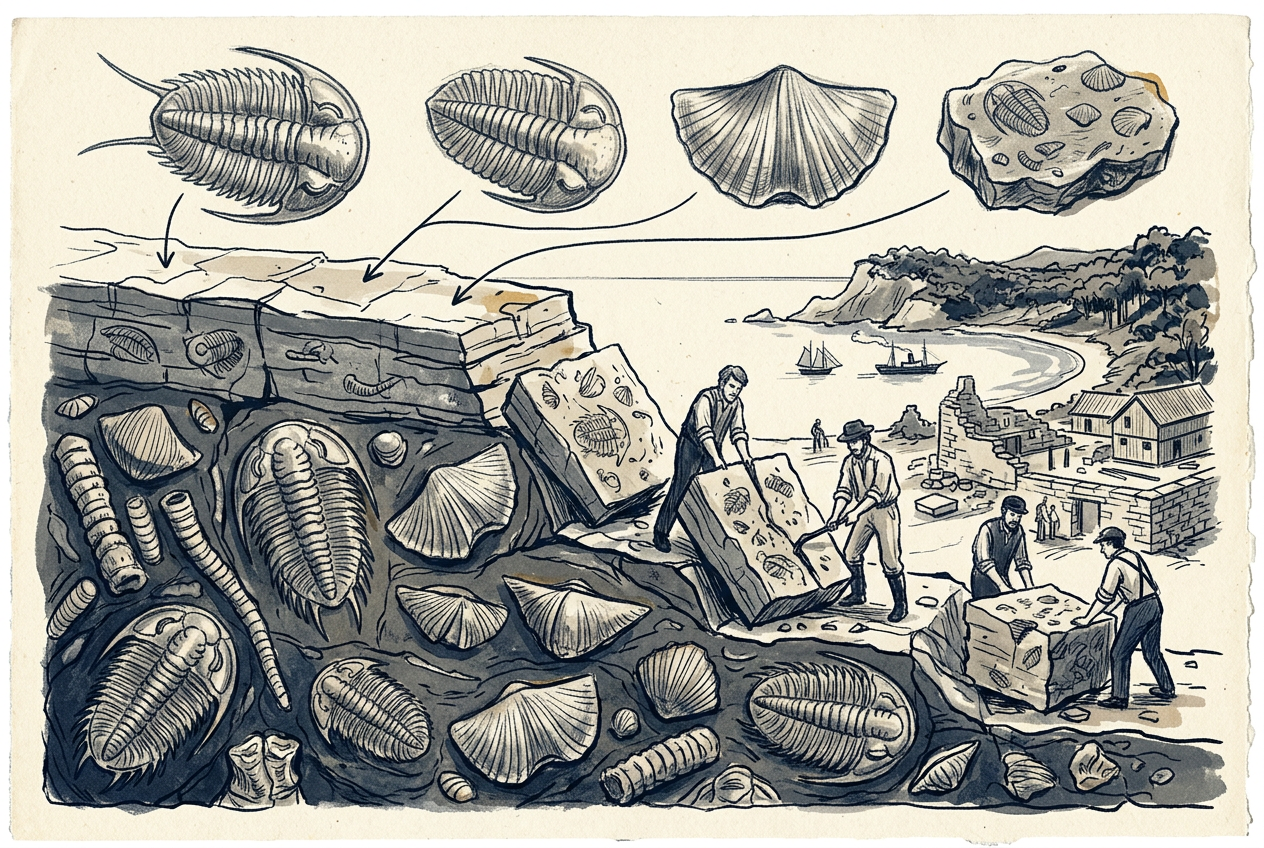
During the Ordovician Period, roughly 450 million years ago, the landmass that would become Tasmania lay submerged beneath a shallow tropical sea. This sea teemed with life: trilobites, brachiopods, crinoids, and nautiloids—creatures with calcium carbonate shells that, when they died, rained onto the seabed in an endless, slow drift.
For millions of years, that skeletal rain accumulated. The shells compacted into limestone, then into a harder, more crystalline rock that geologists call the Gordon Group limestone. It runs in a 50-kilometre band along Tasmania's west coast, from Mole Creek to Hastings, and reaches depths of over 1,000 metres in places.
What makes this limestone unusual is not its size but its purity. The rock is nearly all shell—over 95 per cent calcium carbonate, with almost none of the clay or sand that dilutes most limestones. It is a graveyard, compressed into building stone.
The city of Hobart was built from the remains of an Ordovician reef.
The Stone That Carried a Colony
When British settlers arrived in Van Diemen's Land in the early 1800s, they found a landscape of dense forest and dolerite—a hard, dark igneous rock that splits poorly for building. They needed a stone that could be sawn, carved, and shipped. They found it on the Derwent River estuary, where the Gordon Group limestone had been eroded into coastal cliffs.
The first quarry opened at Risdon Cove in 1804, just months after the settlement was established. Convicts cut blocks by hand, using hammers and wedges, and barged them downriver to Hobart. The stone was soft enough to carve but hardened on exposure—ideal for window surrounds, door lintels, and decorative facades.
Hobart's oldest surviving structures are built from this rock. The Commissariat Store (1810), the Bond Store (1824), and sections of the Anglesea Barracks (1814) all contain Ordovician limestone. Each block holds the microscopic remains of creatures that lived when Tasmania sat near the South Pole, part of the supercontinent Gondwana.
The Reef That Hardened Into a Landscape
Beyond the city, the same limestone shaped Tasmania's wildest country. The Gordon Group forms the spectacular karst landscape of the Mole Creek Caves, where underground rivers dissolved the rock over millions of years, creating shafts, stalactites, and chambers large enough to hold a cathedral.
At Hastings, the limestone emerges as a thermal spring—water heated by deep circulation through the rock, emerging at 27°C year-round. The water carries dissolved calcium carbonate, the same mineral that built the Ordovician shells, and deposits it as travertine terraces that grow a few millimetres each year.
The stone also holds fossils in remarkable abundance. The Gordon Group contains over 200 identified species of Ordovician marine life, including trilobites, brachiopods, bryozoans, and the cone-shaped shells of nautiloid cephalopods that grew up to a metre long. Some beds are so dense with shells that the rock is more fossil than cement.
The Weight of Deep Time
There is a peculiar gravity to walking Hobart's streets. The footpaths, the kerbs, the walls of the old warehouses—all of it is made from the compressed bodies of animals that died before plants colonised the land. The Ordovician seafloor, lifted 450 million years later, now holds up the roofs of cafes and bookshops.
Most cities are built on stone. Hobart was built from life.
More like this
- The 560-Million-Year-Old Garden That Never Saw a PredatorIn South Australia's Flinders Ranges, 560-million-year-old Ediacara surfaces preserve entire seafloor communities of fronds, discs, and quilts — a garden of soft-bodied life that flourished before pre
- The 300-Million-Year-Old Forest That Died Standing UpIn New South Wales, a 300-million-year-old fossil forest preserves dozens of trees buried upright by a Permian volcanic eruption—an entire ecosystem frozen in ash.
- The 1.75-Billion-Year-Old Reef That Outranks the BarrierA 1.75-billion-year-old microbial reef in the Kimberley is the largest biological structure ever built by a single species, preserving a world without predators.