8 July 2026 · 3 min read
The 520-Million-Year-Old Trench That Still Holds a Continent Together
How the 520-million-year-old Kanmantoo Trench off South Australia—a subduction zone that jammed—stitched the Australian continent together and left a belt of metamorphic rock still exposed today.
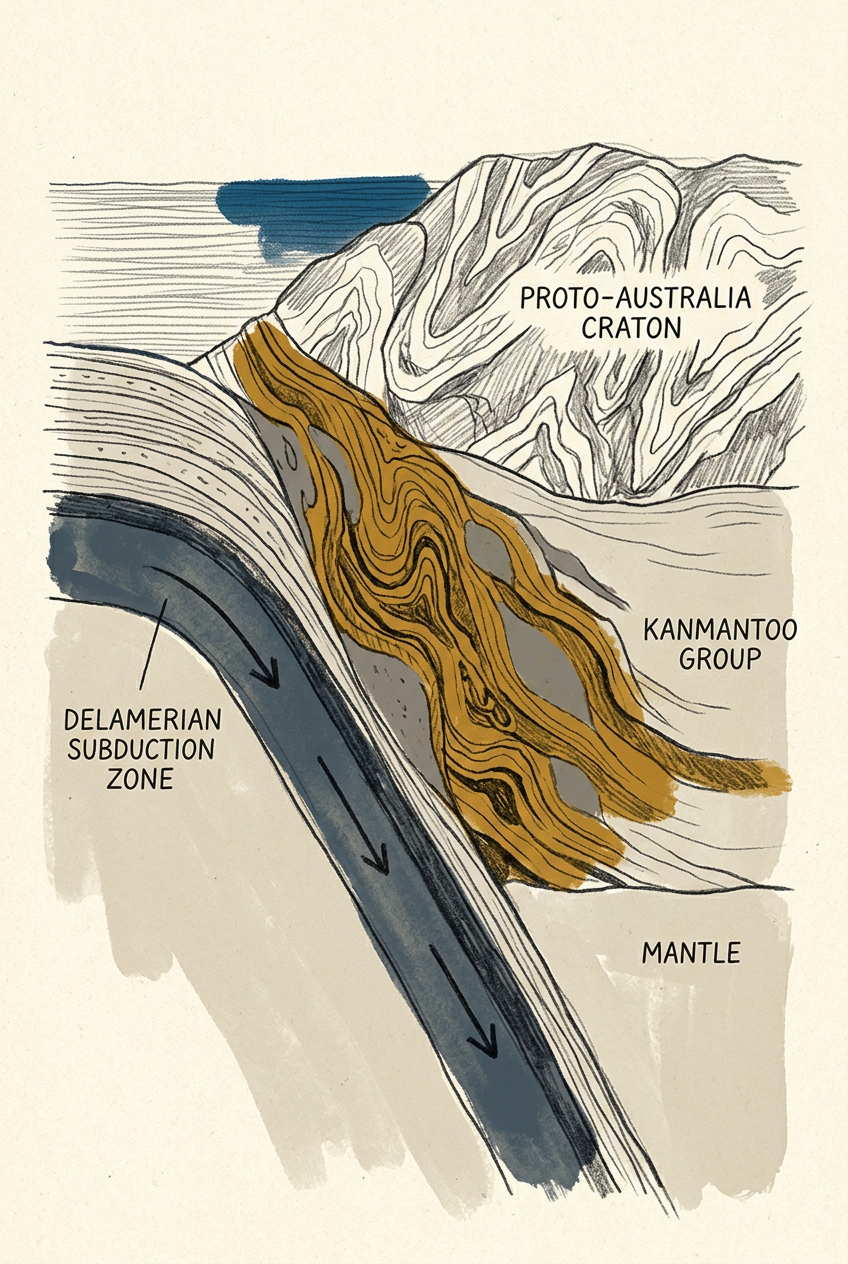
Off the coast of South Australia, a 520-million-year-old subduction zone sits frozen in mid-collision. The Kanmantoo Trench never finished its work. It choked on its own sediment, jammed, and welded two halves of a continent together—a tectonic suture that still runs through the Adelaide Hills and beneath the waters of the Southern Ocean.
The Trench That Could Not Finish
In the Cambrian period, around 520 million years ago, the eastern edge of the ancient continent of Gondwana looked nothing like it does today. A deep ocean trench ran roughly parallel to what is now the South Australian coastline. The oceanic plate to the east was sliding beneath the continental plate to the west, dragging seafloor sediments down into the mantle.
But those sediments were thick—unusually thick. Sandstones, mudstones, and volcanic debris had accumulated in deep submarine fans, perhaps deposited by rivers draining the interior of a newly assembled continent. As the subduction zone pulled them downward, they did not melt cleanly. They crumpled, heated, and recrystallised into a dense belt of metamorphic rock.
The subduction zone stalled. The descending slab broke off. The trench became a suture.
The Rocks That Record a Collision
What remains is the Kanmantoo Fold Belt, a north-south swath of metamorphic rocks that runs through the Mount Lofty Ranges and Kangaroo Island. The rocks tell the story of the jam in their very fabric. Sediments that once lay flat on the seafloor were folded into tight chevrons, their original layering stretched and compressed beyond recognition.
The heat of burial transformed sandstone into quartzite, shale into schist, and—where temperatures climbed highest—both into gneiss. Garnets grew in the dark mica schists, some as large as fingernails. Andalusite crystals, which form only under moderate pressure and high temperature, appear in rocks that never descended deep enough to melt completely.
These minerals are signatures of a stalled subduction. The trench did not pull the sediments down into the mantle. It cooked them in place, then squeezed them back up.
A Continent Stitched Together
Before the Kanmantoo collision, the crust that would become Australia existed as separate pieces—the ancient cratons of the west and the younger accreted terrains of the east. The suture zone closed the gap. It was one of several such collisions that assembled the eastern third of the continent during the Delamerian Orogeny, a mountain-building event that lasted roughly 50 million years.
The Kanmantoo Trench is not a scar. It is a weld—a place where two separate things became one, then forgot they were ever apart.
Today, the suture is largely invisible to the untrained eye. The mountains it raised have eroded to hills. The trench itself lies buried beneath the continental shelf. But the rocks of the Adelaide Hills and the southern Flinders Ranges still carry the distinctive chemical signature of the collision: high-pressure minerals, unusual trace elements, and a fabric of deformation that points to a single, specific direction of compression.
Why It Matters
The Kanmantoo Trench is a reminder that plate tectonics does not always proceed smoothly. Subduction zones jam. Slabs break. Continents assemble through accidents as much as through design. The rocks that record these accidents are some of the most informative we have—they preserve conditions that ordinary subduction, where the slab descends cleanly, obliterates.
In the Kanmantoo Fold Belt, you can walk through a mountain belt that never quite was. The roots of a range that might have rivaled the Himalayas sit exposed in roadside cuttings and coastal cliffs, their garnets glittering in the afternoon sun. The trench that built them failed. But that failure is what made the continent whole.
More like this
- The 5,000-Year-Old Volcanoes That Still Smoke in the SouthIn Victoria's Newer Volcanics Province, 400 volcanic vents erupted as recently as 5,000 years ago—the youngest volcanic field in mainland Australia, where craters still hold blue lakes and scoria cone
- The 1.85-Billion-Year-Old Caldera That Still Feeds the FurnaceIn South Australia's Middleback Ranges, a 1.85-billion-year-old volcanic caldera collapsed and later became one of the world's richest iron ore deposits.
- The 825-Million-Year-Old Rift That Failed But Built a WorldA failed 825-million-year-old rift left a 650-kilometre volcanic chain and sedimentary basin in South Australia that preserved the Ediacaran fossils and still shapes the landscape today.