25 June 2026 · 3 min read
The 510-Million-Year-Old Mud That Swallowed a Trilobite
How 510-million-year-old mudstone in South Australia's Flinders Ranges preserved the first complete Cambrian trilobites in the southern hemisphere, frozen mid-molt in a sudden underwater mudslide.
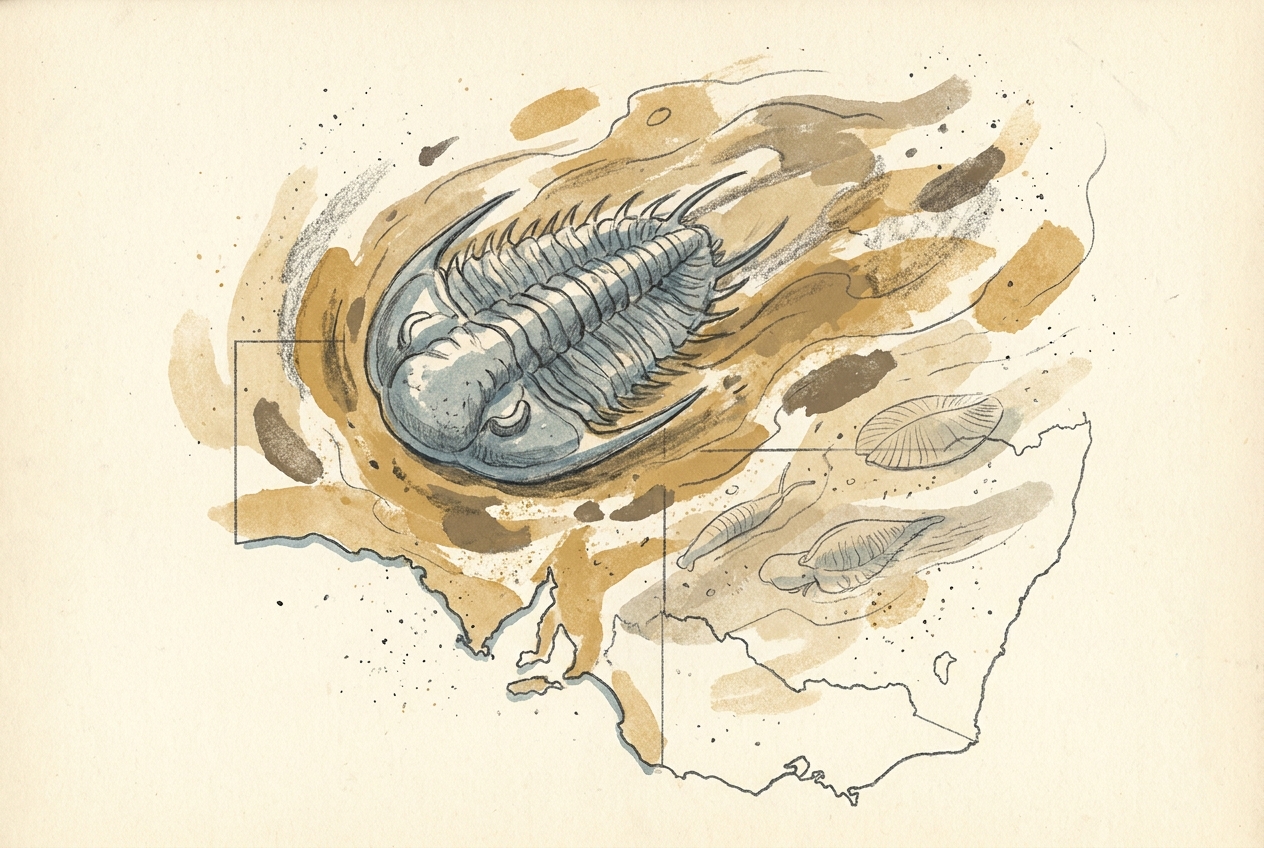
In the Emu Bay Shale of South Australia's Kangaroo Island, a trilobite called Redlichia takooensis was shedding its shell when the mud came. The mud buried it mid-molt, preserving the old exoskeleton still curled around the new one—a moment of vulnerability frozen for 510 million years.
These are not the first trilobites discovered, nor the oldest. But the Emu Bay Shale is the only Cambrian deposit in the southern hemisphere that preserves soft tissue—guts, gills, antennae, even the delicate feeding appendages that usually decay before sediment can seal them. The site is one of the world's great Lagerstätten, a German word paleontologists use for a mother lode of exceptional fossils.
The Mudslide That Preserved a Moment
The Emu Bay Shale formed on the margin of a shallow Cambrian sea, roughly 510 million years ago. The continent that would become Australia sat closer to the equator then, its coastline fringed by carbonate platforms and muddy basins.
A sudden underwater mudslide—a turbidity current—swept across the seafloor, burying everything in its path. Unlike slow sedimentation, which gives scavengers and decay time to destroy soft tissues, rapid burial in fine mud sealed the animals in an oxygen-starved tomb. The result is a fossil record that captures not just the hard shells of trilobites but the soft anatomy of creatures rarely seen anywhere else.
The mud did not simply kill them. It photographed them.
The Giant and the Guts
The most famous fossil from the Emu Bay Shale is Redlichia rex, a trilobite that grew to 30 centimeters—a giant among its Cambrian relatives. Its size suggests it was a predator, and the site has preserved the proof: gut contents containing fragments of smaller trilobites, direct evidence of who ate whom in the Cambrian sea.
But the shale's real treasure is the soft-tissue preservation. Anomalocaris, the apex predator of the Cambrian, is known elsewhere only from isolated body parts—a mouth here, a grasping appendage there. The Emu Bay Shale has yielded entire specimens, including the rare preservation of the animal's digestive glands. Another fossil, Oestokerkus, preserves the complete nervous system, a ghostly carbon film where the nerve cord once ran.
No other Cambrian site in the southern hemisphere preserves soft tissue this way. The Burgess Shale in Canada and Chengjiang in China hold the northern hemisphere record, but Emu Bay is the sole window into what lived in the southern Cambrian seas.
A Window That Almost Stayed Shut
The Emu Bay Shale was known to fossil collectors for decades before its significance was understood. The site outcrops along the northern coast of Kangaroo Island, a rugged stretch of cliffs and wave-cut platforms where the shale is exposed only at low tide. Early collectors pried out trilobite shells but missed the soft tissue entirely—it is invisible to the naked eye, revealed only under microscopy or when the rock is split along the right plane.
In the 1980s, paleontologists from the University of Adelaide began systematic collecting, splitting thousands of slabs of shale. They found the soft tissues preserved as thin carbon films or as mineral replacements in iron oxide. The work continues today: each new slab is a gamble, a 510-million-year-old lottery ticket.
What the Mud Still Holds
The Emu Bay Shale is not a single layer but a series of mudstone beds, each representing a separate turbidity event. Some beds are rich in fossils, others barren. No one knows how many more animals lie buried in the unexcavated sections of the cliff.
What is certain is that the deposit captures a brief interval of Cambrian time—perhaps only a few thousand years—in extraordinary detail. The trilobite caught mid-molt, the predator with its last meal still in its gut, the animal whose nerve cord was traced across half a billion years: all were preserved because mud slid downhill at the wrong moment.
Kangaroo Island's cliffs are still eroding, still yielding their dead. Each winter storm splits another slab, and sometimes, inside it, a creature that has not been seen since the Cambrian sea.
More like this
- The 560-Million-Year-Old Garden That Never Saw a PredatorIn South Australia's Flinders Ranges, 560-million-year-old Ediacara surfaces preserve entire seafloor communities of fronds, discs, and quilts — a garden of soft-bodied life that flourished before pre
- The 300-Million-Year-Old Forest That Died Standing UpIn New South Wales, a 300-million-year-old fossil forest preserves dozens of trees buried upright by a Permian volcanic eruption—an entire ecosystem frozen in ash.
- The 1.75-Billion-Year-Old Reef That Outranks the BarrierA 1.75-billion-year-old microbial reef in the Kimberley is the largest biological structure ever built by a single species, preserving a world without predators.