25 June 2026 · 3 min read
The 1.2-Billion-Year-Old Magma That Split a Supercontinent
How 1.2-billion-year-old volcanic dykes across Western Australia's Gascoyne region record the failed breakup of the supercontinent Rodinia, leaving a 1,000-kilometre scar of ancient magma.
Near Carnarvon, Western Australia, the dirt roads cut across lines of black rock that run straight for hundreds of kilometres—walls of ancient magma frozen in place, too hard to farm, too stubborn to blast. These are the Mundine Well dykes, and they record the moment a supercontinent tried to tear itself apart.
The Fracture That Failed
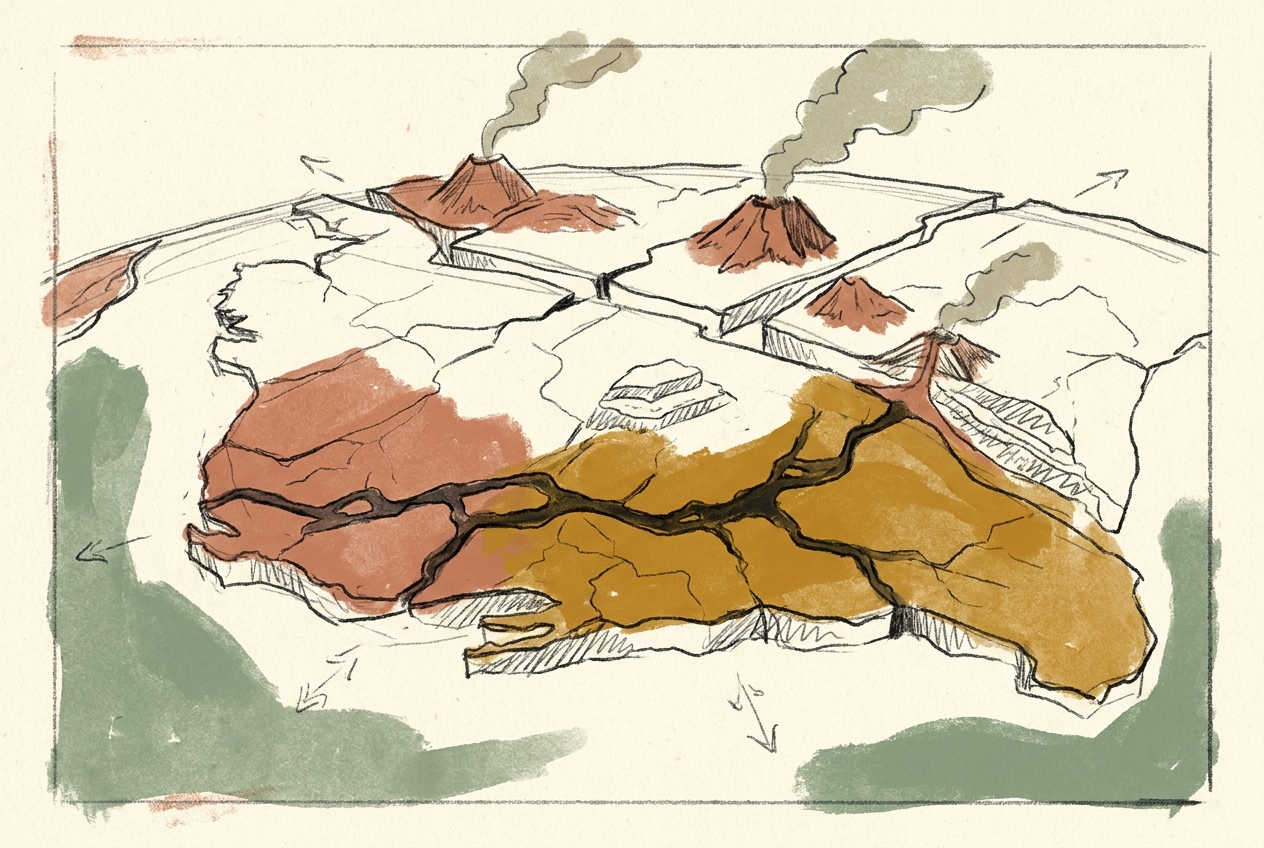
About 1.2 billion years ago, the supercontinent Rodinia was under stress. A plume of hot mantle rose beneath what is now Western Australia, stretching the crust until it cracked. Magma surged upward through the fractures, filling them like blood in a wound.
But the continent did not split. The rift failed, and the magma cooled in place, forming vertical sheets of dolerite—a dark, fine-grained igneous rock—that now stand as some of the longest continuous geological features on Earth. The Mundine Well dyke swarm stretches from the coast near Shark Bay deep into the Gascoyne region, a fan of black stone radiating from a failed centre.
A Thousand Kilometres of Black Rock
Individual dykes in the swarm can be traced for 400 kilometres or more. They range from a few metres to over 100 metres wide. From the air, they appear as dark stripes across the red landscape, cutting across older rock formations with knife-edge precision.
The Mundine Well dykes are among the longest igneous features on the planet—a thousand kilometres of failed continent.
Their orientation points back to a single source: the Warakurna large igneous province, a massive outpouring of volcanic rock that covered much of central and western Australia around the same time. The dykes fed that volcanism, channeling magma from deep below to the surface.
What the Dykes Reveal
Geologists have dated the dykes precisely. Zircon crystals in the dolerite give an age of 1,068 million years—give or take a few million. That date pins the failed rift to a specific moment in Rodinia's history, when the supercontinent was still intact but already showing stress fractures.
By mapping the dykes' orientation and composition, scientists can reconstruct the direction of ancient crustal extension. The Mundine Well swarm points north-northeast, indicating that the continent was being pulled apart in that direction. The fact that the rift failed tells us something about Rodinia's strength: the continent was too thick, or the extension too slow, for a full breakup.
The Landscape They Left Behind
Today, the dykes shape the land in subtle ways. Because dolerite resists erosion better than the surrounding granite and gneiss, the dykes form low ridges that run arrow-straight across the plains. Water pools along their edges, creating lines of greener vegetation that trace the ancient fractures.
In the Gascoyne region, farmers use the dykes as natural fences. The rock walls are too dense for roots to penetrate, so crop lines stop abruptly at their edges. From a satellite, the dykes appear as dark scratches on the red earth—a map of a breakup that never happened.
The Larger Story
Failed rifts like this one are common in the geological record. The North Sea, the East African Rift, and the Basin and Range Province all began as failed rifts. But the Mundine Well dykes are exceptional in their length, their age, and their preservation. They offer a rare window into the mechanics of supercontinent breakup.
Rodinia eventually did break apart, around 750 million years ago, setting the stage for the formation of Gondwana and, later, the modern continents. But the Mundine Well dykes record an earlier, failed attempt—a moment when the crust stretched, cracked, and then healed.
A Quiet Monument
There is no visitor centre at Mundine Well. No walking trails, no interpretive signs. The dykes sit in the remote rangelands of Western Australia, crossed by the occasional gravel road. But they are one of the most eloquent geological features on the continent: a thousand-kilometre line of ancient magma that tells the story of a supercontinent that held together, just barely, for another 300 million years.
More like this
- The 110-Million-Year-Old River That Runs Backwards UndergroundWestern Australia's 110-million-year-old dune system has been slowly dissolving into a labyrinth of caves where an ancient river still flows, carrying the taste of a Cretaceous desert.
- The 5,000-Year-Old Volcanoes That Still Smoke in the SouthIn Victoria's Newer Volcanics Province, 400 volcanic vents erupted as recently as 5,000 years ago—the youngest volcanic field in mainland Australia, where craters still hold blue lakes and scoria cone
- The 300-Million-Year-Old Forest That Died Standing UpIn New South Wales, a 300-million-year-old fossil forest preserves dozens of trees buried upright by a Permian volcanic eruption—an entire ecosystem frozen in ash.