7 July 2026 · 3 min read
The 505-Million-Year-Old Eyes That Still See
A 505-million-year-old Cambrian predator preserved in South Australia's Emu Bay Shale still bears the world's oldest compound eyes, each with over 16,000 calcite lenses.
A 505-million-year-old seafloor sits preserved in a South Australian quarry—not as rock, but as a single moment of Cambrian catastrophe, frozen in pyrite. At Emu Bay on Kangaroo Island, a slab of fine-grained mudstone holds the oldest known eyes in the fossil record, still gleaming with their original lenses.
The Quarry That Preserved a Catastrophe
Emu Bay Shale is a Lagerstätte—a deposit of exceptional preservation—formed when a series of underwater mudslides buried entire Cambrian communities alive. The sediment was so fine and so rapidly deposited that it captured soft tissues rarely seen in the fossil record: guts, gills, nerve cords, and corneas.
Unlike the Burgess Shale in Canada, which is 508 million years old, Emu Bay's fossils are slightly older and were deposited in a different setting. The seafloor was shallow, oxygen-poor, and periodically smothered by clouds of sediment that killed everything in an instant. The result is a collection of animals preserved with their three-dimensional structure intact—including the world's oldest compound eyes.
The Eye That Saw the Cambrian World
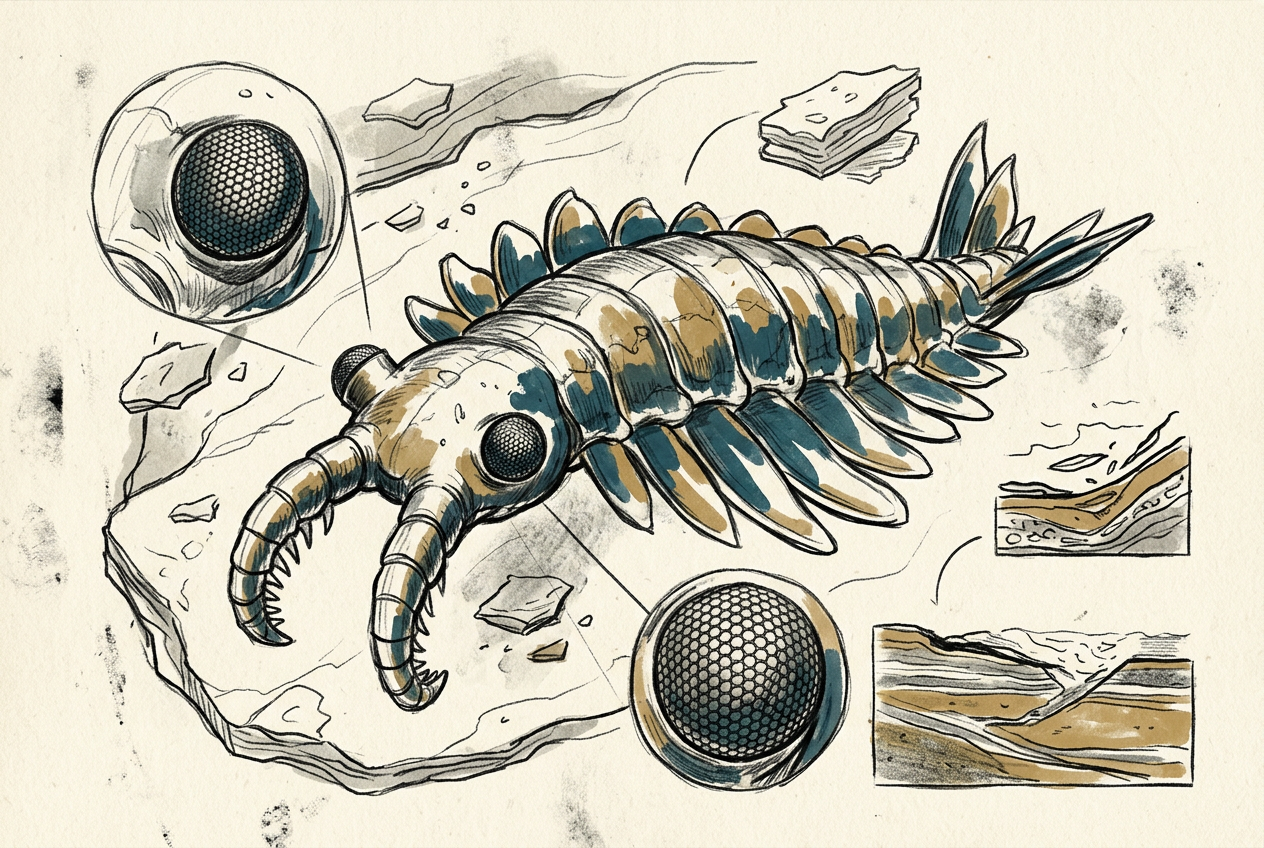
In 2012, paleontologists split open a slab of Emu Bay Shale and found the fossil of Anomalocaris, a meter-long apex predator that was the shark of its time. But the animal itself was not the prize. Preserved on its head were two stalked compound eyes, each containing over 16,000 individual lenses—hexagonal units packed into a curved surface that gave Anomalocaris panoramic, high-resolution vision.
The lenses were originally made of calcite, a mineral that resists compression during burial. While the soft tissue of the eye rotted away, the calcite lenses remained, each one a tiny optical crystal oriented to focus light precisely on the retina. In some specimens, the individual lens facets are still visible to the naked eye, 505 million years later.
The oldest known eyes in the fossil record were not simple light-sensitive pits but sophisticated optical instruments—capable of detecting motion, contrast, and depth in a world that had never been seen before.
A Brief Window of Sight
The Emu Bay Shale captures a key evolutionary moment: the Cambrian "arms race" between predators and prey. Before this period, most animals were blind filter-feeders or grazers. The appearance of compound eyes—and the sharp vision they conferred—triggered a cascade of adaptations: shells for protection, burrowing for escape, and swimming for flight.
Anomalocaris was not the only animal at Emu Bay with sophisticated vision. The trilobites found there also have compound eyes, though with far fewer lenses. But the predator's eye was extraordinary for its time—and remains so today. No other Cambrian fossil has preserved lenses of this size and clarity.
What the Eyes Tell Us
The Emu Bay Shale is now considered one of the most important Cambrian fossil deposits in the world, alongside Chengjiang in China and the Burgess Shale in Canada. But it is unique in its preservation of calcite eyes—a feature that has allowed scientists to reconstruct not just the anatomy of Anomalocaris but its behavior.
By analyzing the curvature and spacing of the lenses, researchers have calculated that Anomalocaris lived in well-lit, shallow waters and could detect objects less than a centimeter across at a distance of several meters. It was an active hunter, not a passive filter-feeder—a revelation that changed our understanding of Cambrian ecology.
In a few dozen slabs of mudstone from a South Australian quarry, the first animal eyes on Earth still hold their gaze.
More like this
- The 560-Million-Year-Old Garden That Never Saw a PredatorIn South Australia's Flinders Ranges, 560-million-year-old Ediacara surfaces preserve entire seafloor communities of fronds, discs, and quilts — a garden of soft-bodied life that flourished before pre
- The 300-Million-Year-Old Forest That Died Standing UpIn New South Wales, a 300-million-year-old fossil forest preserves dozens of trees buried upright by a Permian volcanic eruption—an entire ecosystem frozen in ash.
- The 1.75-Billion-Year-Old Reef That Outranks the BarrierA 1.75-billion-year-old microbial reef in the Kimberley is the largest biological structure ever built by a single species, preserving a world without predators.