7 July 2026 · 4 min read
The 100-Million-Year-Old Sea That Turned Bones to Opal
How 100-million-year-old marine reptile and dinosaur bones in the Cretaceous sediments of Lightning Ridge were transformed into precious opal, preserving ancient life in gemstone.
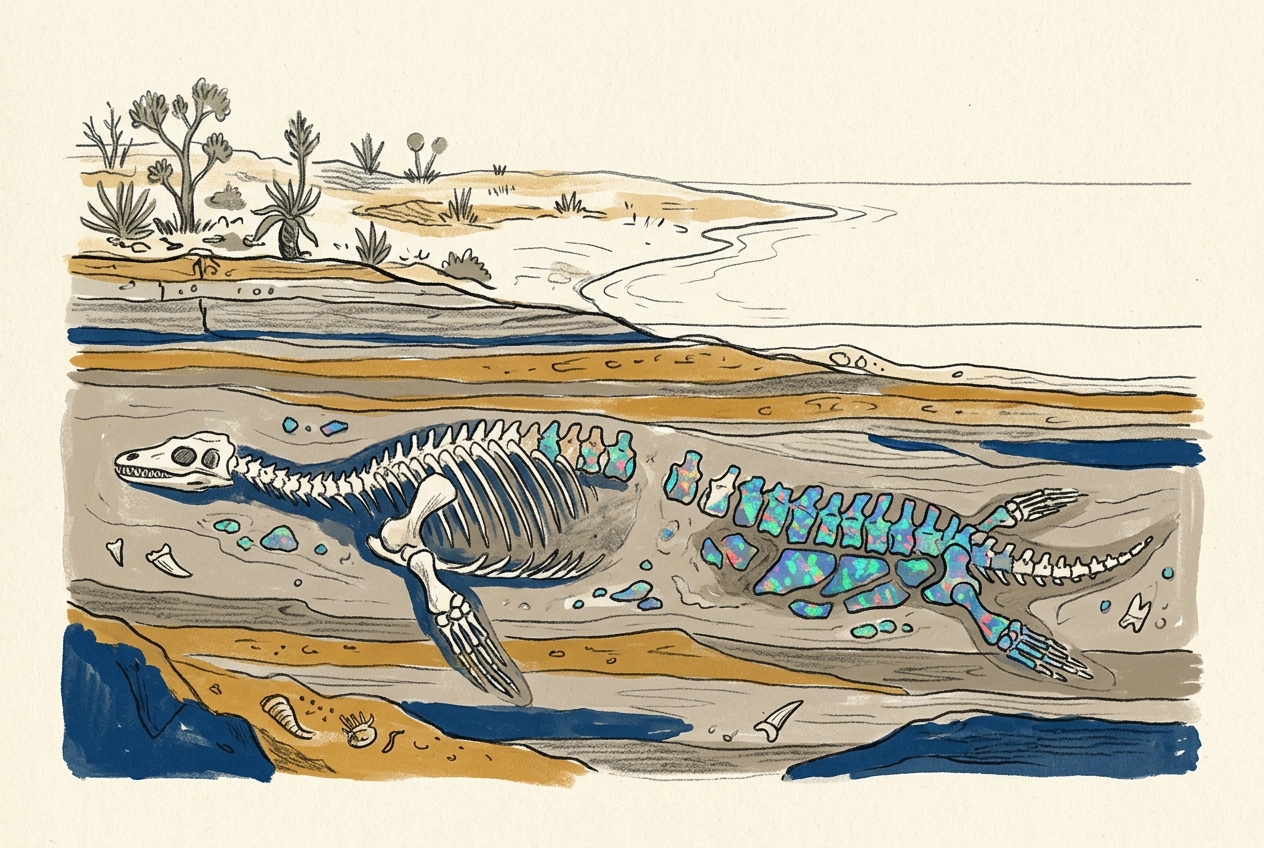
A 100-million-year-old plesiosaur jaw sits in a museum drawer in New South Wales. It weighs nothing special. But turn it under light, and the bone flashes green, blue, and orange — because the bone itself has become opal. Every fragment of the creature's skeleton was replaced, molecule by molecule, by silica-rich groundwater. The animal is gone. Its shape remains, carved in gemstone.
The Sea That Covered a Continent
During the Early Cretaceous, between 120 and 100 million years ago, much of eastern Australia lay under a shallow inland sea. This was not the open ocean. It was a broad, warm epicontinental seaway that stretched from what is now the Gulf of Carpentaria down to the southern coast. Sediment from the eroding highlands to the east washed into this sea, depositing sand, silt, and clay in thick layers.
The Lightning Ridge region, in northern New South Wales, was near the western shore of this sea. Rivers carried freshwater and fine sediment into the brackish waters. In these coastal deltas and estuaries, a rich ecosystem flourished. Fish, turtles, crocodiles, and giant marine reptiles — plesiosaurs, ichthyosaurs, and the long-snouted Platypterygius — swam in the warm shallows. On land, small dinosaurs and early mammals lived among the conifers and cycads.
When these animals died, their remains settled into the sandy mud at the bottom of the sea. Layer by layer, the sediment buried them.
The Slow Alchemy of Groundwater
Burial alone does not create opal. The process requires a precise sequence of geological events. First, the sediments had to be compacted into rock — a fine-grained sandstone and claystone known as the Wallangulla Sandstone. Then, millions of years later, the region had to be uplifted and exposed to weathering.
Rainwater, slightly acidic from dissolved carbon dioxide, seeped down through the sandstone. It dissolved silica from the quartz grains and clay minerals. This silica-rich water moved through cracks and cavities in the rock, including the spaces once occupied by bone and shell.
As the water evaporated or changed chemistry, the silica precipitated out — not as quartz crystals, but as a disordered, hydrated form of silica: opal. The process was extraordinarily slow and gentle. It preserved the finest details of the original bone, down to the cellular structure. Where a bone had been, there was now a void; where there was a void, opal grew.
The creature's skeleton became a mould, and the mould became a gem.
The Black Opal Horizon
Lightning Ridge is famous for black opal — a dark body tone that makes the internal colours blaze against a deep background. The darkness comes from trace amounts of carbon and iron oxide trapped within the silica spheres during formation. These microscopic spheres, arranged in a regular lattice, diffract light into the spectral colours that make opal valued above most other gems.
The opal-bearing layer at Lightning Ridge is a thin horizon, rarely more than a metre thick, that sits about 15 to 20 metres below the surface. Miners follow this seam in narrow underground shafts, often working alone by lamplight. The rock is soft, crumbly claystone that can collapse without warning. In a century of mining, only a handful of opalized fossils have been recovered — a tooth here, a vertebra there, an entire jaw once in a generation.
The most famous specimen is Eric the Pliosaur, a near-complete opalized skeleton of a 100-million-year-old pliosaur discovered in 1987. Every bone, from the tip of its snout to the end of its tail, had turned to opal. The skeleton weighed nearly 60 kilograms. It is the most complete opalized vertebrate fossil in the world.
A Fossil That Is Also a Gem
Opalized fossils occupy a strange category. They are simultaneously mineral specimens and palaeontological remains. A museum might value them for the scientific information they carry — the shape of a tooth, the articulation of a joint. A gem dealer might value them for the play of colour across a polished surface. The two values are not always compatible.
In practice, many opalized fossils have been cut and polished into gemstones before their scientific significance was recognised. Miners in the early twentieth century, finding a bright piece of opal, had no reason to suspect the bone-shaped lump in their hand was a 100-million-year-old reptile. They cut it into cabochons and sold it. The fossil was lost; the gem remained.
Today, the Lightning Ridge opal fields are protected by the Australian Museum and the state government. Miners are required to report any fossil discoveries. But the seam is narrow, the tunnels are dark, and the opal is worth more than the science. Every year, more of that ancient sea is pulled to the surface, cut, polished, and set into rings. The plesiosaurs and ichthyosaurs that once swam in Cretaceous sunlight now glow under gallery lights — their bones transformed, but still present, in every flash of colour.
More like this
- The 560-Million-Year-Old Garden That Never Saw a PredatorIn South Australia's Flinders Ranges, 560-million-year-old Ediacara surfaces preserve entire seafloor communities of fronds, discs, and quilts — a garden of soft-bodied life that flourished before pre
- The 300-Million-Year-Old Forest That Died Standing UpIn New South Wales, a 300-million-year-old fossil forest preserves dozens of trees buried upright by a Permian volcanic eruption—an entire ecosystem frozen in ash.
- The 1.75-Billion-Year-Old Reef That Outranks the BarrierA 1.75-billion-year-old microbial reef in the Kimberley is the largest biological structure ever built by a single species, preserving a world without predators.