6 July 2026 · 3 min read
The 50,000-Year-Old Pit That Swallowed the Megafauna
Beneath the Nullarbor Plain, limestone caves preserve complete skeletons of Australia's extinct megafauna—marsupial lions, three-tonne wombats, and giant kangaroos—trapped when they fell through the s
Deep beneath the Nullarbor Plain, in a labyrinth of limestone caves, lies the continent's richest fossil cache—hundreds of thousands of bones from animals that vanished 50,000 years ago, preserved in a darkness that never lifts.
The Limestone Trap
The Nullarbor is the world's largest karst landscape: a 200,000-square-kilometre slab of limestone laid down as seafloor during the Miocene, 15 million years ago. When the sea withdrew, rainwater—slightly acidic from atmospheric carbon dioxide—began dissolving the rock. Over millions of years, it carved a network of underground chambers, shafts, and passages that now stretch for hundreds of kilometres beneath the featureless plain.
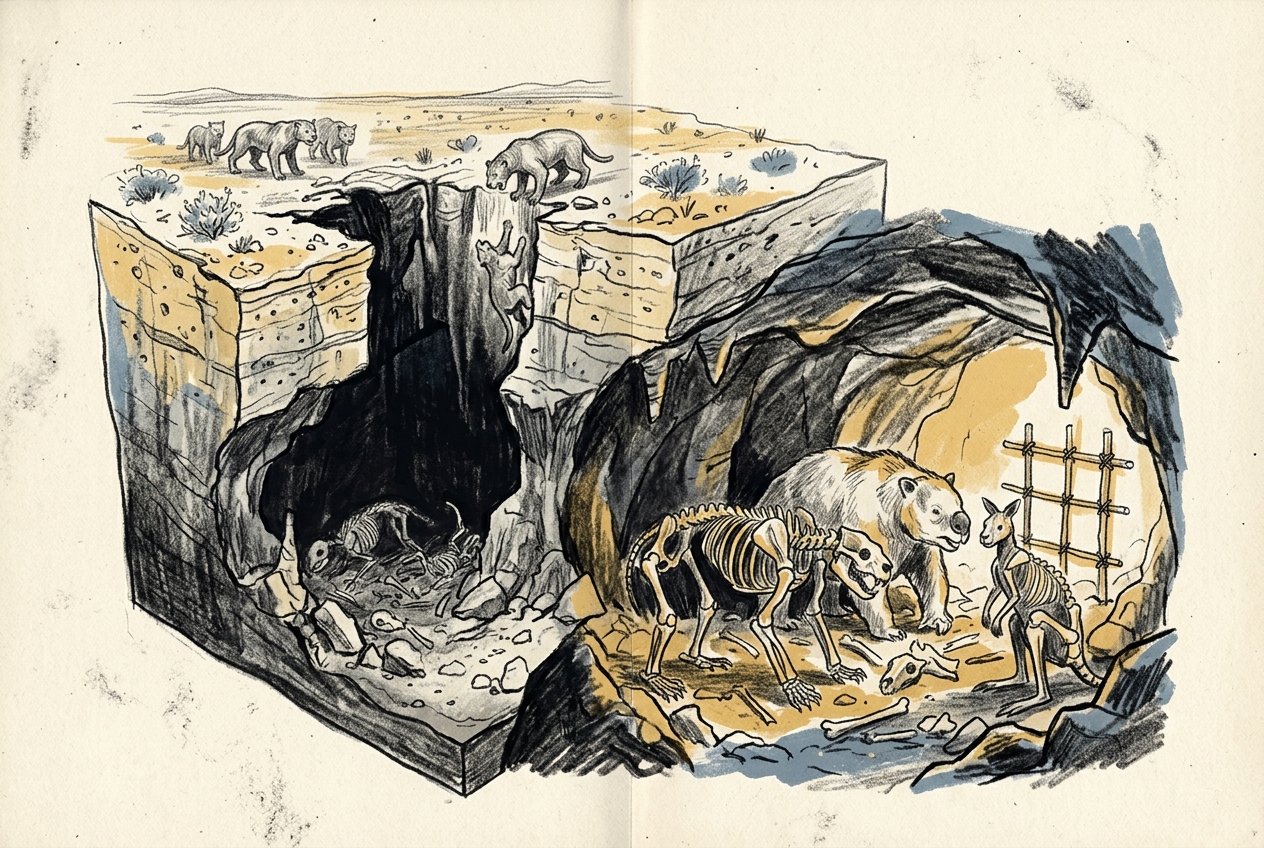
These caves became natural traps. Animals wandering across the scrubby surface would step onto thin limestone roofs, collapse into the darkness below, and die. The caves' constant temperature and humidity preserved their bones with extraordinary fidelity. No scavengers, no sunlight, no freeze-thaw cycles. Just slow calcification.
"The Nullarbor caves are time capsules. They don't just hold bones—they hold complete ecosystems, frozen at the moment of collapse."
The Megafauna Menagerie
The caves have yielded remains of creatures that defy modern imagination. The marsupial lion Thylacoleo carnifex, a pouched predator with blade-like premolars and opposable thumbs, fell into these pits and left complete skeletons behind. Diprotodon optatum, the largest marsupial that ever lived—a wombat the size of a rhinoceros, weighing three tonnes—lies in the same chambers. Giant short-faced kangaroos that could not hop, only stride; a flightless bird twice the size of an emu; a python that reached six metres in length.
What makes the Nullarbor fossils exceptional is not just their number but their completeness. At sites like Thylacoleo Cave and the Murrawijinie Caves, researchers have found articulated skeletons—bones still connected as they were in life—buried under layers of windblown sediment and fallen limestone. These are not scattered fragments washed together by rivers. They are animals that died where they landed, their bodies undisturbed for tens of millennia.
A Vanished World
The megafauna disappeared around 50,000 years ago—roughly the same time humans arrived on the continent. Some researchers point to climate change, as the Nullarbor shifted from woodland to arid scrub. Others see a pattern of human hunting pressure. The caves cannot settle the debate, but they provide the evidence: radiocarbon and uranium-series dating of bones, teeth, and sediment layers gives a precise chronology of extinction.
One mystery persists. Why did so many animals fall into these caves? The concentration of remains is far higher than random chance would predict. Some geologists suspect the caves acted as water sources during droughts—animals gathered around sinkholes, and the weakest or most desperate fell through. Others note that many of the bones belong to juveniles and old individuals, suggesting the caves culled the vulnerable.
The Bones Beneath the Plain
Today, the Nullarbor's caves remain largely unexplored. New chambers are discovered every year, often by cavers lowering themselves into black shafts that have not seen light since the Pleistocene. Each descent is a descent into the continent's deep past—a past written not in rock, but in bone.
The limestone itself is indifferent. It continues to dissolve, slowly reshaping the labyrinth. But the bones it holds are finite. Each collapse, each chamber, each skeleton is a single frame from a film that played out for 50,000 years and then stopped. We are still counting the frames.
More like this
- The 110-Million-Year-Old River That Runs Backwards UndergroundWestern Australia's 110-million-year-old dune system has been slowly dissolving into a labyrinth of caves where an ancient river still flows, carrying the taste of a Cretaceous desert.
- The 5,000-Year-Old Volcanoes That Still Smoke in the SouthIn Victoria's Newer Volcanics Province, 400 volcanic vents erupted as recently as 5,000 years ago—the youngest volcanic field in mainland Australia, where craters still hold blue lakes and scoria cone
- The 560-Million-Year-Old Garden That Never Saw a PredatorIn South Australia's Flinders Ranges, 560-million-year-old Ediacara surfaces preserve entire seafloor communities of fronds, discs, and quilts — a garden of soft-bodied life that flourished before pre