6 July 2026 · 3 min read
The 1.6-Billion-Year-Old Snot That Built a Mountain
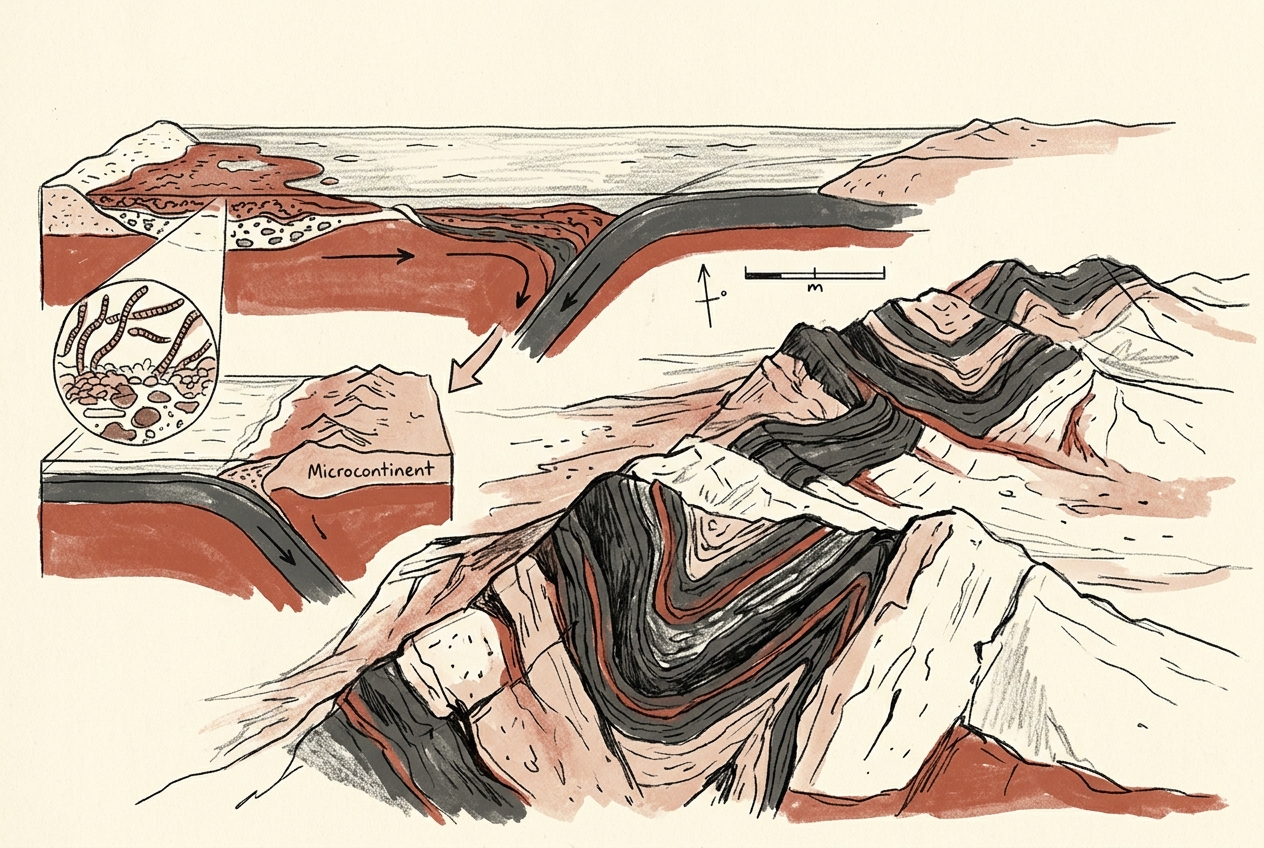
In central Australia's Strangways Range, 1.6-billion-year-old microbial mats—built by bacteria in a stagnant sea—were buried, heated, and folded into a mountain belt that still carries their chemical
The 1.6-Billion-Year-Old Snot That Built a Mountain
In the Strangways Range of central Australia, a 1.6-billion-year-old pile of microbial slime lies buried a kilometre deep—compressed, heated, and folded into a mountain belt that should not exist.
A Seafloor That Never Stopped Farming
The McArthur Basin, sprawling across the border of the Northern Territory and Queensland, was once a shallow, stagnant sea. No fish swam in it. No shells littered its floor. What lived there instead were vast microbial mats—layered communities of bacteria and archaea that oozed sticky mucus and trapped sediment like flypaper.
These mats grew in water so salty and sulfidic that most organisms would have died. But the microbes thrived. They built structures called microbialites: dome-shaped mounds, wrinkled sheets, and columnar pillars that grew millimetre by millimetre over tens of thousands of years. Unlike stromatolites, which are built by cyanobacteria and trap carbonate grains, these mats were constructed by sulfate-reducing bacteria that precipitated dolomite directly from seawater.
The result was a seafloor paved in biological concrete.
The Crunch That Made a Mountain
Around 1.6 billion years ago, the North Australian Craton began to collide with another block of crust. The shallow sea was squeezed shut. The microbialite pavement—still soft, still waterlogged—was shoved downward into the Earth's hot interior.
Most sedimentary rocks, when buried and heated, simply recrystallise into bland metamorphic rock. But the microbialites were different. Their organic content—the remains of billions of dead microbes—acted as a lubricant. The rock deformed plastically, folding into tight, crumpled shapes like a bedsheet wadded by a giant hand. The Strangways Range today is a chaos of recumbent folds, overturned strata, and thrust slices stacked ten kilometres thick.
Geologists call this the Strangways Orogeny. It happened in the Mesoproterozoic, a billion years before the first animal evolved.
A Rock That Remembers Its Biology
What makes the Strangways Range unusual is not just its age. It is that the rock itself still carries the chemical signature of the microbes that built it.
The mountains of central Australia were built by bacteria—and the bacteria are still there, written into the isotopes of the stone.
Carbon isotopes in the dolomite show a strong biological fractionation: the ratio of carbon-12 to carbon-13 is skewed exactly as it would be if organic matter had been incorporated into the rock. Sulfur isotopes tell a similar story, recording the activity of sulfate-reducing bacteria in the ancient seafloor. Even the trace elements—molybdenum, uranium, vanadium—match the pattern of a microbial mat ecosystem, not a normal marine sediment.
The rock is, in effect, a fossil of an ecosystem.
The Quiet Revolution
The Strangways Range is not famous. It has no gold, no diamonds, no uranium. It is a dry, red, sparsely vegetated belt of hills that most Australians will never visit. But it holds a quiet lesson: that biology can shape geology on a scale we rarely acknowledge.
For most of Earth's history, the only architects were microbes. They built reefs, they built seafloors, and when tectonic forces crushed those seafloors into mountains, the mountains remembered. The Strangways Range is a monument not to erosion or volcanism, but to the slow, relentless work of slime.
And that slime, buried and cooked and squeezed for 1.6 billion years, still holds the shape of the world it built.
More like this
- The 560-Million-Year-Old Garden That Never Saw a PredatorIn South Australia's Flinders Ranges, 560-million-year-old Ediacara surfaces preserve entire seafloor communities of fronds, discs, and quilts — a garden of soft-bodied life that flourished before pre
- The 300-Million-Year-Old Forest That Died Standing UpIn New South Wales, a 300-million-year-old fossil forest preserves dozens of trees buried upright by a Permian volcanic eruption—an entire ecosystem frozen in ash.
- The 1.75-Billion-Year-Old Reef That Outranks the BarrierA 1.75-billion-year-old microbial reef in the Kimberley is the largest biological structure ever built by a single species, preserving a world without predators.