6 July 2026 · 3 min read
The 5,000-Year-Old Crater That Turns Blue Every Summer
Mount Gambier is a 5,000-year-old maar volcano in South Australia whose crater lake turns brilliant cobalt each summer—a reminder that Australia's geology is still active.
Some mountains grow upward. This one grew downward.
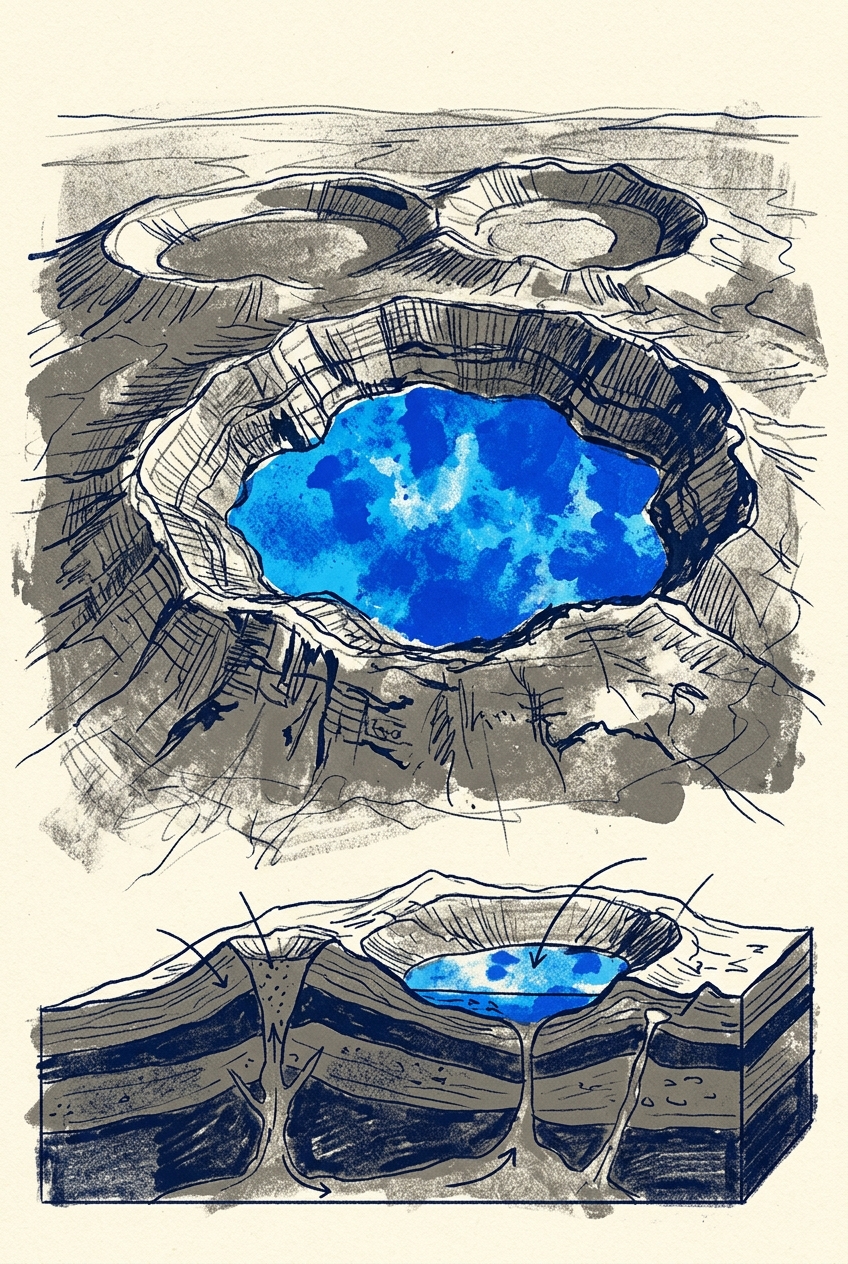
Mount Gambier in South Australia is not a peak but a crater—a deep, water-filled wound in the limestone, ringed by volcanic ash and scoria. It is one of the youngest volcanoes on the Australian continent, and it holds a secret beneath its still, blue surface.
The Eruption That Dug a Hole
Around 5,000 years ago, a series of violent explosions tore through the limestone plain of what is now the city of Mount Gambier. Magma rising from the mantle met groundwater, flashed instantly to steam, and blasted the rock apart. The eruptions did not build a cone so much as excavate a crater.
This is the signature of a maar volcano. Unlike the graceful slopes of Mount Fuji or the shield of Mauna Loa, a maar forms when magma encounters water. The result is a shallow, bowl-shaped depression. Mount Gambier's crater lake—called Blue Lake—fills that depression to a depth of 72 metres.
Three other craters lie nearby: Leg of Mutton Lake, Brownes Lake, and the Valley Lake. Together they form the Mount Gambier volcanic complex, the youngest volcanic field in Australia. The first eye to see it may have been human; Aboriginal oral traditions describe the eruptions.
The Lake That Changes Colour
Blue Lake is famous for a trick it performs each year. From April to November, the water is a dull grey-blue. Then, each December, it turns a brilliant cobalt—so vivid that it can be seen from space.
The cause is not pollution or algae. Calcite crystals form in the warmer surface waters during summer, scattering sunlight in the blue wavelengths. In winter, the lake's water column mixes, the crystals dissolve, and the colour fades. The change is remarkably precise: it happens within a few days, every year, without fail.
Beneath the lake, the crater walls are lined with volcanic ash and scoria. Divers have explored only the upper 30 metres; the deeper water is anoxic and cold. At the bottom, the original eruption vent is still intact.
The youngest volcano in Australia is not a mountain. It is a hole in the ground, filled with water that turns blue every summer.
A Landscape Still Hot at Heart
Mount Gambier sits at the southern edge of the Newer Volcanics Province, a 15,000-square-kilometre field of more than 400 volcanic centres stretching from Melbourne to Mount Gambier. Activity began about 4.5 million years ago and continued until the most recent eruption—here—only 5,000 years ago.
Geologists debate whether the province is extinct or merely dormant. The mantle beneath it is still anomalously hot. Seismic studies show low-velocity zones that suggest partial melt. The continent is not finished building itself.
If another eruption occurs, it will likely be a maar again. The limestone plain is riddled with groundwater. The next steam explosion could happen anywhere in the region, without warning.
What the Crater Teaches
Mount Gambier is a reminder that Australia's geological story is not ancient history. The continent is moving north at about seven centimetres per year, colliding with Southeast Asia, stretching its eastern edge. The Newer Volcanics Province is one result of that restless motion.
The lake itself is a time capsule. Sediment cores from Blue Lake preserve 5,000 years of pollen, charcoal, and dust—a continuous record of climate and vegetation change since the eruption. The first humans to witness the event left no written record, but the lake keeps their story in layers of mud.
On a summer day, the water is so blue it hurts to look at. That colour, that clarity, is the gift of a volcano that never grew tall.
More like this
- The 110-Million-Year-Old River That Runs Backwards UndergroundWestern Australia's 110-million-year-old dune system has been slowly dissolving into a labyrinth of caves where an ancient river still flows, carrying the taste of a Cretaceous desert.
- The 5,000-Year-Old Volcanoes That Still Smoke in the SouthIn Victoria's Newer Volcanics Province, 400 volcanic vents erupted as recently as 5,000 years ago—the youngest volcanic field in mainland Australia, where craters still hold blue lakes and scoria cone
- The 300-Million-Year-Old Forest That Died Standing UpIn New South Wales, a 300-million-year-old fossil forest preserves dozens of trees buried upright by a Permian volcanic eruption—an entire ecosystem frozen in ash.