6 July 2026 · 3 min read
The 30-Million-Year-Old Seabed That Became a Trap
Beneath the Nullarbor Plain's featureless limestone surface lies a labyrinth of caves that have trapped and preserved Australia's extinct megafauna for 50,000 years.
On the remote Nullarbor Plain, the world's longest straight railway runs 478 kilometres without a single curve. The track exists because the rock beneath it is the flattest, most featureless surface on Earth—a 30-million-year-old limestone seabed that was lifted from the ocean and never folded, faulted, or eroded into anything interesting.
The Sea That Came Ashore
The Nullarbor is not a desert in the usual sense. It is a marine platform, a slab of Eocene limestone that was deposited on a shallow continental shelf between 35 and 15 million years ago. When Australia drifted north after breaking from Antarctica, the shelf rose. What emerged was a perfect horizontal plane: 200,000 square kilometres of limestone that tilts only 1 metre per kilometre.
The rock itself is almost pure calcium carbonate—the compressed skeletons of foraminifera, bryozoans, and molluscs that lived in the warm Eocene seas. There are no rivers, no creeks, no surface water. Rain vanishes instantly into the porous limestone, and the landscape has remained unchanged for millions of years.
The World Below the Flat
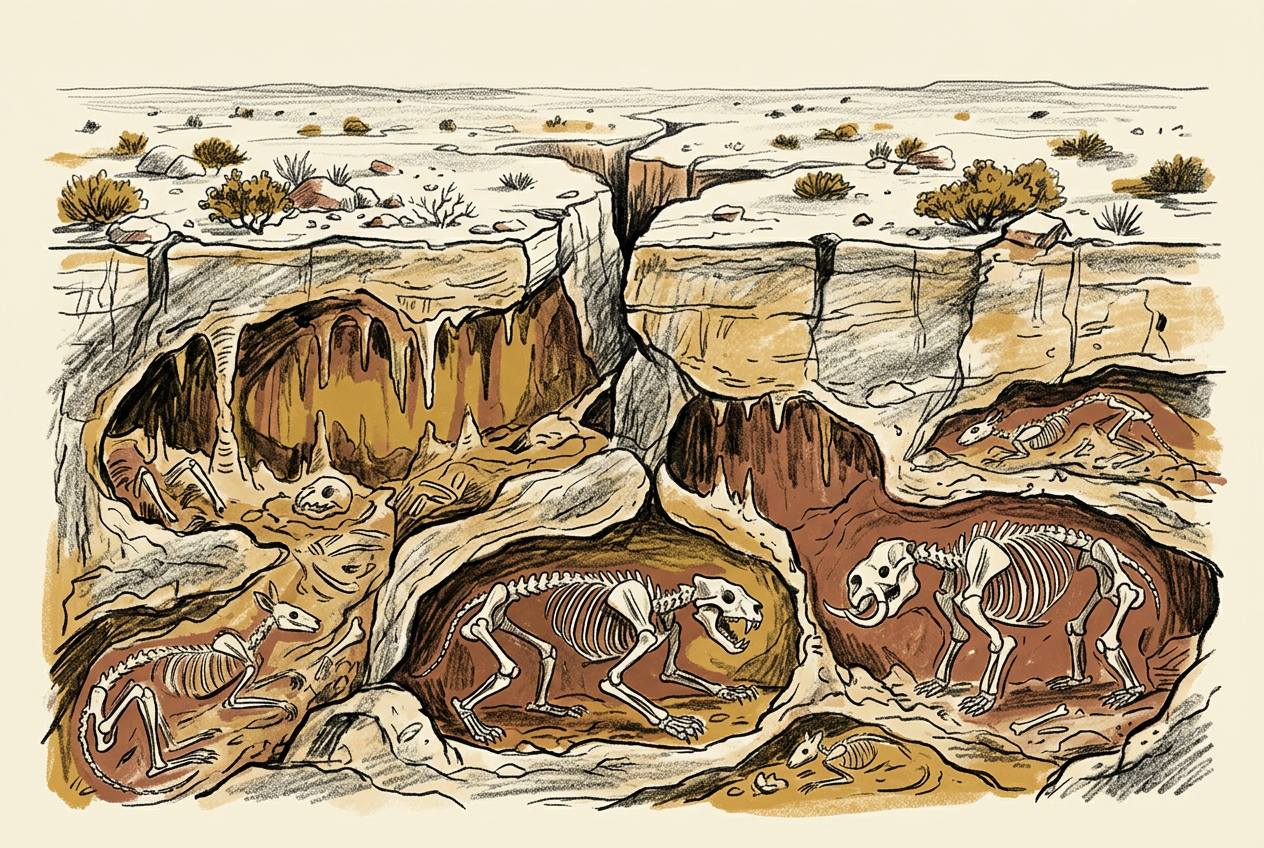
Beneath the featureless surface lies one of the most extensive cave systems on Earth. The Nullarbor's limestone is riddled with karst conduits, solution pipes, and blowholes. Some caves extend more than 100 metres deep. Others open as vertical shafts that have trapped animals for millennia.
The same rock that refuses to hold a river on top holds the bones of everything that ever fell through it.
The caves are natural pitfall traps. Animals wandering the featureless plain step onto a thin crust of limestone and drop into darkness. The result is a fossil record that spans the Pleistocene: marsupial lions (Thylacoleo), three-tonne wombats (Diprotodon), giant short-faced kangaroos (Procoptodon), and the 8-metre-long snake Wonambi naracoortensis.
A 50,000-Year-Old Snapshot
The most remarkable of these death traps is a cave known as the Thylacoleo Chamber, discovered in 2002 during a survey of the Murrawijinie Caves. The floor is a jumble of bones from at least 14 species of megafauna, all preserved in dry air and stable temperatures. Radiocarbon dates place the assemblage around 50,000 years ago—the moment when humans had just arrived on the continent.
The fossils are not just bones. Some are complete skeletons, still articulated, as if the animals had simply lain down to sleep. The dryness of the cave has preserved collagen in some specimens, allowing scientists to extract ancient DNA. This is as close as we can come to meeting a marsupial lion face to face.
The Great Drying
The Nullarbor's caves also record a climate shift. The megafauna that fell into these pits lived during a wetter period, when the plain carried grasslands and scattered woodlands. Today, the surface receives less than 200 millimetres of rain per year. The bones in the caves mark the boundary between two worlds: one in which giant wombats browsed the Nullarbor, and one in which nothing much grows at all.
The limestone itself tells the same story. The Eocene sea that laid down the rock was warm and rich in life. The platform it built is now so dry that the only movement on its surface is the occasional dust devil and the weekly train from Port Augusta to Kalgoorlie, running dead straight across a seabed that forgot to become a landscape.
More like this
- The 110-Million-Year-Old River That Runs Backwards UndergroundWestern Australia's 110-million-year-old dune system has been slowly dissolving into a labyrinth of caves where an ancient river still flows, carrying the taste of a Cretaceous desert.
- The 5,000-Year-Old Volcanoes That Still Smoke in the SouthIn Victoria's Newer Volcanics Province, 400 volcanic vents erupted as recently as 5,000 years ago—the youngest volcanic field in mainland Australia, where craters still hold blue lakes and scoria cone
- The 560-Million-Year-Old Garden That Never Saw a PredatorIn South Australia's Flinders Ranges, 560-million-year-old Ediacara surfaces preserve entire seafloor communities of fronds, discs, and quilts — a garden of soft-bodied life that flourished before pre