25 June 2026 · 3 min read
The 40,000-Year-Old Volcano That Gave Us a Mirror
How a 40,000-year-old volcanic eruption in South Australia's Mount Gambier region created a maar crater lake that preserves the only known deposit of volcanic glass used by First Nations peoples for m
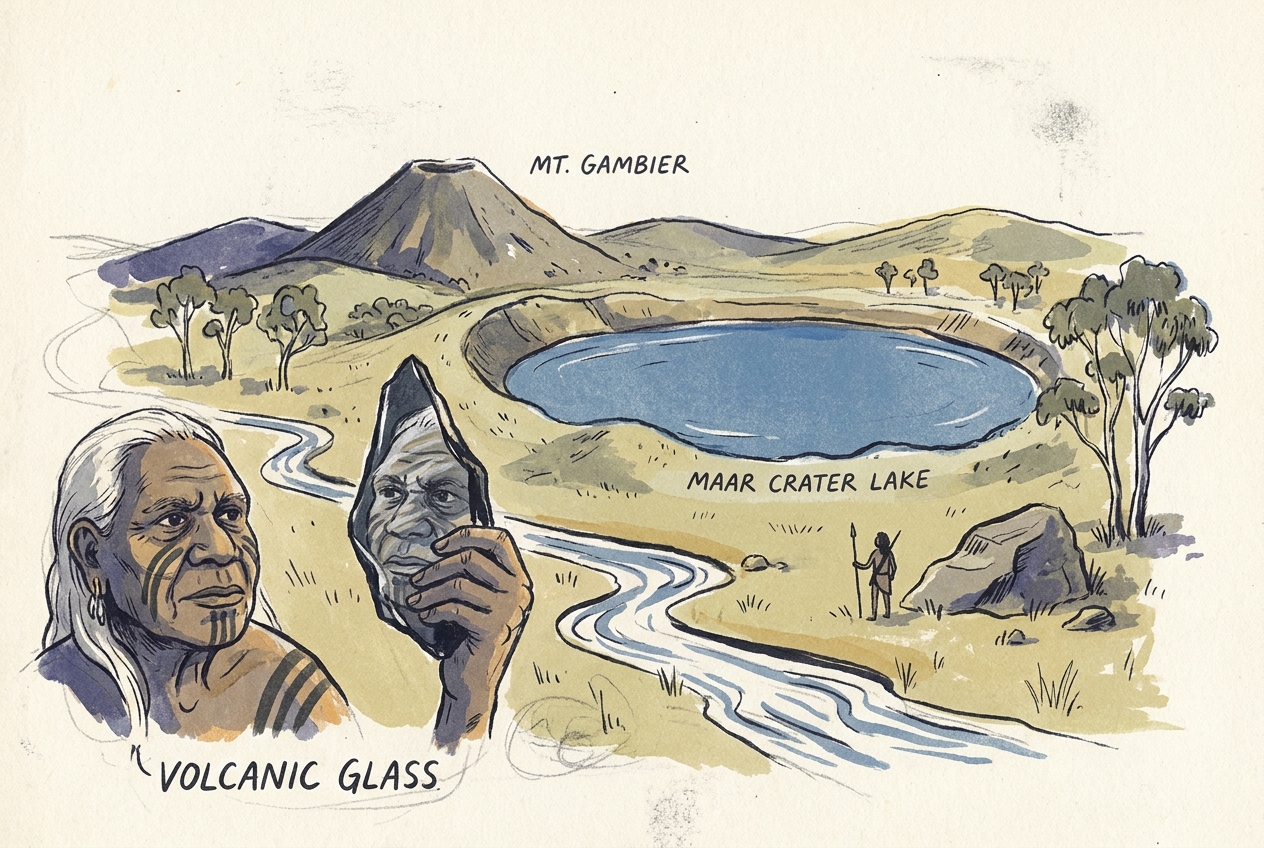
On the Limestone Coast of South Australia, a 40,000-year-old volcanic crater holds a lake so still it reflects the sky like polished obsidian. But the real mirror lies beneath the water — sheets of black volcanic glass that Aboriginal people quarried for tools sharp enough to shave hair and smooth enough to see your own face.
The Maar That Became a Lake
Mount Gambier is not a mountain. It is a maar — a broad, shallow crater formed when rising magma met groundwater and exploded. The eruption happened around 40,000 years ago, a blink in geological time. Steam blasted through 200 metres of limestone, pulverising rock and ejecting ash across the surrounding plain.
When the eruption ceased, the crater filled with water. Today, the Blue Lake sits 70 metres deep, its colour shifting from grey to vivid cobalt in summer as calcium carbonate microcrystals scatter sunlight. But the lake is only the surface. Beneath it lies what the eruption left behind: deposits of volcanic glass, formed when lava cooled too fast for crystals to grow.
Glass from Instant Cooling
Volcanic glass — obsidian — forms when silica-rich magma chills so rapidly that atoms have no time to arrange into a crystalline lattice. The result is a natural glass, brittle and sharp-edged. Most obsidian is black, though trace iron can produce brown or green varieties.
What makes the Mount Gambier deposit unusual is its purity and its context. The glass here is not a thick lava flow but a scattered deposit of glassy fragments called hyaloclastite — the product of magma interacting explosively with water. The fragments are riddled with tiny bubbles, gas trapped as the melt quenched. Aboriginal knappers selected the densest, bubble-free shards for their finest tools.
A flake of this volcanic glass can be thinner than a fingernail and sharper than a surgical scalpel.
The Quarry Underwater
Archaeological evidence shows that people were collecting Mount Gambier glass within a few thousand years of the eruption. The Buandig people, traditional custodians of the region, quarried the crater walls and the submerged deposits at the lake's edge. They carried the glass hundreds of kilometres across the continent — pieces have been found in archaeological sites as far away as the Murray River and the Coorong.
What did they make from it? Spear points, knives, scrapers. But also something rarer: small polished pieces used as mirrors. The glass could be ground flat on one side, then wetted to create a reflective surface. It is one of the few known instances of mirror-making anywhere in pre-contact Australia.
A Record in Ash
The eruption left more than glass. The ash layer — a white marker horizon known as the Mount Gambier tephra — is found across southeastern Australia, from Kangaroo Island to the Snowy Mountains. It gives geologists a precise time stamp: anything buried below that ash is older than 40,000 years; anything above is younger.
That ash layer has helped date megafauna bones, human occupation sites, and the advance of the last ice age. A single volcanic event, lasting days, fixed a line in the sedimentary record that scientists still trace.
The Glass That Remains
Today, the Blue Lake supplies drinking water to Mount Gambier city. The volcanic glass deposits are mostly submerged or built over. A few outcrops remain accessible, but collecting is prohibited. The finest pieces sit in museum collections — black, sharp, and still capable of holding a reflection after 40 millennia.
The eruption that made them was small by global standards. It built no mountain, created no vast lava field. But it produced something rare: a natural glass pure enough to become a mirror, and a time marker that still anchors the chronology of an entire continent.
More like this
- The 110-Million-Year-Old River That Runs Backwards UndergroundWestern Australia's 110-million-year-old dune system has been slowly dissolving into a labyrinth of caves where an ancient river still flows, carrying the taste of a Cretaceous desert.
- The 5,000-Year-Old Volcanoes That Still Smoke in the SouthIn Victoria's Newer Volcanics Province, 400 volcanic vents erupted as recently as 5,000 years ago—the youngest volcanic field in mainland Australia, where craters still hold blue lakes and scoria cone
- The 300-Million-Year-Old Forest That Died Standing UpIn New South Wales, a 300-million-year-old fossil forest preserves dozens of trees buried upright by a Permian volcanic eruption—an entire ecosystem frozen in ash.