25 June 2026 · 3 min read
The 300-Million-Year-Old Lake That Preserved a Polar Forest
How 300-million-year-old coal seams beneath eastern Australia preserve the only known polar rainforest from the Permian ice age—a forest that grew within 15 degrees of the South Pole.
In the coal mines of New South Wales, miners sometimes break open a slab of black stone and find a leaf. Not a fossilised imprint, but a leaf—carbonised, fragile, still showing its veins. These are the remains of the last polar rainforest on Earth.
The Permian Coal Forests
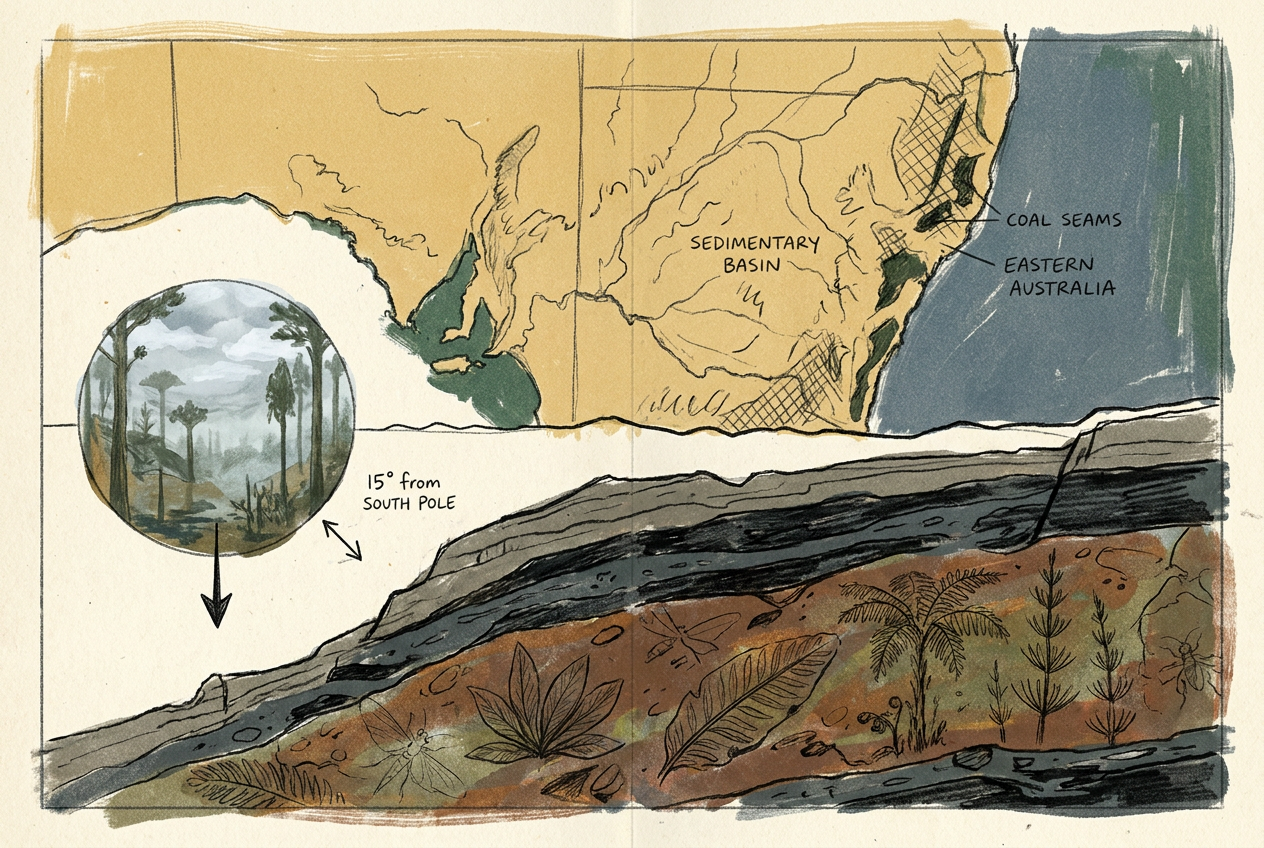
Three hundred million years ago, during the Permian Period, Australia sat far south of its present position. The continent was part of Gondwana, and its eastern margin lay within 15 degrees of the South Pole. Yet this was no barren icefield. The climate was cool and wet, and the landscape was covered in dense forests of a strange plant called Glossopteris.
Glossopteris was a seed fern with tongue-shaped leaves that shed each autumn into dark, tannin-stained rivers. The leaves accumulated in vast swampy basins—what geologists now call the Sydney, Bowen, and Gunnedah basins—where they were buried, compressed, and slowly transformed into coal. These basins hold some of the world's thickest and most extensive coal seams, stretching from central Queensland down through New South Wales.
What makes these deposits extraordinary is not their size. It is the preservation. In many coal mines, entire leaves are found intact, still showing the fine network of veins that once carried water through the leaf blade. Some specimens retain cuticle—the waxy outer layer of the leaf—preserved in such detail that botanists can identify individual cell shapes under a microscope.
In the dark of a Permian coal seam, a leaf that fell 300 million years ago still holds the shape of its cells.
A Forest at the Edge of Ice
The polar forests of Permian Australia grew under conditions that seem impossible. For much of the year, the sun never rose above the horizon. Temperatures hovered near freezing. Yet the trees grew tall—some reaching 30 metres—and their growth rings show they added wood each year in a regular rhythm, even during months of total darkness.
How did they survive? The answer lies in the leaves themselves. Glossopteris leaves are large and thin, suggesting the trees shed them each winter and regrew them in spring, much like modern deciduous trees. This strategy works well in high latitudes: the tree avoids the cost of maintaining leaves through the dark polar winter, then captures as much light as possible during the continuous summer daylight.
The coal seams also preserve the remains of the forest floor: roots, spores, and the pollen of other plants that lived beneath the canopy. These fossils reveal a diverse ecosystem—club mosses, horsetails, and ferns—growing in waterlogged soils along river channels and lake margins. It was a world of cool, wet forests that stretched across the high southern latitudes.
The Carbon That Built an Economy
The Permian coal seams of eastern Australia are not just a scientific treasure. They are the foundation of Australia's modern economy. The coal that powers steel mills in Japan, India, and South Korea began as Glossopteris leaves falling into Permian swamps. The same basins that preserve these ancient forests also produce the metallurgical coal that built Queensland's export wealth.
This creates a strange continuity. The carbon atoms in a steel furnace today were once part of a leaf that photosynthesised under a polar sun, in a forest that has no modern equivalent. When miners break open a coal face and find a leaf, they are seeing the original material—not a replacement, not a trace element, but the actual organic matter of a 300-million-year-old plant, still recognisable after all that time.
The Last of Its Kind
The Permian polar forests did not survive. At the end of the Permian, 252 million years ago, the largest mass extinction in Earth's history wiped out most of the world's species. Glossopteris vanished entirely. No close relatives survive today. The forests that once covered the high southern latitudes are gone, preserved only as coal and carbon films in the rocks beneath eastern Australia.
But the leaves remain. In museum drawers and mine sites across New South Wales and Queensland, these thin black films still hold the shape of a world that has no parallel—a polar rainforest, growing in the dark, that fed the modern world.
More like this
- The 560-Million-Year-Old Garden That Never Saw a PredatorIn South Australia's Flinders Ranges, 560-million-year-old Ediacara surfaces preserve entire seafloor communities of fronds, discs, and quilts — a garden of soft-bodied life that flourished before pre
- The 300-Million-Year-Old Forest That Died Standing UpIn New South Wales, a 300-million-year-old fossil forest preserves dozens of trees buried upright by a Permian volcanic eruption—an entire ecosystem frozen in ash.
- The 1.75-Billion-Year-Old Reef That Outranks the BarrierA 1.75-billion-year-old microbial reef in the Kimberley is the largest biological structure ever built by a single species, preserving a world without predators.