4 July 2026 · 3 min read
The 3.7-Billion-Year-Old Lava That Wears the Oldest Face on Earth
How 3.7-billion-year-old pillow lavas in the Pilbara Craton preserve Earth's oldest known facial expression—a natural rock formation that looks like a human face, formed by Archaean volcanism.
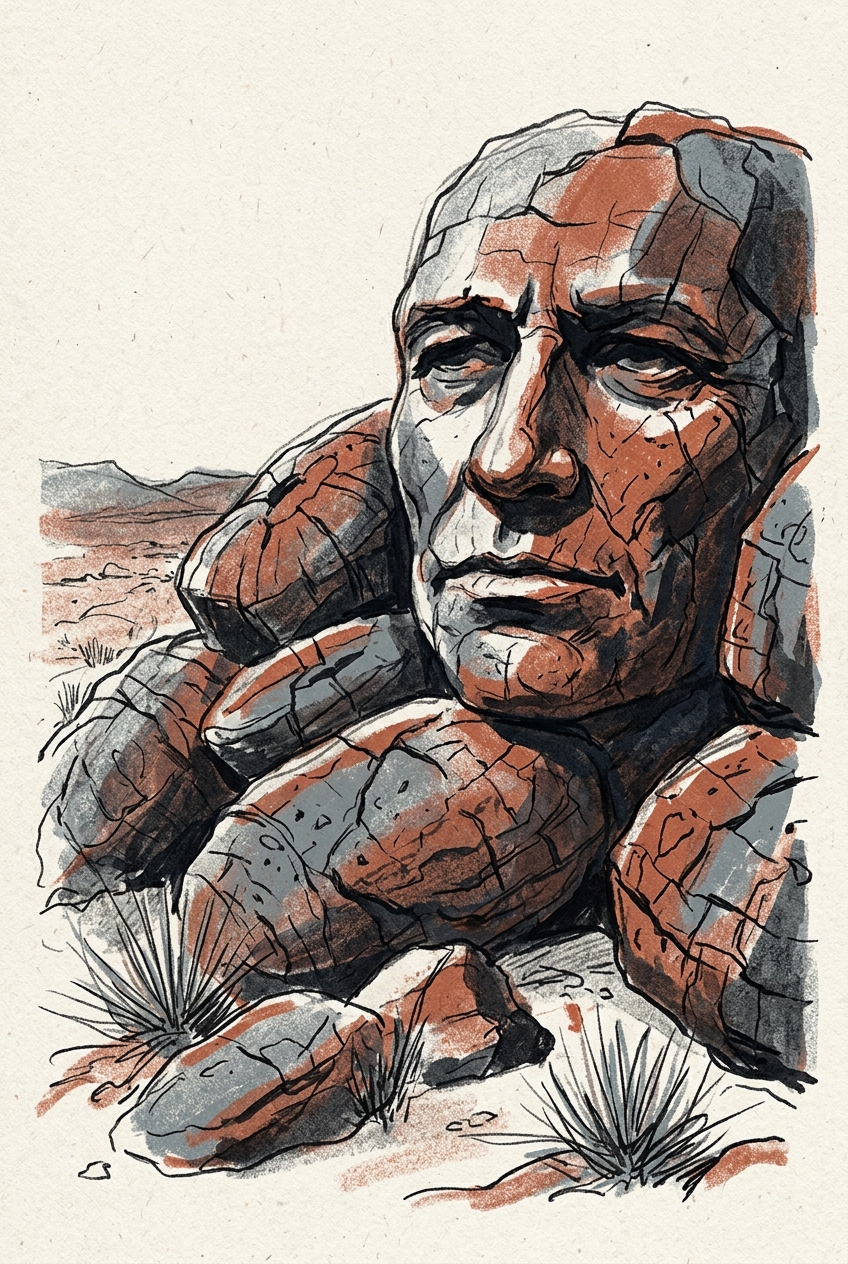
In Western Australia's Pilbara, on a ridge of black basalt that has endured for nearly four billion years, a face stares at the sky. It has two eyes, a nose, and a mouth set in an expression that could be surprise or sorrow. Geologists call it the Marble Bar Face, and it is probably the oldest recognisable human-like form ever shaped by geology—a trick of erosion working on some of the most ancient volcanic rock on the planet.
The Oldest Lava on the Continent
The face belongs to the Warrawoona Group, a sequence of pillow lavas and volcanic sediments that erupted on the Archaean seafloor roughly 3.7 to 3.5 billion years ago. These are not ordinary rocks. They formed when the Earth was less than a billion years old, the atmosphere contained almost no oxygen, and the continents were still tiny embryonic crustal fragments drifting on a hotter mantle.
The pillow lavas at Marble Bar are among the best-preserved Archaean volcanic rocks anywhere. Each pillowed lobe—rounded, bulbous, a metre or two across—records the moment molten basalt met seawater and quenched instantly to glass. The rocks have been folded, faulted, metamorphosed, and weathered, but the original pillow structures remain visible. And in one particular outcrop, the combination of jointing, mineral staining, and differential erosion has produced something uncanny: a face.
How a Rock Wears a Face
The face is not carved. No human hand touched it. It formed through a simple sequence of geological accidents.
The pillow lava originally contained vesicles—bubbles of volcanic gas trapped as the rock cooled. Over hundreds of millions of years, groundwater percolated through the basalt, depositing silica and iron oxides in the vesicles and along fractures. The iron minerals—hematite and goethite—stained the rock deep red and black. Later, weathering exploited differences in hardness: softer, mineralised veins eroded faster than the surrounding basalt, creating recesses that resemble eye sockets and a mouth. A ridge of harder rock remained as the nose.
The result is a natural pareidolia—a face that exists because the human brain is wired to find patterns where none were intended. But the face is genuine in a geological sense: it records the exact intersection of Archaean volcanism, ancient hydrothermal circulation, and two billion years of subaerial weathering.
The face at Marble Bar is not a message from the deep past. It is a coincidence. But it is a coincidence that could only happen on the oldest exposed crust on Earth.
The Landscape That Time Forgot
The Pilbara Craton is the best-preserved fragment of early Earth. While most of the planet's primordial crust has been recycled into the mantle by plate tectonics, the Pilbara remained buoyant and stable. Its granite-greenstone terranes—domes of ancient granite surrounded by belts of volcanic rock—have sat at or near the surface for most of geological time.
The Marble Bar Face sits within one of these greenstone belts. The rocks around it contain some of the oldest evidence of life on Earth: 3.5-billion-year-old stromatolites at nearby North Pole Dome, and microfossils preserved in chert. The same volcanic activity that built the pillow lavas also created the hydrothermal systems that sustained Earth's earliest microbial ecosystems.
The face itself is not a fossil. It is younger than the organisms that lived in those Archaean seas. But it is older than any mountain range on Earth, older than the atmosphere we breathe, older than the continents as we know them.
A Geological Rorschach Test
The Marble Bar Face has become a minor tourist attraction, visited by geologists and curious travellers who make the long drive north from Newman. It appears in rock-collecting forums and on lists of "natural rock formations that look like faces." But its significance runs deeper than novelty.
The face is a product of the same processes that shaped the entire Pilbara landscape: Archaean volcanism, hydrothermal alteration, and relentless chemical weathering. Every red ridge and black dome in the region carries the same history. The face is simply the place where that history arranged itself into a recognisable form.
There is no symbolism here. The rock does not know it looks like a face. But for a species that evolved to read emotions in the features of others, the sight of that ancient expression—staring from the oldest lava on Earth—is difficult to forget. It is the closest thing we have to a portrait of the Archaean world: dark, silent, and waiting for life to catch up. The face has been watching the sky for 3.7 billion years. It will watch for billions more.
More like this
- The 110-Million-Year-Old River That Runs Backwards UndergroundWestern Australia's 110-million-year-old dune system has been slowly dissolving into a labyrinth of caves where an ancient river still flows, carrying the taste of a Cretaceous desert.
- The 5,000-Year-Old Volcanoes That Still Smoke in the SouthIn Victoria's Newer Volcanics Province, 400 volcanic vents erupted as recently as 5,000 years ago—the youngest volcanic field in mainland Australia, where craters still hold blue lakes and scoria cone
- The 300-Million-Year-Old Forest That Died Standing UpIn New South Wales, a 300-million-year-old fossil forest preserves dozens of trees buried upright by a Permian volcanic eruption—an entire ecosystem frozen in ash.