4 July 2026 · 3 min read
The 650-Million-Year-Old Glass That Still Holds the Rift's Shape
How 650-million-year-old volcanic glass in South Australia's Gairdner Ranges preserves the moment a continent tried to tear apart—and failed.
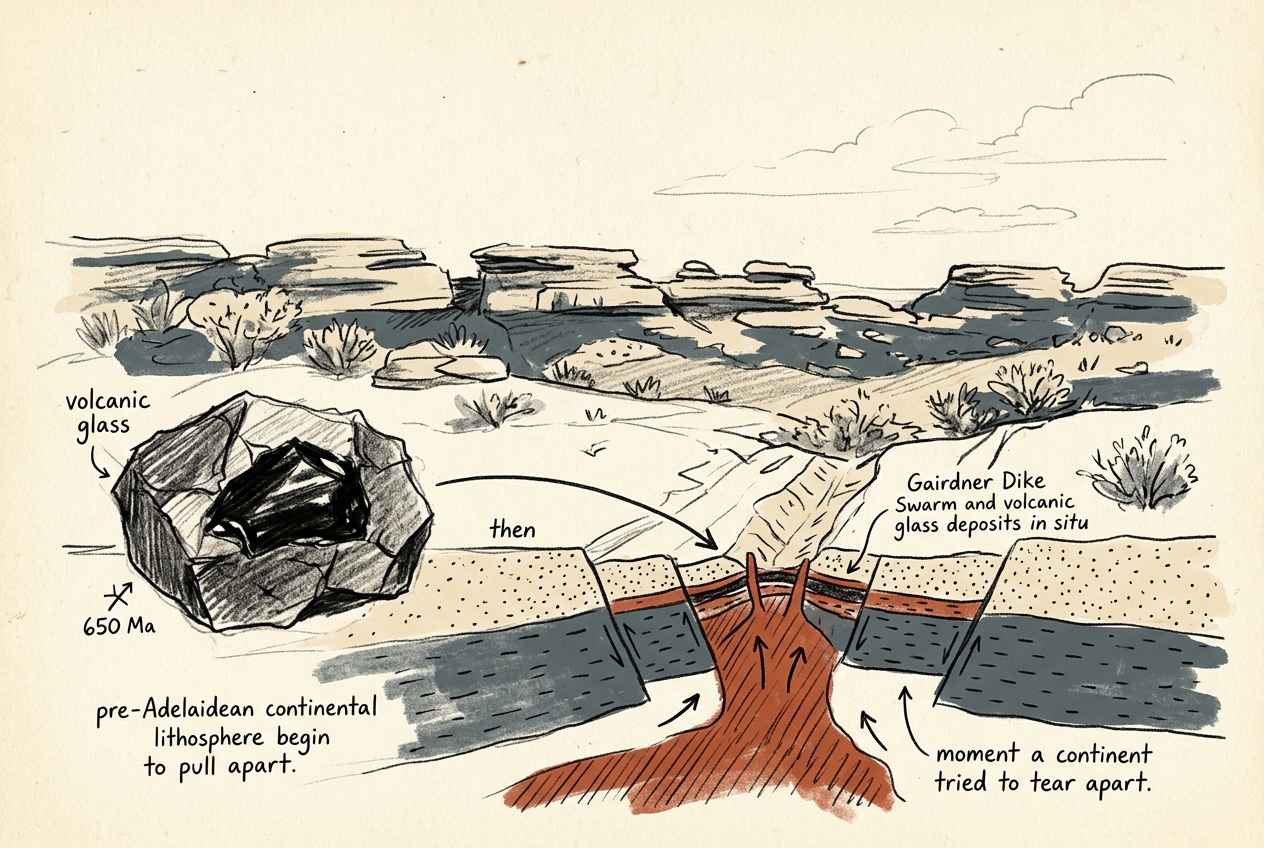
On the shore of Lake Gairdner, a dry salt pan in South Australia, the rock looks like black obsidian—except it is older than most animal life, and it cracked open in sheets as the continent tried to split in half.
The rock is not obsidian but a rare volcanic glass called Gairdner dacite, exposed across the Gairdner Ranges northwest of Port Augusta. It formed 650 million years ago, during the breakup of the supercontinent Rodinia, when the crust beneath central Australia stretched, thinned, and bled lava that chilled so fast it never crystallised.
The Failed Rift
The Gairdner dacite is the surface expression of the Willouran Rift, a 650-million-year-old fracture zone that runs for 500 kilometres beneath South Australia. The rift was part of a larger effort to tear the continent apart along what is now the Stuart Shelf. It almost worked.
Magma rose through the thinning crust and erupted onto the seafloor as pillow lava and volcanic glass. The glass preserved the chemistry of the mantle at that moment: low in silica, rich in trace elements that fingerprint a continent being pulled apart. Geochemists call these continental flood basalts with a rift signature—the chemical ghost of a breakup that never finished.
The rift failed. Rodinia stayed together a while longer. But the glass it left behind is still there, black and brittle, holding the shape of the strain.
A Landscape of Broken Glass
The Gairdner Ranges are not tall. They rise only 200 metres above the salt lake, but their jagged ridges are unmistakable. The dacite weathers into angular scree slopes that crunch underfoot like shattered bottles. Fresh surfaces are jet-black with a conchoidal fracture—the same kind of curved break you see in window glass.
Radiometric dating of the Gairdner dacite gives an age of 650 ± 10 million years, placing it squarely in the Cryogenian Period, when the Earth was locked in the Sturtian glaciation. The lava erupted through ice-contact environments: some flows show signs of quenching against glaciers, producing a texture called hyaloclastite—glass that shattered when it hit cold water or ice.
The glass also contains tiny crystals of zircon and baddeleyite, which allow precise dating. These crystals trapped uranium as they formed, and their decay clocks have ticked steadily ever since, giving geologists a pinpoint on the moment the rift opened.
What the Glass Remembers
The Gairdner dacite records more than a date. It preserves the stress field of the ancient crust. The glass is cut by thousands of thin fractures—columnar joints that formed as the lava cooled and contracted. The orientation of these columns matches the direction of regional extension: northwest-southeast, the same direction the crust was pulling apart.
In places, the dacite is interlayered with sedimentary breccias—angular chunks of older rock ripped from the rift walls and dumped into the volcanic pile. These breccias contain fragments of the Gawler Craton, the 3-billion-year-old basement that the rift tried to split. The craton held. The rift failed. But the breccia is proof of how deep the fracturing went.
The Unfinished Continent
The Willouran Rift never produced an ocean. Australia stayed attached to Antarctica and India for another 400 million years, until the breakup of Gondwana finally succeeded in the Cretaceous. But the Gairdner dacite is a snapshot of the attempt: a moment when the lithosphere thinned, magma rose, and the continent almost broke.
Today, the glass sits in the desert, exposed by wind and salt and the slow erosion of 650 million years. It is not a tourist attraction. There is no visitor centre. But for geologists, it is one of the best-preserved records of a failed rift anywhere on Earth—a sheet of frozen magma that still holds the shape of the stress that made it.
More like this
- The 110-Million-Year-Old River That Runs Backwards UndergroundWestern Australia's 110-million-year-old dune system has been slowly dissolving into a labyrinth of caves where an ancient river still flows, carrying the taste of a Cretaceous desert.
- The 5,000-Year-Old Volcanoes That Still Smoke in the SouthIn Victoria's Newer Volcanics Province, 400 volcanic vents erupted as recently as 5,000 years ago—the youngest volcanic field in mainland Australia, where craters still hold blue lakes and scoria cone
- The 300-Million-Year-Old Forest That Died Standing UpIn New South Wales, a 300-million-year-old fossil forest preserves dozens of trees buried upright by a Permian volcanic eruption—an entire ecosystem frozen in ash.