5 July 2026 · 3 min read
The 3.5-Billion-Year-Old Cones That Still Breathe in the Sun
How 3.5-billion-year-old stromatolites at Shark Bay are not fossils but living structures—and what they reveal about the dawn of oxygen on Earth.
At Hamelin Pool in Western Australia's Shark Bay, the water is twice as salty as the open ocean. And there, just beneath the surface, the oldest living structures on Earth are still growing.
They are not rocks, not plants, not animals. They are stromatolites—layered microbial mounds built by cyanobacteria, the organisms that invented photosynthesis more than three billion years before anything else thought to try.
The Living Reef That Time Forgot
Stromatolites dominated Earth for nearly two billion years. They were the planet's first globally significant ecosystem, and they left behind fossils by the continent-full—especially in Western Australia's Pilbara, where 3.5-billion-year-old stromatolite fossils survive in the Dresser Formation.
But those are ghosts. At Hamelin Pool, the stromatolites are alive.
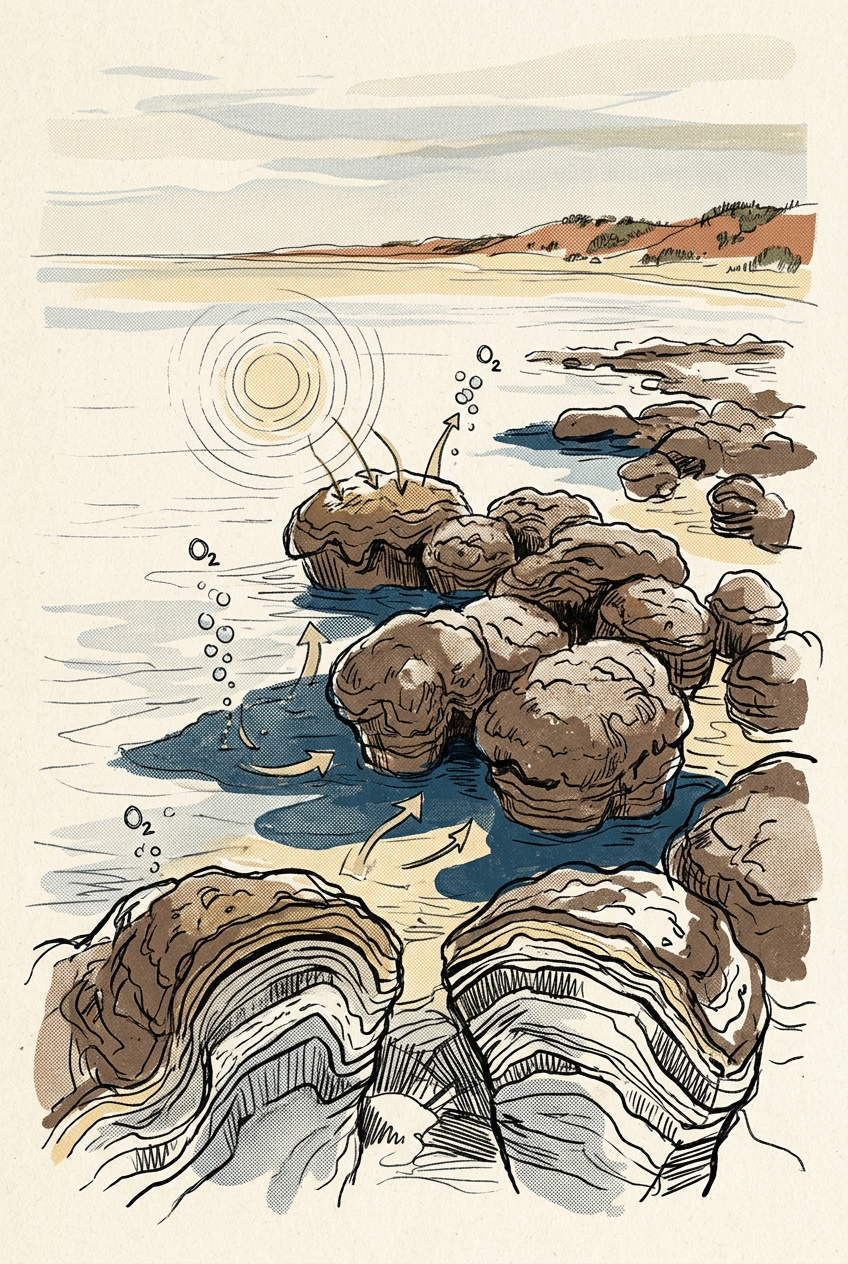
What makes Shark Bay special is its salinity. The water is so briny that grazing snails and chitons—the animals that would normally eat the cyanobacterial mats—cannot survive. Without predators, the microbes build upward, trapping and binding sediment into domes that grow about one millimetre per year. Some of these living mounds stand half a metre tall and are thousands of years old, though the colony itself has persisted for much longer.
The organism that built the first oxygen on Earth still builds a reef in Western Australia—because nothing evolved that could eat it.
The Breath That Changed the World
The cyanobacteria in Shark Bay's stromatolites do exactly what their ancestors did 3.5 billion years ago: they split water molecules using sunlight, releasing oxygen as waste.
At first, that oxygen was dangerous. It poisoned the anaerobic microbes that dominated the Archaean world. But over hundreds of millions of years, the cumulative output of countless stromatolite colonies transformed the atmosphere. This was the Great Oxidation Event, a planetary shift that made animal life possible.
The Hamelin Pool stromatolites are not simply relics of that process. They are still performing it, every day, in full sunlight. Their oxygen production is measurable, their growth visible over years, their metabolism identical to the one that rusted the oceans and painted the Hamersley banded iron formations red.
A Living Archive in a Dying Sea
The stromatolites of Shark Bay are rare. Only two other places on Earth—the Exuma Cays in the Bahamas and a lake in the Andes—host living marine examples. Australia's colony is the largest and most accessible.
But they are vulnerable. Hamelin Pool's salinity depends on a narrow hydrological balance. A changing climate, reduced rainfall, or a storm that breaches the shell beds holding back the ocean could dilute the water enough to let predators in. If that happens, the snails will arrive, and the stromatolites will stop growing.
There are no younger stromatolites waiting to replace them. The conditions that allow these colonies to thrive—extreme salinity, low nutrients, minimal competition—are the same conditions that make them irreplaceable. Once the water changes, the oldest living ecosystem on Earth will become just another fossil.
What They Still Tell Us
Scientists at Shark Bay study the stromatolites to understand how life shaped the early Earth. The way the microbial mats trap sediment, the chemical gradients within each dome, the subtle layering that records seasonal changes—all of it offers a window into the Archaean world that no purely fossil site can provide.
But the stromatolites also raise a quieter question. The cyanobacteria inside them are essentially immortal as a lineage. They have survived every extinction, every ice age, every shift in atmospheric chemistry. They built the oxygen we breathe and then stepped aside for the animals that oxygen made possible.
They are still building it, one millimetre per year, in a hot, salty bay on the western edge of Australia.
More like this
- The 560-Million-Year-Old Garden That Never Saw a PredatorIn South Australia's Flinders Ranges, 560-million-year-old Ediacara surfaces preserve entire seafloor communities of fronds, discs, and quilts — a garden of soft-bodied life that flourished before pre
- The 300-Million-Year-Old Forest That Died Standing UpIn New South Wales, a 300-million-year-old fossil forest preserves dozens of trees buried upright by a Permian volcanic eruption—an entire ecosystem frozen in ash.
- The 1.75-Billion-Year-Old Reef That Outranks the BarrierA 1.75-billion-year-old microbial reef in the Kimberley is the largest biological structure ever built by a single species, preserving a world without predators.