26 June 2026 · 2 min read
The 3.6-Billion-Year-Old Crust That Refuses to Sink
How the ancient Pilbara Craton's buoyant granite domes kept it from being recycled into the mantle, preserving Earth's earliest continental crust.
In northwestern Australia, a piece of the Earth's first skin still sits at the surface. The Pilbara Craton has not been subducted, buried, or destroyed. It has stayed exactly where it formed for more than 3.6 billion years—a ghost of a time when the planet was barely cool enough to have solid ground.
The Domes That Defied Gravity
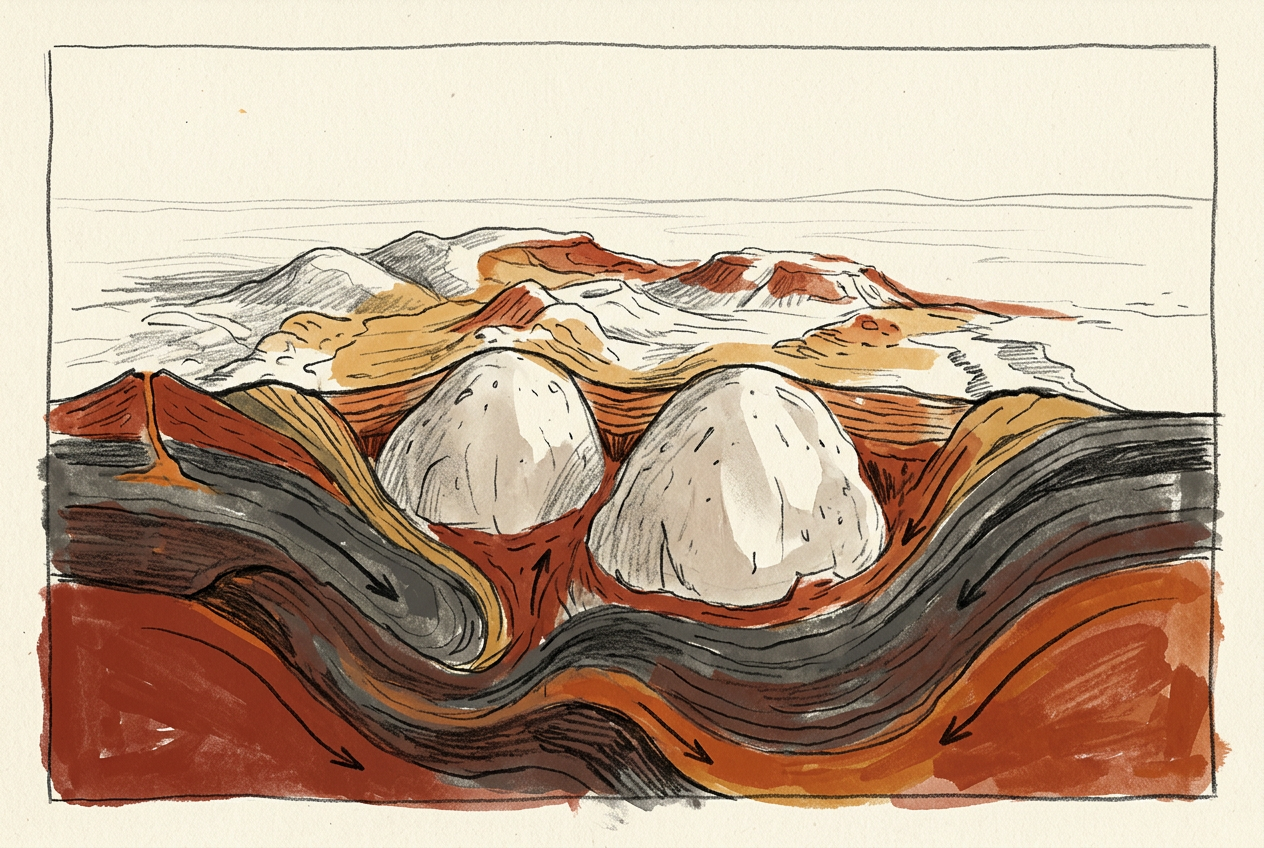
The craton's survival comes down to a quirk of its architecture. Between 3.6 and 2.8 billion years ago, the Pilbara was a series of volcanic islands not unlike modern Hawaii—except the magma that erupted was rich in magnesium and iron, forming dense greenstone belts that would normally sink into the mantle. But these belts were surrounded by something unusual: enormous domes of granite that rose like blisters from the crust.
These granite domes, each tens of kilometres across, were buoyant. As the dense greenstone sank, the lighter granite pushed upward, creating a stable keel that locked the entire block in place. The process, called sagduction, is unique to the Archaean—no modern tectonic system works quite this way. The result is a crustal raft that has floated on the mantle for over three billion years, resisting every attempt to pull it under.
A Window into the Hadean
The Pilbara's exposure is almost absurdly complete. You can walk from a 3.5-billion-year-old seafloor to a 3.4-billion-year-old beach to a 3.2-billion-year-old river delta without crossing a single unconformity that represents more than a few million years. In most of the world, crust this old has been reheated, folded, and scrambled beyond recognition. Here, the rocks are so well preserved that you can still see ripple marks from Archaean tides.
The North Pole Dome, near Marble Bar, contains pillow lavas that erupted under seawater 3.5 billion years ago—the bubbles of ancient ocean chemistry still locked inside their glassy rinds.
This preservation is not an accident. Because the craton never sank, its rocks were never subjected to the high pressures and temperatures of deep burial. They remain essentially as they were, making the Pilbara the best natural laboratory on Earth for understanding how the first continents formed.
Why Nothing Else Survived
Most of Earth's early crust was recycled back into the mantle within a few hundred million years. The process was efficient: dense basaltic crust sank along primitive subduction zones, or was simply too thick to support itself and collapsed under its own weight. The Pilbara escaped because its granite domes provided exactly the right mix of buoyancy and rigidity.
Other ancient cratons—the Kaapvaal in South Africa, the Yilgarn in Western Australia—survived by similar mechanisms, but none exposes such a continuous record of the Archaean surface. The Pilbara is not just old. It is intact. That rarity makes it more than a geological curiosity. It is a direct view into a chapter of Earth history that, everywhere else, has been erased.
More like this
- The 110-Million-Year-Old River That Runs Backwards UndergroundWestern Australia's 110-million-year-old dune system has been slowly dissolving into a labyrinth of caves where an ancient river still flows, carrying the taste of a Cretaceous desert.
- The 5,000-Year-Old Volcanoes That Still Smoke in the SouthIn Victoria's Newer Volcanics Province, 400 volcanic vents erupted as recently as 5,000 years ago—the youngest volcanic field in mainland Australia, where craters still hold blue lakes and scoria cone
- The 1.75-Billion-Year-Old Reef That Outranks the BarrierA 1.75-billion-year-old microbial reef in the Kimberley is the largest biological structure ever built by a single species, preserving a world without predators.