26 June 2026 · 3 min read
The 250-Million-Year-Old River That Cut a Gorge Through Time
How the Clarence River system in northern New South Wales carved through 250 million years of volcanic and sedimentary rock, exposing the only complete Triassic-to-Jurassic sequence on the Australian
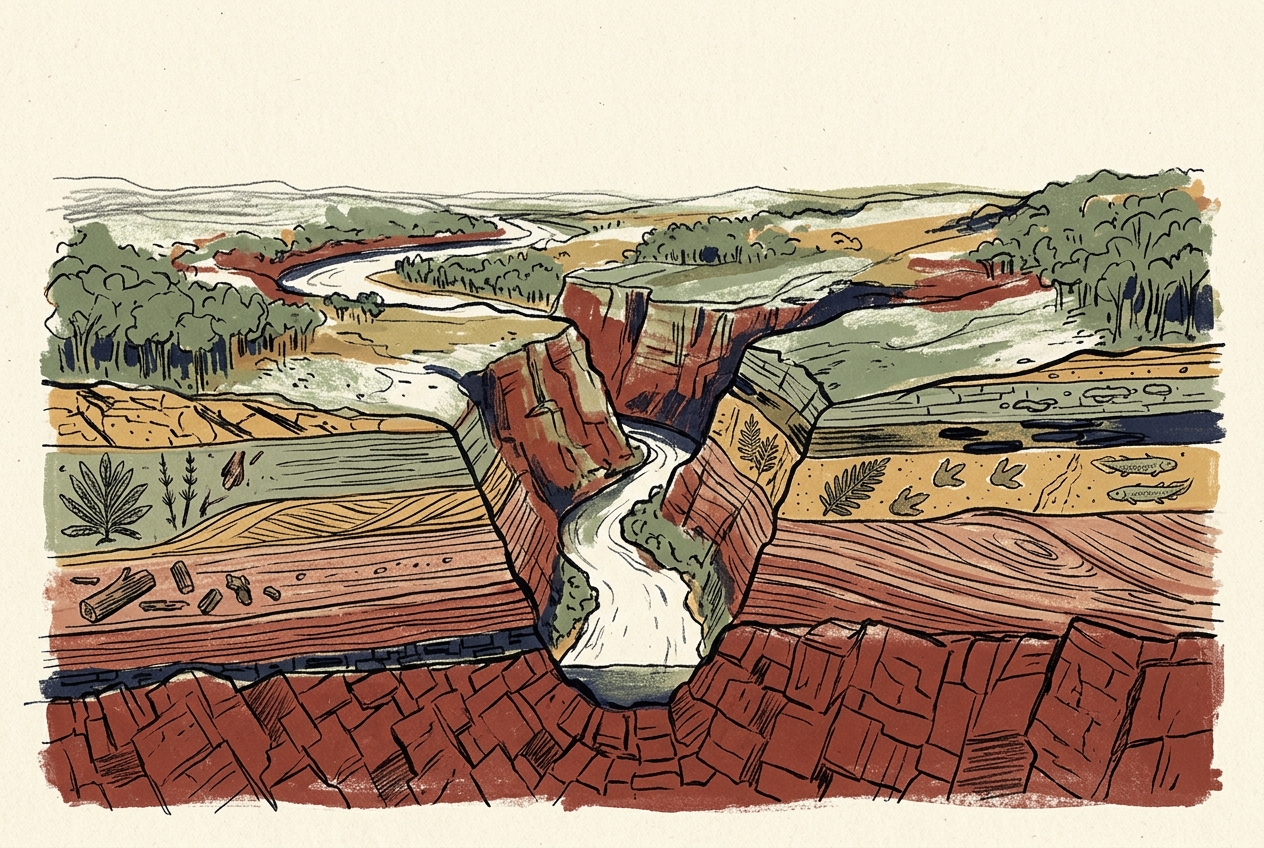
At the bottom of a narrow gorge in northern New South Wales, the Clarence River runs over a surface that was once the floor of a Triassic sea. Above it, tier after tier of rock climbs toward the sky—basalt flows, sandstone sheets, ancient river gravels—a 250-million-year stack of Earth's history exposed in a single cut.
The River That Refused to Move
Most large rivers shift course over geological time. The Clarence did not. For at least 70 million years, since the Late Cretaceous, this river has followed the same line through what is now the Gondwana Rainforests of northern New South Wales. It cut downward as the continent rose, like a saw blade lowered onto a slowly lifting block of wood.
The result is a series of gorges—the Nymboida, the Boyd, the Mann—that together expose a cross-section of eastern Australia's sedimentary and volcanic past. The oldest rocks at river level are Triassic sandstones and coal measures, laid down around 250 million years ago in swampy coastal plains. Above them sit Jurassic sandstones and shales, then Cretaceous sediments, and finally, capping the plateau, the remnants of massive Tertiary basalt flows that erupted 20 to 50 million years ago.
No other place in Australia preserves this complete a sequence from the Triassic through to the present in a single vertical section.
A Forest Preserved in Stone
Near the town of Grafton, the river has cut into the Triassic Chillingham Volcanics—a formation that records a different kind of violence. Around 230 million years ago, a series of volcanic eruptions buried a standing forest in ash and sediment. The trees toppled, but their trunks were preserved as they fell, aligned in the same direction like matchsticks laid by a giant hand.
The fossilised logs of the Chillingham Volcanics are not rare petrifications. They are whole trees, some more than 30 metres long, turned to agate and jasper. The silica that replaced the wood came from the same volcanic ash that killed them. The logs lie where they fell, pointing southwest, the direction of the prevailing wind at the moment of eruption.
The trees fell in the same direction, as if the wind had been frozen mid-gust.
The Lava That Built a Plateau
Around 50 million years ago, after the river had already been cutting for 20 million years, a new phase of volcanism began. The Ebor Volcano, centred near present-day Dorrigo, erupted vast quantities of basalt that spread across the existing landscape, capping the plateau with a dark, weather-resistant crust.
The basalt flows preserved the underlying landscape. Where the river has cut through them, the ancient valley profiles remain intact beneath the lava cap—a palimpsest of an older drainage system, now suspended hundreds of metres above the modern river.
These volcanic caps also created the conditions for the gorge's steepest walls. The basalt is hard and resistant; the underlying sandstone erodes more easily. When the sandstone gives way, the basalt cap fractures and collapses in massive slabs, leaving sheer cliffs that tower over the river below.
What the Gorge Reveals
The Clarence River's incision has exposed not just a sequence of rocks but a sequence of worlds. At the base: Triassic coal swamps, home to early dinosaurs and giant amphibians. Above: Jurassic forests of podocarps and cycads. Higher still: Cretaceous seas that deposited the sandstones now quarried for building stone. And at the top: the basalt-capped plateau where rainforest species survived the ice ages in refuges.
Each layer is a page. The gorge is the book.
More like this
- The 110-Million-Year-Old River That Runs Backwards UndergroundWestern Australia's 110-million-year-old dune system has been slowly dissolving into a labyrinth of caves where an ancient river still flows, carrying the taste of a Cretaceous desert.
- The 5,000-Year-Old Volcanoes That Still Smoke in the SouthIn Victoria's Newer Volcanics Province, 400 volcanic vents erupted as recently as 5,000 years ago—the youngest volcanic field in mainland Australia, where craters still hold blue lakes and scoria cone
- The 560-Million-Year-Old Garden That Never Saw a PredatorIn South Australia's Flinders Ranges, 560-million-year-old Ediacara surfaces preserve entire seafloor communities of fronds, discs, and quilts — a garden of soft-bodied life that flourished before pre