26 June 2026 · 2 min read
The 1.6-Billion-Year-Old Mound That Built a Mineral Mountain
How 1.6-billion-year-old microbial mounds in South Australia's Flinders Ranges became the world's richest manganese deposit—a mountain built by bacteria and concentrated by weather.
A ridge the colour of a healing bruise rises from the red dust of South Australia's Far North. The Groote Eylandt deposit is the world's richest manganese source, and it began not with a volcanic blast or a tectonic crush, but with a 1.6-billion-year-old colony of microbes.
The Mound Builders
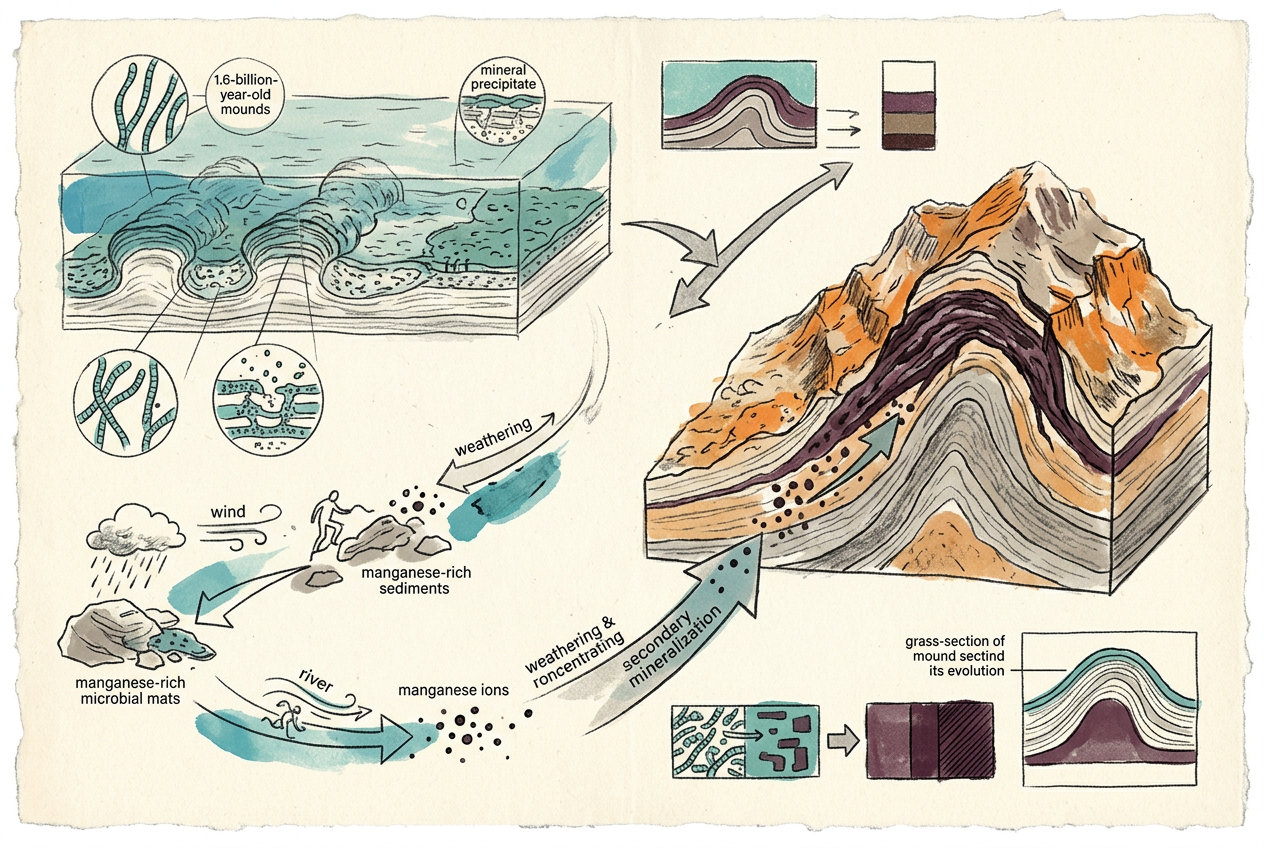
In the shallow seas that covered much of Australia during the Proterozoic Eon, cyanobacteria built layered domes of sediment—stromatolites. These microbial mats trapped fine particles from the water, including dissolved manganese that had leached from ancient volcanic rocks on nearby land.
The mounds grew slowly, layer by microscopic layer. Over tens of millions of years, the manganese accumulated to extraordinary concentrations. Today, the Groote Eylandt deposits contain up to 50 percent manganese by weight—among the highest grades on Earth.
What makes the deposit remarkable is not just its purity but its origin. Most manganese ores form through hydrothermal activity or metamorphism. Here, the metal was concentrated by the patient filtering action of bacteria, working in sunlight.
A single tonne of Groote Eylandt ore contains half a tonne of manganese—a concentration that took a billion and a half years to achieve.
The Island of Metal
Groote Eylandt itself is a sandstone plateau in the Gulf of Carpentaria, part of the same Proterozoic basin that underlies much of northern Australia. The manganese beds sit directly on 1.6-billion-year-old sandstone, preserved in a geological setting that has remained remarkably stable.
The deposit was discovered in 1907 by a missionary who noticed the heavy black rocks were attracting the attention of local Anindilyakwa people, who had long used the manganese oxides for body painting and ceremonial markings.
Commercial mining began in the 1960s. The ore needed no crushing or beneficiation—it could be scooped directly from shallow pits and shipped as lump ore, a testament to the purity the microbes had achieved.
Weathering's Final Touch
After the stromatolites had done their work, another force refined the deposit further. Over millions of years of tropical weathering, groundwater dissolved the surrounding sandstone and limestone, leaving the manganese oxides concentrated in residual layers.
The weathering also transformed the mineralogy. Primary manganese carbonates from the original microbial mounds were oxidised into harder, denser oxides—pyrolusite and cryptomelane—that resisted erosion while surrounding rock washed away.
This double concentration—first biological, then chemical—created a deposit where manganese forms massive beds up to 15 metres thick. The island now produces about 4 million tonnes of manganese ore annually, much of it destined for steelmaking.
A Quiet Revolution
Groote Eylandt challenges the assumption that major ore deposits require dramatic geological violence. Here, no mountain-building event, no hydrothermal system, no volcanic arc was needed. Just bacteria, shallow water, and time.
The same principle operates elsewhere in Australia. The McArthur River zinc-lead deposit and the Brockman iron deposits both show evidence of microbial concentration. But Groote Eylandt remains the purest example: a mountain built by living things, then refined by weather.
When you handle a piece of steel, consider that the manganese that hardens it may have been concentrated by 1.6-billion-year-old bacteria on an island in the Gulf of Carpentaria. The metal in your hand was once a microbe's waste product, patiently accumulated across geological time.
More like this
- The 110-Million-Year-Old River That Runs Backwards UndergroundWestern Australia's 110-million-year-old dune system has been slowly dissolving into a labyrinth of caves where an ancient river still flows, carrying the taste of a Cretaceous desert.
- The 560-Million-Year-Old Garden That Never Saw a PredatorIn South Australia's Flinders Ranges, 560-million-year-old Ediacara surfaces preserve entire seafloor communities of fronds, discs, and quilts — a garden of soft-bodied life that flourished before pre
- The 1.75-Billion-Year-Old Reef That Outranks the BarrierA 1.75-billion-year-old microbial reef in the Kimberley is the largest biological structure ever built by a single species, preserving a world without predators.