25 June 2026 · 3 min read
The 3.5-Billion-Year-Old Sea That Built the World's Oldest Sapphires
How 3.5-billion-year-old metamorphism in Western Australia's Yilgarn Craton created some of Earth's oldest sapphires—long before the gem was thought possible.
The oldest sapphires on Earth were not born in volcanoes. They were baked in a seafloor that had already been dead for a billion years, compressed under mountains that have since eroded to dust, and finally washed into a creek bed in Western Australia's Yilgarn Craton, where a prospector bent to pick up a pebble that weighed 1,160 carats.
The Craton That Refuses to Erode
The Yilgarn Craton is a scrap of Archaean crust so ancient and so stable that it has sat largely undisturbed for 2.5 billion years. Covering most of southwestern Australia, it is a landscape of low, scrubby hills and salt lakes—a continent's worn-down basement, exposed by eons of erosion. In the 1990s, miners searching for gold and nickel near the town of Mount Magnet began finding something unexpected: vivid blue and green sapphire crystals mixed with the gravels of ancient river channels. The crystals were water-worn, rounded, and often paired with ruby—a sign they had travelled far from their source.
Dating soon revealed the surprise. The sapphires were not 250 million years old, like Queensland's volcanic gems, or 500 million, like those from New South Wales. They were 3.5 billion years old—formed in the Archaean, when the Earth was barely a billion years old and life was still confined to single cells.
A Seafloor That Became a Jewel
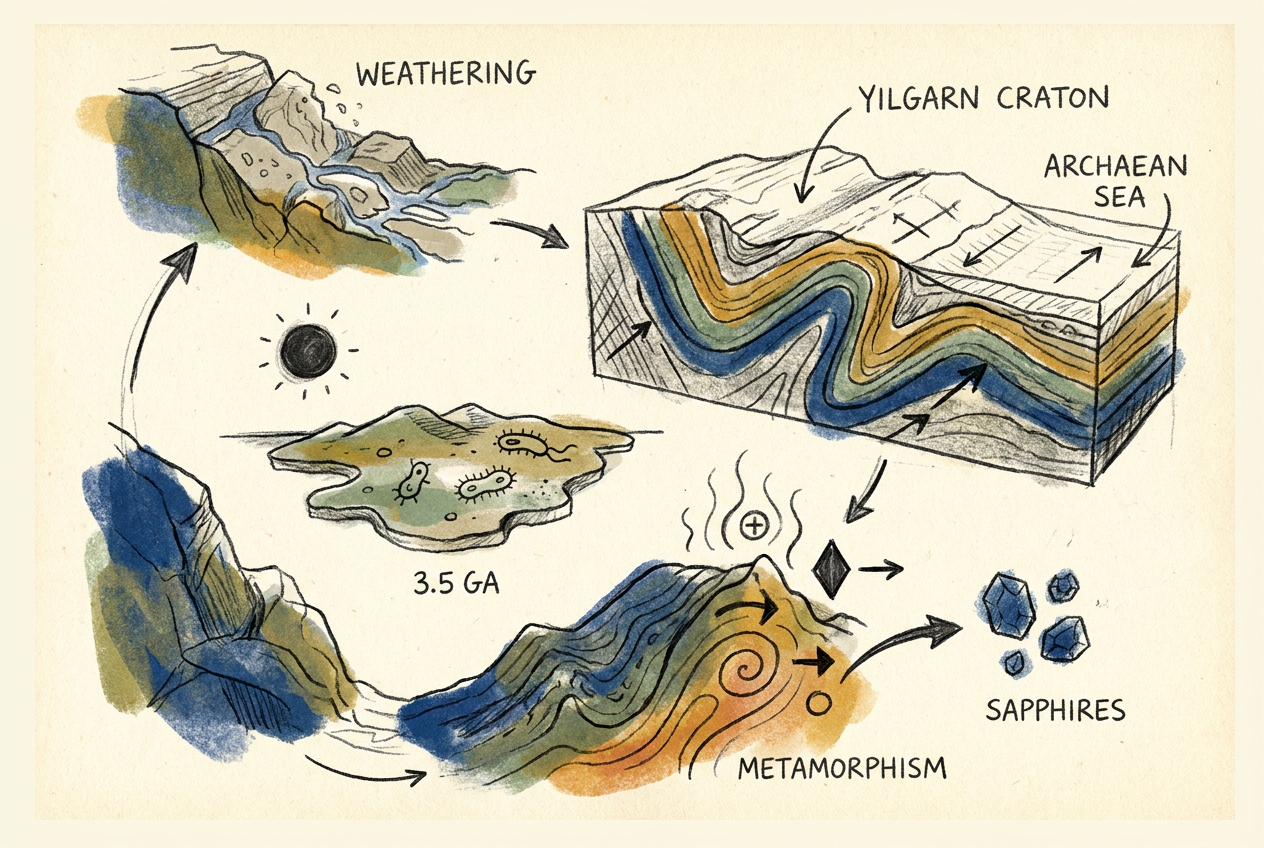
The sapphires formed in a rock called felsic gneiss, a banded, high-grade metamorphic rock that was once a sequence of seafloor sediments and volcanic ash. Around 3.5 billion years ago, the Yilgarn Craton was part of an early continent being assembled by plate collisions. Deep burial and intense heat—temperatures exceeding 700 degrees Celsius—transformed the aluminium-rich clays of the ancient seafloor into corundum, the mineral that becomes sapphire and ruby.
What makes these sapphires extraordinary is their setting. Most corundum deposits on Earth form in young metamorphic belts or in volcanic rocks that carried them from the mantle. The Yilgarn sapphires grew in place, within a rock that had already been through multiple cycles of metamorphism, and then survived for billions of years as the surrounding landscape eroded away.
The gems lay embedded in their host rock for half the age of the planet before a river finally freed them.
The Creek That Held a Fortune
The largest crystal, discovered in 1997 at a site called the Blue Well deposit near Mount Magnet, was a 1,160-carat sapphire that miners initially mistook for a piece of bottle glass. It was incomplete—a fragment of a much larger crystal—and its deep blue colour came from trace amounts of iron and titanium substituting for aluminium in the corundum lattice. Other crystals from the same deposit show green, yellow, and parti-coloured zones, recording shifts in the chemistry of the metamorphic fluids that fed their growth.
Prospectors have since found sapphire gravels scattered across a 200-kilometre arc of the Yilgarn, from Cue to Southern Cross. The deposits are small and patchy—the crystals were never concentrated by volcanic pipes or rich alluvial traps—but they are geologically priceless. They prove that corundum can form and survive in the Archaean crust, a finding that has reshaped models of how the early Earth's continents grew.
What the Gems Reveal
The Yilgarn sapphires carry a hidden record of the Archaean deep crust. The trace-element patterns in the crystals suggest they grew from an aluminium-rich sediment that had been weathered from an even older landmass—perhaps one of the first continents to emerge from the Archaean seas. The oxygen isotopes locked in the crystals point to fluids that had circulated through the seafloor, picking up silica and alumina before being baked into gemstone.
For the gem trade, these sapphires are a curiosity: most are too fractured or too dark to cut into fine jewellery. But for geologists, they are a window into a time when the Earth was still assembling its first stable crust, and when the processes that would later produce the world's great gem deposits were first being tested. The Yilgarn's 3.5-billion-year-old sapphires are not just old. They are the opening chapter of a story that ends in jewellers' windows on the other side of the world.
More like this
- The 110-Million-Year-Old River That Runs Backwards UndergroundWestern Australia's 110-million-year-old dune system has been slowly dissolving into a labyrinth of caves where an ancient river still flows, carrying the taste of a Cretaceous desert.
- The 5-Million-Year-Old Cave Archive Beneath a Treeless PlainBeneath the treeless Nullarbor Plain, a labyrinth of limestone caves preserves five million years of Australian climate in sediment layers, fossil bones, and ancient air bubbles.
- The 790,000-Year-Old Scar That Still Holds ShrapnelOn the Nullarbor Plain, a 790,000-year-old meteorite left a 24-metre-wide crater that preserves fragments of the iron projectile itself—a rare survival among Earth's impact structures.