25 June 2026 · 3 min read
The 3.4-Billion-Year-Old Sea That Preserved Earth's Oldest Glass
How 3.4-billion-year-old volcanic glass in Western Australia's Pilbara Craton was transformed into the Strelley Pool chert, preserving some of Earth's oldest microfossils.
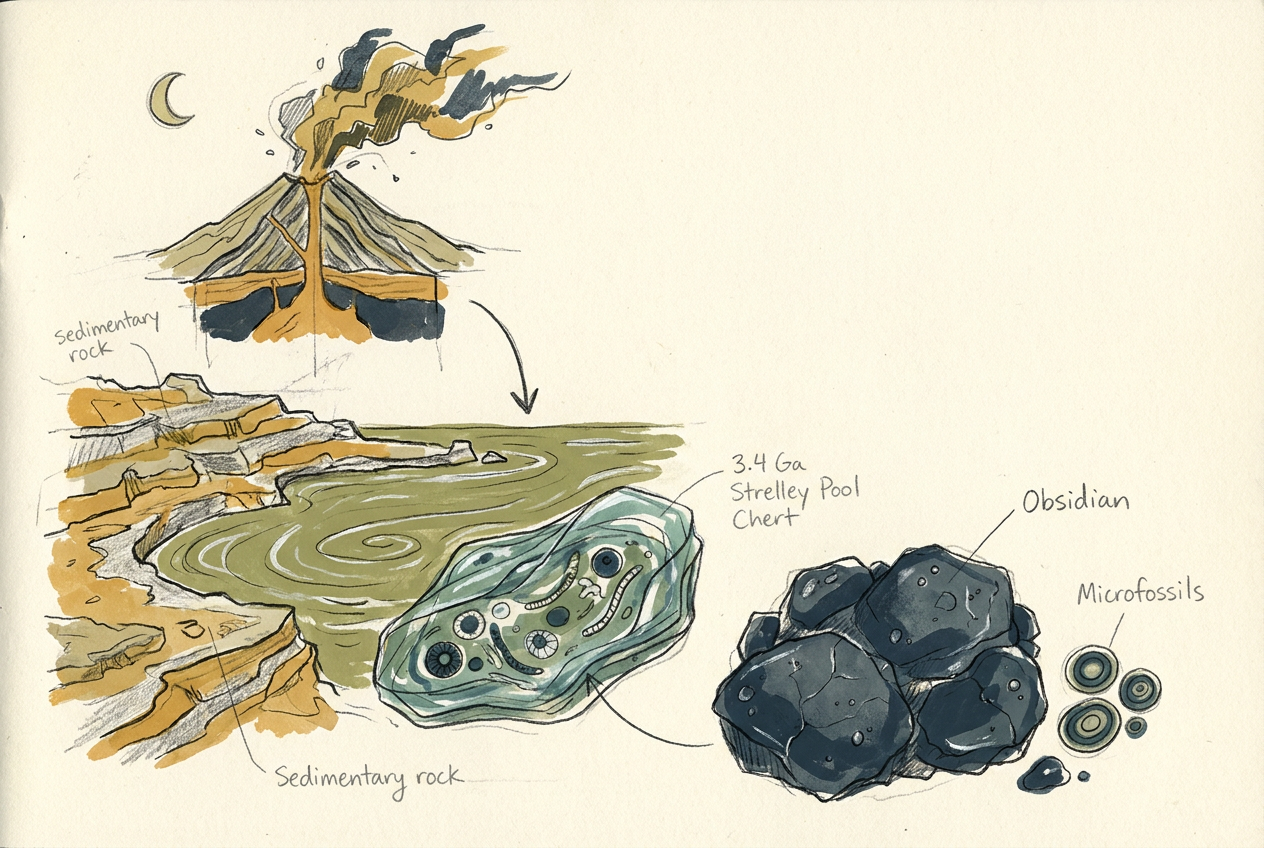
In Western Australia's Pilbara Craton, a 3.4-billion-year-old seafloor once held a layer of volcanic glass so fine that it shattered like windowpanes. That glass never cooled on land. It erupted onto the seabed, where seawater quenched the lava into a million fragments of black obsidian, each no wider than a fingernail. Today those shards are gone, replaced by microcrystalline quartz—chert—that preserves the ghost of the original glass in stunning detail. And inside that chert lie the oldest uncontested fossils of life on Earth.
The Glass That Fell Through Water
The rocks of the Strelley Pool formation sit in the East Pilbara, about 40 kilometres west of Marble Bar—a town named for a banded jasper bar that was once mistaken for marble. Three and a half billion years ago, this was a shallow marine basin dotted with volcanic vents. The eruptions were not the explosive kind we see today. Instead, basalt lava poured onto the seafloor and instantly froze into a crust of glass, a process called hyaloclastite formation.
As the lava advanced, the glassy crust shattered under its own weight and the pressure of escaping steam. The fragments—angular, sharp-edged, chemically unstable—rained onto the surrounding seabed. Over thousands of years, layer upon layer of these glass shards accumulated, interbedded with fine volcanic ash and chemical precipitates from the hot waters.
The Fossil That Hid in Quartz
Seawater does not leave volcanic glass alone. The shards, rich in silica, began to dissolve almost immediately. But as they dissolved, the silica reprecipitated in the spaces between them, filling every void with microcrystalline quartz. This process, called silicification, happened so precisely that the chert preserves the original shapes of the glass shards—their angular outlines, their curved fracture surfaces, their internal banding.
Within this chert, paleontologists have found structures that look like cells: carbonaceous filaments and spheres, some arranged in chains, others clustered in mats. The most famous of these are the Strelley Pool microfossils, first described in 2011. They are not the oldest claimed evidence of life—that honour belongs to 3.7-billion-year-old graphite inclusions in Greenland—but they are the oldest that nearly everyone agrees upon. The filaments resemble modern iron-oxidising bacteria. The spheres cluster like colonies of microbes that lived in shallow, silica-rich waters.
The glass that once shattered under the weight of an Archaean sea now holds the oldest uncontested record of life, sealed in stone before the continents had properly formed.
The Seafloor That Became a Time Capsule
The Strelley Pool chert is not a single layer but a series of beds, each representing a different moment in the life of that ancient basin. Some beds contain stromatolites—layered microbial mats that built domes on the seafloor. Others contain only the glass shards and their fossil passengers. Together, they record a world that was violently volcanic, chemically unstable, and yet somehow habitable.
The preservation is uncanny. In some samples, individual microfossils can be seen under a scanning electron microscope with their cell walls intact, replaced by carbon but still recognisable as biological. The chert acted like a glass jar, sealing the organic matter from the oxidising waters that would have destroyed it. Without the original volcanic glass—without its dissolution and reprecipitation—these fossils would never have survived.
The Window That Nearly Closed
The Strelley Pool formation is one of the few places on Earth where rocks from the Archaean eon remain exposed and unaltered. Most 3.4-billion-year-old crust has been buried, heated, squeezed, and recrystallised beyond recognition. The Pilbara Craton is different: it has sat at the surface, more or less undisturbed, for billions of years. That stability is rare. It is why Australia holds more Archaean fossils than any other continent.
But even in the Pilbara, the window is closing. Weathering, erosion, and the slow creep of the landscape are eating away at the chert beds. The same process that preserved them—silicification—also made them hard and resistant, but nothing lasts forever. The oldest glass on Earth, turned to stone, is slowly returning to sand.
More like this
- The 5,000-Year-Old Volcanoes That Still Smoke in the SouthIn Victoria's Newer Volcanics Province, 400 volcanic vents erupted as recently as 5,000 years ago—the youngest volcanic field in mainland Australia, where craters still hold blue lakes and scoria cone
- The 560-Million-Year-Old Garden That Never Saw a PredatorIn South Australia's Flinders Ranges, 560-million-year-old Ediacara surfaces preserve entire seafloor communities of fronds, discs, and quilts — a garden of soft-bodied life that flourished before pre
- The 300-Million-Year-Old Forest That Died Standing UpIn New South Wales, a 300-million-year-old fossil forest preserves dozens of trees buried upright by a Permian volcanic eruption—an entire ecosystem frozen in ash.