7 July 2026 · 3 min read
The 3.5-Billion-Year-Old Lava That Still Tastes of the Mantle
In the Pilbara, 3.5-billion-year-old komatiite lavas preserve the chemical fingerprint of the Earth's pristine mantle—unaltered by plate tectonics or crustal contamination.
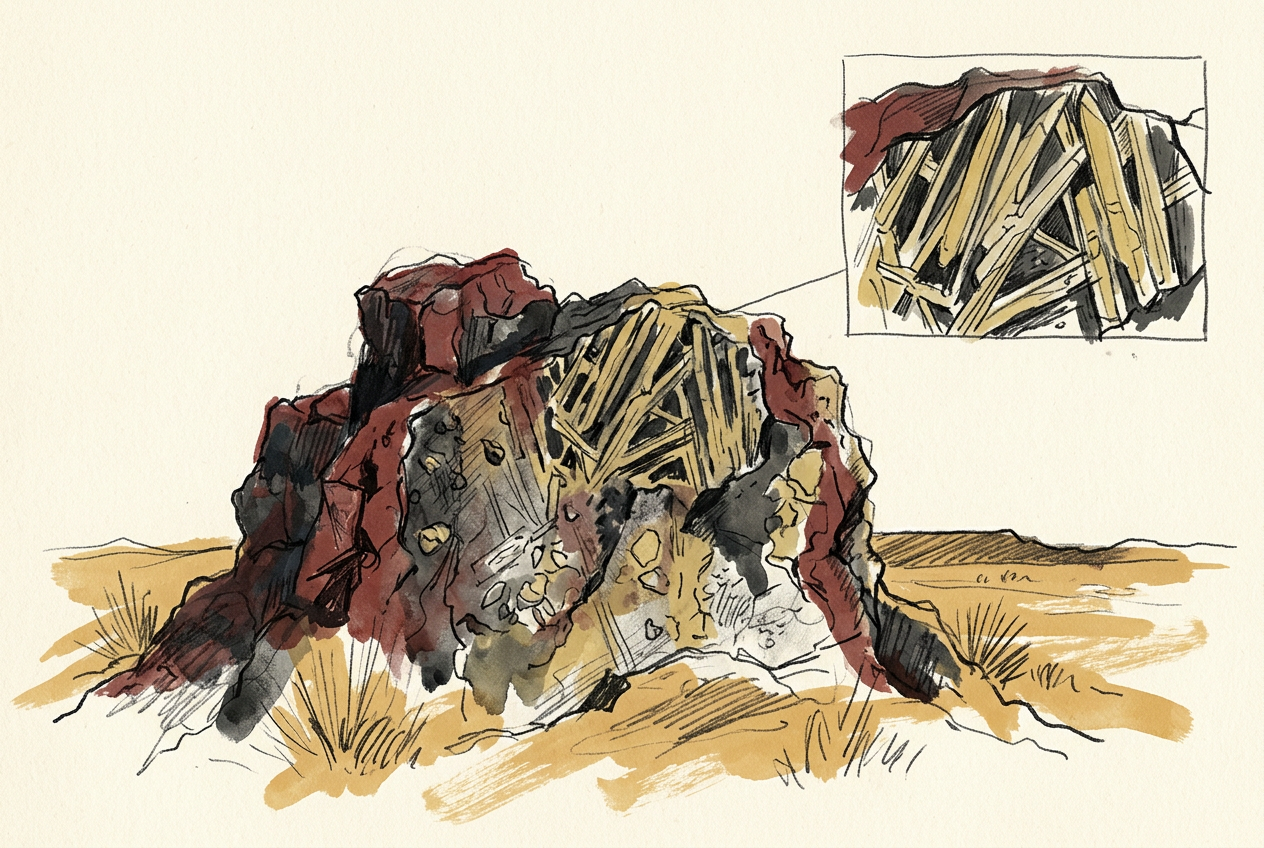
The lava came from deep enough to have avoided contamination by the young Earth's crust. When it reached the surface 3.5 billion years ago, in what is now the Pilbara region of Western Australia, it cooled into pillow basalt—rounded lobes that form when magma meets water. Those pillows are still there, and so is the chemistry of the mantle that produced them.
The Oldest Mantle
The Pilbara Craton is one of only two surviving fragments of the Earth's original continental crust. Its oldest rocks, the 3.5-billion-year-old Coonterunah Formation, are komatiites—ultramafic lavas that erupted at temperatures exceeding 1,600 °C, far hotter than any modern volcano. A komatiite is essentially a piece of the mantle brought to the surface, still carrying the chemical signature of the deep Earth before plate tectonics began.
These rocks contain more than 30 percent magnesium oxide, a concentration that tells geologists the lava rose from depths where the mantle had never been depleted by earlier melting. In modern volcanism, such compositions are impossible because the mantle has been repeatedly tapped. The Pilbara komatiites are the only direct samples we have of the pristine Archean mantle.
The Earth's interior, before it had been picked over by hundreds of millions of years of volcanism, was a different chemical world.
The Trace-Element Archive
The komatiites also preserve trace elements that act as fingerprints of the early Earth. Ratios of elements such as niobium, thorium, and uranium in the Coonterunah lavas match those of the primitive mantle—the theoretical composition of the Earth before any crust formed. This means the magma never passed through older continental crust on its way to the surface; it came straight from the deep interior, unmodified.
Geochemists have measured these ratios in the Pilbara samples and found they are identical to those in chondritic meteorites, the building blocks of the solar system. The 3.5-billion-year-old lavas are therefore not just old rocks but chemical time capsules, containing the same proportions of elements that existed when the Earth first accreted. No younger basalt on Earth can make this claim.
A Window into the Hadean
The Hadean eon—the first 500 million years of Earth history—left almost no rock record. The planet was too hot, too molten, too battered by impacts. But the Pilbara komatiites offer an indirect view. Because their chemistry matches the primitive mantle, they confirm that the deep Earth had already differentiated into core, mantle, and crust by 3.5 billion years ago, and that the mantle had not yet been stirred by convection into the homogenous layer it is today.
Recent studies of the Coonterunah Formation have also found inclusions of ancient zircon crystals, some dating to 3.8 billion years ago. These are not part of the lava itself but were ripped from older crust during eruption—making them the oldest terrestrial material ever found inside a volcanic rock. The komatiites literally carry fragments of the Hadean within them.
The Living Crust
The Pilbara Craton is also home to the world's oldest continuous surface, a landscape that has not been buried or deeply eroded for more than 2 billion years. The komatiite outcrops at North Pole Dome—named not for the Arctic but for a nearby mining claim—are weathered into rounded black boulders that look like sleeping elephants. Microbial mats still grow on their surfaces, just as they did when the lavas first cooled.
These living films are modern, but they belong to the same lineage of photosynthetic bacteria that began oxygenating the atmosphere not long after these komatiites erupted. The rocks that record the chemistry of the early mantle also sit on the landscape that records the dawn of life. The oldest and the newest are in the same place, and the gap between them is almost too wide to hold in the mind.
More like this
- The 5,000-Year-Old Volcanoes That Still Smoke in the SouthIn Victoria's Newer Volcanics Province, 400 volcanic vents erupted as recently as 5,000 years ago—the youngest volcanic field in mainland Australia, where craters still hold blue lakes and scoria cone
- The 300-Million-Year-Old Forest That Died Standing UpIn New South Wales, a 300-million-year-old fossil forest preserves dozens of trees buried upright by a Permian volcanic eruption—an entire ecosystem frozen in ash.
- The 1.85-Billion-Year-Old Caldera That Still Feeds the FurnaceIn South Australia's Middleback Ranges, a 1.85-billion-year-old volcanic caldera collapsed and later became one of the world's richest iron ore deposits.