7 July 2026 · 3 min read
The 2.7-Billion-Year-Old Bubbles That Still Hold the Sky
In Western Australia's Pilbara, 2.7-billion-year-old lava pillows preserve the oldest direct evidence of Earth's atmosphere—bubbles of Archean air trapped in basalt.
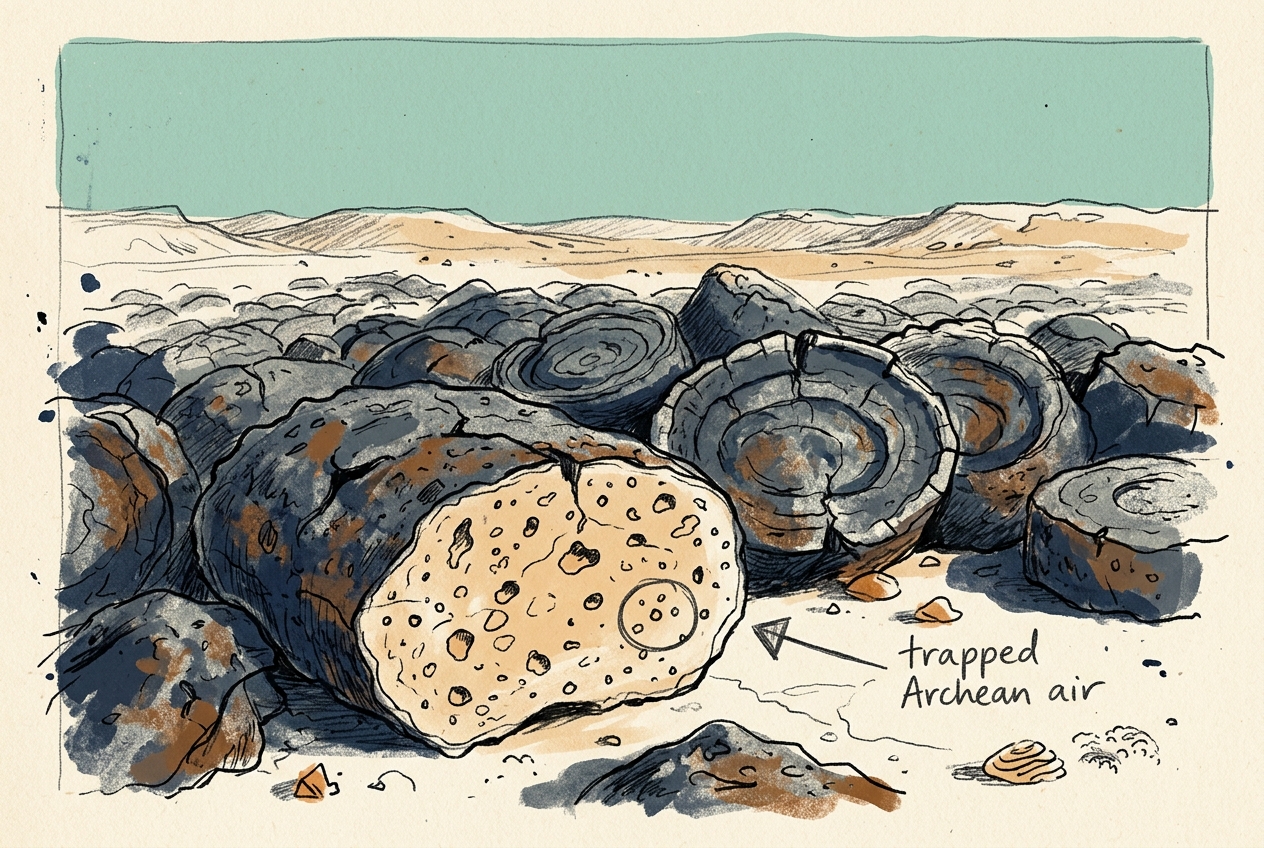
In the dry gorges of Western Australia's Pilbara region, there are rocks that still contain the sky that existed before oxygen. Not a metaphor. Actual bubbles of 2.7-billion-year-old air, trapped in basalt pillows that erupted on an ancient seafloor and never opened. They are the oldest direct samples of Earth's atmosphere ever found.
The Lava That Could Not Breathe
The pillow basalts of the Jeerinah Formation, near the town of Nullagine, formed when Archean lava oozed onto the seabed and quenched instantly into rounded, bulbous shapes. As the molten rock cooled, gases dissolved within it—mostly carbon dioxide, methane, and nitrogen—bubbled out and became trapped inside vesicles. Those vesicles, sealed by glassy rinds, remained closed for 2.7 billion years.
In 2015, a team led by geochemist David Shuster extracted these bubbles and analysed their contents. They found carbon dioxide isotopes that could not have come from modern contamination. They found noble gases with signatures matching ancient mantle sources. Most strikingly, they found that the bubbles contained almost no oxygen—below 0.1 percent—confirming that Earth's atmosphere before the Great Oxidation Event was a chemically alien place.
The pillows themselves tell a parallel story. Their rounded shapes, preserved in exquisite detail, indicate that the magma erupted in deep water under high pressure—enough to prevent the gases from expanding too violently. The water that cooled them was itself likely rich in dissolved iron and silica, the chemical soup from which the banded iron formations of the Hamersley Range would later precipitate.
A Window into the Archean Greenhouse
What did the 2.7-billion-year-old sky taste like? The bubbles suggest an atmosphere dominated by carbon dioxide, with roughly 100 to 1,000 times the modern concentration. Methane from early microbial life may have been present in significant amounts as well. Together, these greenhouse gases kept the young Earth warm despite a sun that was 20 percent dimmer than today.
The Archean atmosphere was a thick blanket of CO₂ and methane—no oxygen, no ozone, no blue sky as we know it.
This matters for understanding the history of life. The microbes that built the Pilbara's 3.5-billion-year-old stromatolites were already producing oxygen, but for 800 million years that oxygen never accumulated in the atmosphere. It was consumed instead by reactions with iron dissolved in the oceans, precipitating as rust that settled onto the seafloor in layer after layer of banded iron formation.
The Pilbara's bubbles are a chemical fossil of that stalled world—a world where life was changing the planet but the atmosphere had not yet caught up.
What the Bubbles Left Behind
The pillows are not the only record of Archean air in the Pilbara. Ancient paleosols—fossil soils preserved beneath basalt flows—also preserve chemical traces of the atmosphere that weathered them. Uranium-rich minerals in these soils show that weathering rates were far higher than today, consistent with a CO₂-rich atmosphere that produced carbonic acid rain.
But the bubbles are more direct. They are a sealed capsule, a time machine with no moving parts. The same technique used to analyse them—crushing samples in a vacuum chamber and measuring the released gases—has since been applied to Archean basalts in South Africa and Canada. None have yielded bubbles as well preserved as those of the Jeerinah Formation.
The Pilbara is often called the best place on Earth to study the early planet. Its rocks are old, flat-lying, and minimally metamorphosed—they have not been cooked or crushed enough to destroy their delicate vesicles. The same tectonic stability that preserved the craton for billions of years also preserved the sky inside its lava.
The Lesson in a Bubble
The Pilbara's 2.7-billion-year-old air reminds us that the past is not always inferred. Sometimes it is still physically present, waiting to be cracked open. Every breath we take today—21 percent oxygen, 78 percent nitrogen, a whisper of CO₂—is the product of a transformation that took two billion years to complete. The bubbles preserve the before picture.
They also pose a quiet challenge. If 2.7-billion-year-old basalt can hold a sample of its atmosphere, what else might be sealed inside the rocks beneath our feet? The Archean Earth is not gone. It is just buried, waiting for someone to tap the glass.
More like this
- The 110-Million-Year-Old River That Runs Backwards UndergroundWestern Australia's 110-million-year-old dune system has been slowly dissolving into a labyrinth of caves where an ancient river still flows, carrying the taste of a Cretaceous desert.
- The 5,000-Year-Old Volcanoes That Still Smoke in the SouthIn Victoria's Newer Volcanics Province, 400 volcanic vents erupted as recently as 5,000 years ago—the youngest volcanic field in mainland Australia, where craters still hold blue lakes and scoria cone
- The 300-Million-Year-Old Forest That Died Standing UpIn New South Wales, a 300-million-year-old fossil forest preserves dozens of trees buried upright by a Permian volcanic eruption—an entire ecosystem frozen in ash.