5 July 2026 · 3 min read
The 30-Million-Year-Old Limestone That Hides the Oldest Human in Australia
Beneath Australia's vast, flat Nullarbor Plain lies a hidden labyrinth of limestone caves that hold the continent's oldest human remains and the bones of its extinct megafauna.
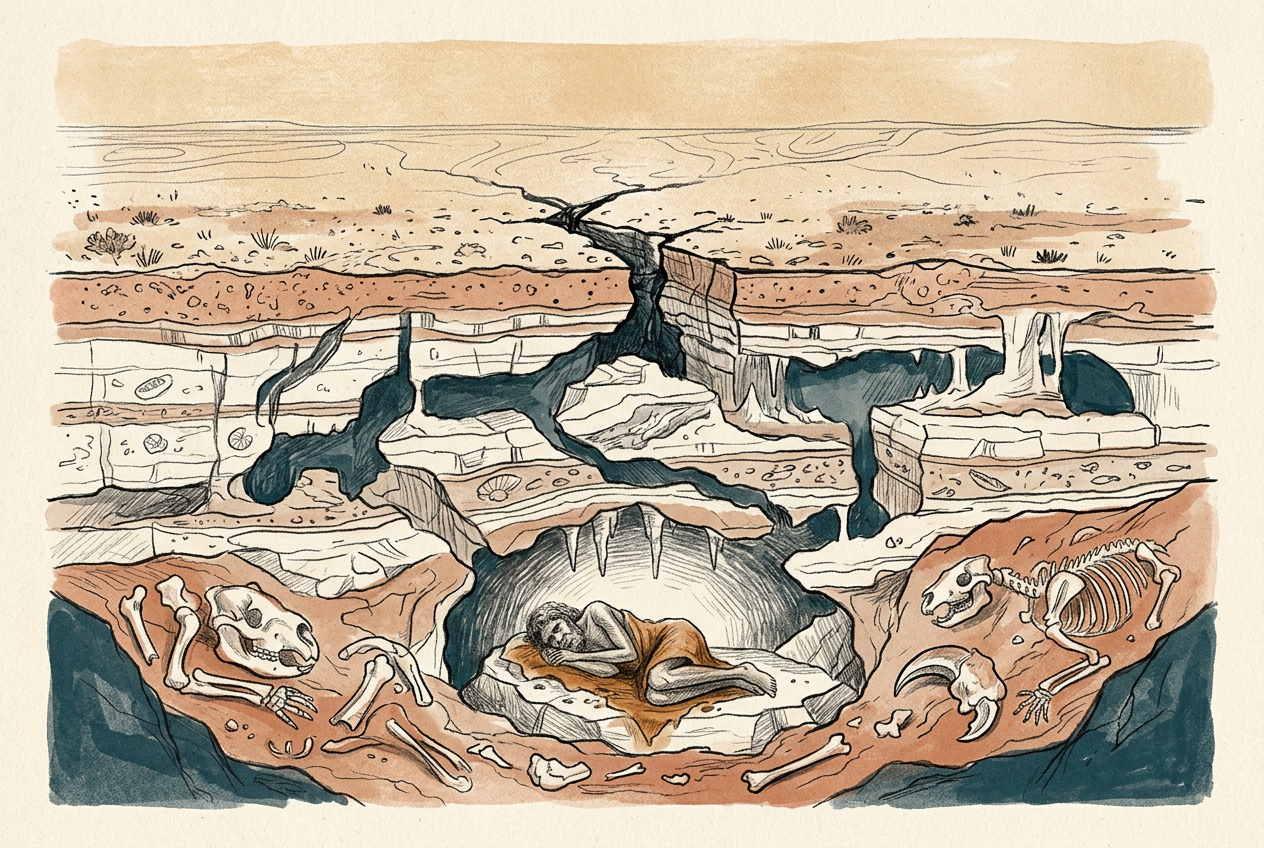
The Nullarbor Plain is the largest single limestone karst landscape on Earth—a flat, pale slab of rock the size of the United Kingdom. Beneath its surface, more than 250 caves and blowholes have been carved by groundwater over the past 30 million years, and some of them hold the continent's oldest known human remains.
The Sea That Left a Desert
Seventy million years ago, the Nullarbor was the floor of a warm, shallow sea. As the Australian continent drifted north during the Cenozoic, that sea withdrew, leaving a flat plain of limestone and dolomite. The limestone is remarkably pure—up to 99 per cent calcium carbonate—and remarkably young by Australian standards. Most of the continent's rocks are billions of years old; the Nullarbor's bedrock formed between 65 and 40 million years ago.
The plain's flatness is the result of a long stillness. No rivers cross it. There is no surface drainage. Rain falls through the porous limestone and vanishes underground, where it begins a slow, patient work of dissolution.
The Architecture Beneath the Plain
Over millions of years, slightly acidic rainwater has eaten channels and chambers into the limestone. The result is a hidden labyrinth: more than 250 known caves, plus uncounted blowholes, solution pipes, and dolines. Many are still actively forming.
Koonalda Cave extends more than a kilometre into the dark. Its walls bear the oldest known human markings in Australia—finger-flutings drawn in soft limestone by Aboriginal people at least 20,000 years ago.
Some of these caves are enormous. Mullamullang Cave, one of the longest in the Southern Hemisphere, runs for 40 kilometres of surveyed passage. Its main chamber is 30 metres high and 50 metres wide—a cathedral carved not by a river, but by the slow drip of rain through a thousand millennia of rock.
The caves preserve more than geology. In the dry, stable air of the Nullarbor's underground, organic material can survive for tens of thousands of years. Thylacine bones have been found in the caves, along with the remains of giant wombats and the eggs of Genyornis, a flightless bird that stood two metres tall.
The Oldest Human in Australia
In 1969, archaeologists digging in the entrance of a small cave on the southern edge of the plain made an extraordinary find. A human skeleton, buried in a shallow grave, lay beneath a layer of rockfall. The skeleton was that of a tall, gracile man, perhaps 50 years old when he died. Radiocarbon dating placed his death at around 42,000 years ago.
This is the oldest human skeleton found in Australia, and one of the oldest outside Africa. He is known as Mungo Man's contemporary—both lived during the same Ice Age, when sea levels were lower and Australia's coastline was further out. But while Mungo Man was cremated, the Nullarbor man was buried intact, his body placed carefully in the limestone, his arms folded across his chest.
The cave where he was found is unremarkable—a small, low opening in the cliff face, easily missed. But it was exactly the kind of place people would have used: sheltered, dry, with a view across the coastal plain that is now underwater. The Nullarbor then was not the treeless desert it is today. It was a grassy woodland, dotted with lakes and springs, rich with game.
A Landscape of Slow Change
The Nullarbor Plain continues to dissolve. Every year, a little more limestone is carried away in solution, a few more centimetres of cave passage are etched into the rock. The rate is almost imperceptible—perhaps 0.01 millimetres per year—but over geological time it is enough to reshape a continent.
The caves of the Nullarbor are not static museum pieces. They are active, alive, still being carved. And they hold, in their dry chambers, the bones of animals that no longer walk the Earth, and the remains of people who walked it when the world was colder and the sea was further away.
More like this
- The 110-Million-Year-Old River That Runs Backwards UndergroundWestern Australia's 110-million-year-old dune system has been slowly dissolving into a labyrinth of caves where an ancient river still flows, carrying the taste of a Cretaceous desert.
- The 5,000-Year-Old Volcanoes That Still Smoke in the SouthIn Victoria's Newer Volcanics Province, 400 volcanic vents erupted as recently as 5,000 years ago—the youngest volcanic field in mainland Australia, where craters still hold blue lakes and scoria cone
- The 560-Million-Year-Old Garden That Never Saw a PredatorIn South Australia's Flinders Ranges, 560-million-year-old Ediacara surfaces preserve entire seafloor communities of fronds, discs, and quilts — a garden of soft-bodied life that flourished before pre