25 June 2026 · 3 min read
The 580-Million-Year-Old Scar That Shook the Ediacaran World
A 580-million-year-old meteorite impact in South Australia's Gawler Craton scattered glass across the continent and may have reshaped the course of early animal life.
On the floor of the South Australian outback, a 300-kilometre scar runs east to west across the Stuart Shelf. It is the only known place on Earth where a single meteorite impact punched through a kilometre of rock and scattered its debris across an entire continent.
The Lake That Wasn't There
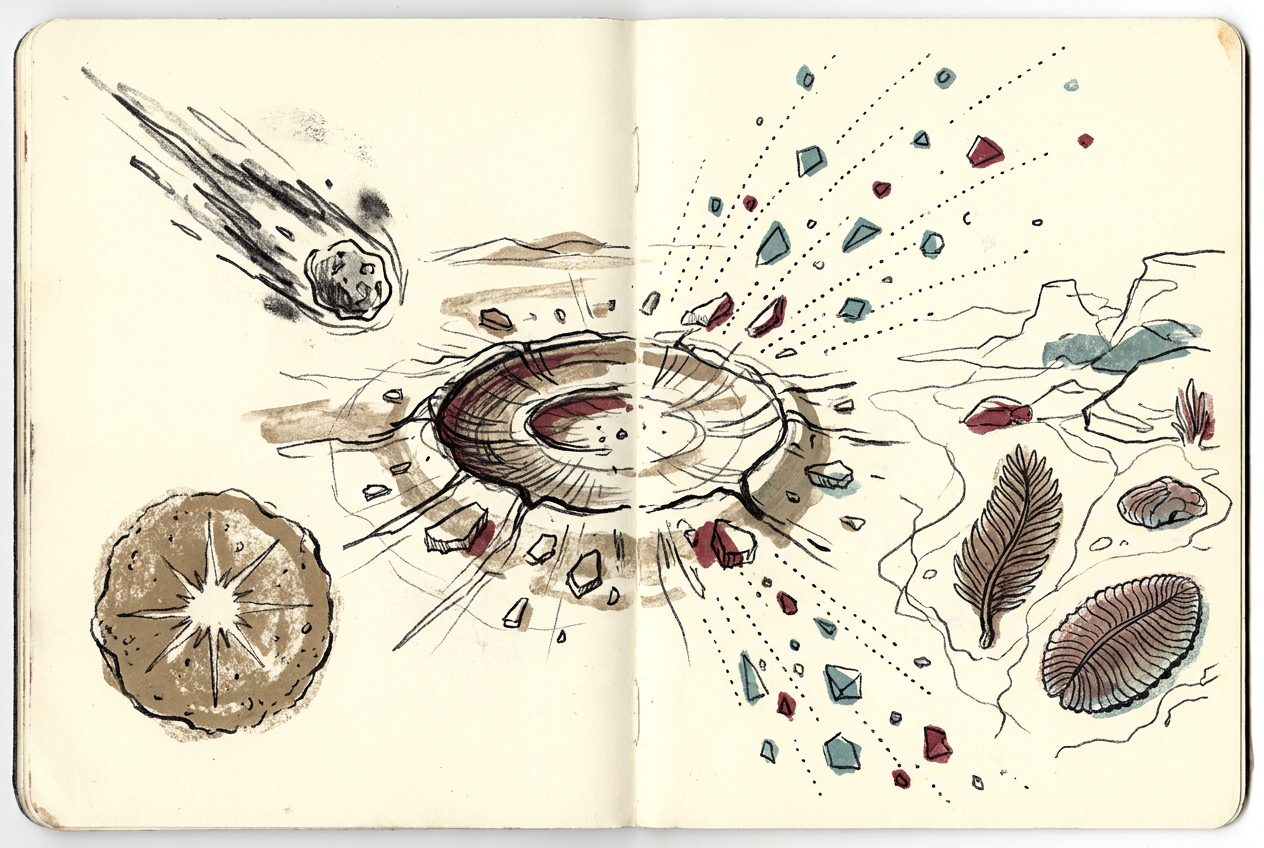
Lake Acraman appears on maps as a dry saltpan 30 kilometres wide, but the real feature lies beneath. In the 1980s, geologists studying satellite images noticed something odd: a circular depression surrounded by concentric rings of fractured rock. Drilling later confirmed it was an impact structure, one of the largest in Australia, buried under sediment for half a billion years.
The meteorite that struck here was roughly five kilometres across. It hit with enough force to melt the surrounding granite into glass and throw fragments across what is now every state on the mainland. The crater itself—now filled with Neoproterozoic sediment—is invisible from the ground. Only from above does the faint ring of hills betray its presence.
The impact threw debris across 500,000 square kilometres, a geological fingerprint visible today in rocks from the Flinders Ranges to the Pilbara.
The Glass That Fell Like Rain
When the meteorite struck, it vaporised. The shockwave melted the target rock—a 1.6-billion-year-old granite of the Gawler Craton—and hurled molten droplets into the atmosphere. These cooled mid-air and fell as tektites: centimetre-sized shards of black glass with the chemical signature of the impact site.
Geologists found these Acraman tektites in shale beds of the Bunyeroo Formation, 300 kilometres east of the crater. The layer is consistent—a single horizon of glass fragments, exactly where you would expect ejecta to settle after a large impact. Radiometric dating of the shocked zircon crystals gives an age of roughly 580 million years.
That age is crucial. It places the impact squarely in the Ediacaran Period, just as the first complex multicellular life was appearing in the oceans.
A Pause in the Fossil Record
The Ediacaran biota—the frond-like organisms that preceded the Cambrian explosion—left their most famous fossils in the Flinders Ranges, directly above the Acraman ejecta layer. Below the tektite horizon, the fossil assemblages are diverse and abundant. Above it, they change.
Some researchers argue that the Acraman impact triggered a local or global extinction event. The evidence is circumstantial but suggestive: a decline in Ediacaran diversity above the impact layer, a shift toward smaller, simpler forms, and a long recovery period before the more complex animals of the Cambrian appear.
Others are more cautious. The Ediacaran fossil record is patchy, and correlation does not prove causation. But the coincidence is striking. A five-kilometre rock from space hits the continent, and the world's first visible animals stumble.
The Crater That Keeps Giving
Acraman is not Australia's oldest impact structure—that title belongs to the 2.2-billion-year-old Yarrabubba in Western Australia—nor its largest, a distinction held by the 400-kilometre Woodleigh structure. But Acraman is the most scientifically useful. Its ejecta layer provides a precise time marker across the continent, a way to correlate sedimentary rocks that otherwise have no common reference point.
Every piece of black glass found in those Bunyeroo shales is a message from half a billion years ago: a snapshot of the moment the Earth's crust rang like a bell, and the future of life on this planet shifted, however slightly, in a new direction.
More like this
- The 560-Million-Year-Old Garden That Never Saw a PredatorIn South Australia's Flinders Ranges, 560-million-year-old Ediacara surfaces preserve entire seafloor communities of fronds, discs, and quilts — a garden of soft-bodied life that flourished before pre
- The 550-Million-Year-Old Frond That Died on PurposeA 550-million-year-old frond in the Flinders Ranges preserves the oldest known evidence of programmed cell death, recorded in the symmetrical decay pattern of Dickinsonia.
- The 825-Million-Year-Old Rift That Failed But Built a WorldA failed 825-million-year-old rift left a 650-kilometre volcanic chain and sedimentary basin in South Australia that preserved the Ediacaran fossils and still shapes the landscape today.