25 June 2026 · 3 min read
The 1.1-Billion-Year-Old Lake That Holds Earth's Oldest Sex
How 1.1-billion-year-old red algae from a lake in Central Australia preserved the oldest known evidence of sexual reproduction—cells dividing in a way that changed life forever
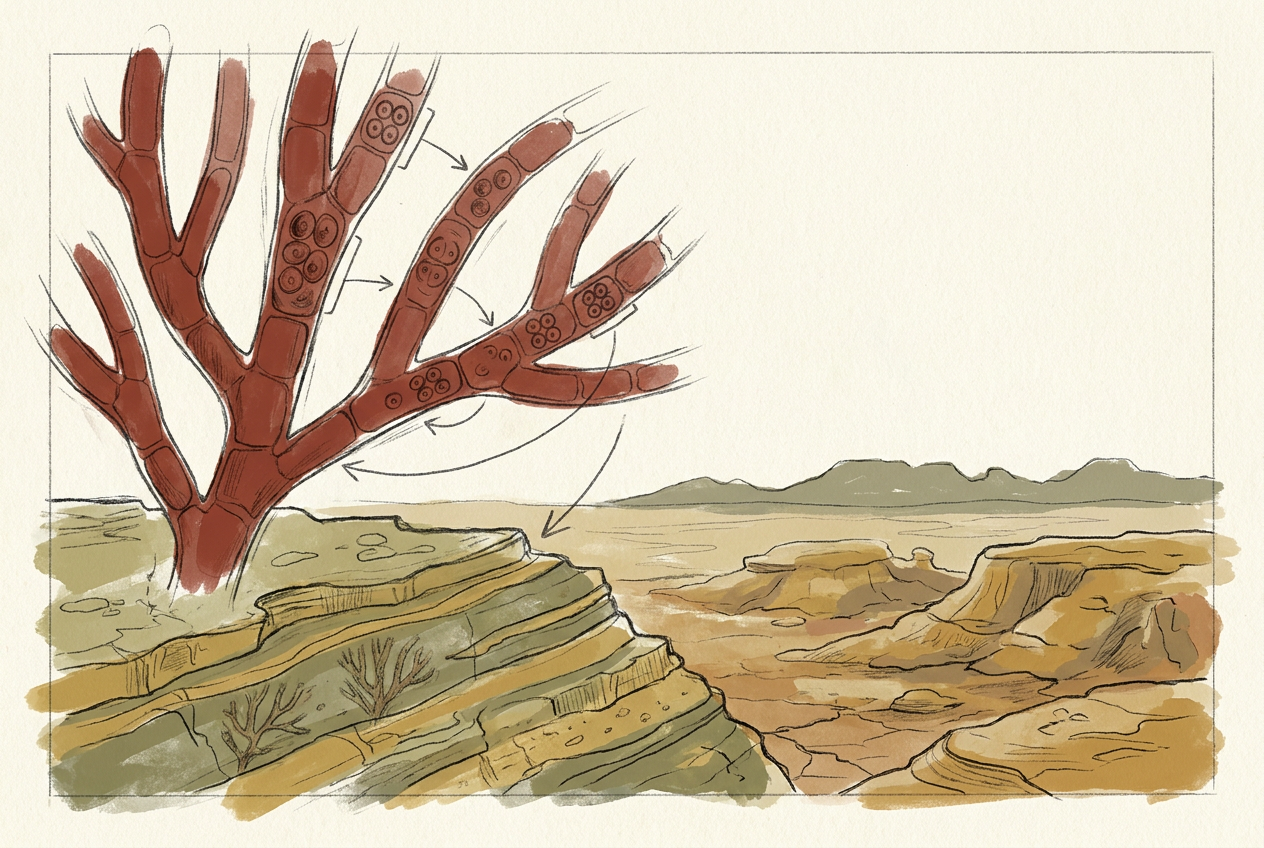
A billion years ago, in a shallow salt lake in what is now the Northern Territory, something unprecedented happened. A single-celled organism split its genome in half, fused with another cell, and produced offspring with shuffled DNA. That act of sexual reproduction, preserved in microscopic detail, marks the oldest known moment of biological mixing on Earth.
The Lake That Held a Revolution
The Roper Group of sedimentary rocks, exposed along the Roper River southeast of Katherine, preserves a 1.1-billion-year-old sequence of mudstones and shales. These rocks were laid down in an ancient inland sea or vast lake system that stretched across central Australia during the Mesoproterozoic Era. For decades, geologists knew the Roper sediments were rich in microfossils—tiny organic-walled remains of early life. But only recently have detailed imaging techniques revealed what those fossils were actually doing.
In 2016, a team led by palaeobiologist Stefan Bengtson examined fossilised cells from the Roper Group under synchrotron X-ray tomography. The images showed something extraordinary: clusters of red algae preserved in the act of cell division, with paired nuclei and evidence of meiosis—the specialised cell division that produces sperm and egg cells. These are the oldest known sexually reproducing organisms by a wide margin, predating the next oldest evidence by roughly 500 million years.
What the Cells Reveal
The fossils belong to a group called bangiophyte red algae, distant relatives of the nori used in sushi today. The Roper specimens are remarkably complete: individual cells less than 50 micrometres across, preserved in three dimensions within nodules of phosphate. The synchrotron scans revealed internal structures—cell walls, nuclei, and what appear to be preserved chromosomes—arranged in patterns consistent with meiosis.
A billion-year-old cell, caught in the middle of dividing its DNA, tells us that complex life was experimenting with sex long before animals ever appeared.
This matters because sexual reproduction, with its shuffling of genetic material between individuals, dramatically accelerates evolution. Before sex, organisms reproduced by simple division, creating clones. After sex, variation exploded. The Roper algae show that this evolutionary innovation was already established by 1.1 billion years ago, deep in the Proterozoic, when the continents were barren and the oceans held only microbes.
A Window Before Animals
The Roper Group fossils sit in a strange temporal gap. They are younger than the 1.6-billion-year-old eukaryotic cells found in the Kimberley, but far older than the Ediacaran biota that would appear around 575 million years ago. For roughly 500 million years, sexually reproducing algae drifted through ancient seas, slowly accumulating genetic diversity, while the planet waited for animals to evolve.
The sediments themselves tell a quiet story. The Roper lake or sea was shallow, periodically starved of oxygen, and rich in organic matter. Those conditions allowed delicate cells to be preserved intact—not squashed by sediment, not eaten by scavengers, but locked in phosphate nodules that hardened like tiny time capsules. The same rocks have since been uplifted and eroded, exposing the fossils along riverbanks where cattle now graze.
What Was Lost and What Remains
No animals lived in that billion-year-old lake. No predators hunted the algae. The world was silent, slow, and microbial. Yet the evolutionary groundwork laid in those waters—the invention of genetic mixing—made everything that followed possible. Every animal, every plant, every fungus on Earth carries the legacy of that first meiotic division.
The Roper fossils are not dramatic. They do not form cliffs or gemstones. They are microscopic smudges in grey mudstone, invisible to the naked eye. But under the synchrotron's beam, they reveal a moment when life changed course—when two cells met, exchanged DNA, and began the long experiment that would eventually produce trilobites, dinosaurs, and poets.
More like this
- The 560-Million-Year-Old Garden That Never Saw a PredatorIn South Australia's Flinders Ranges, 560-million-year-old Ediacara surfaces preserve entire seafloor communities of fronds, discs, and quilts — a garden of soft-bodied life that flourished before pre
- The 300-Million-Year-Old Forest That Died Standing UpIn New South Wales, a 300-million-year-old fossil forest preserves dozens of trees buried upright by a Permian volcanic eruption—an entire ecosystem frozen in ash.
- The 1.75-Billion-Year-Old Reef That Outranks the BarrierA 1.75-billion-year-old microbial reef in the Kimberley is the largest biological structure ever built by a single species, preserving a world without predators.