5 July 2026 · 2 min read
The 1.6-Billion-Year-Old Seafloor That Was Turned Inside Out
How 1.6-billion-year-old volcanic islands on South Australia's Yorke Peninsula were folded, thrust upward, and turned into a copper district that built a colony.
On South Australia's Yorke Peninsula, a slab of 1.6-billion-year-old seafloor has been turned inside out by forces that should have destroyed it. The Moonta-Wallaroo copper district sits on one of the most deformed pieces of crust on Earth—a volcanic arc that was buried, sheared, and then resurrected.
The Archipelago That Became Ore
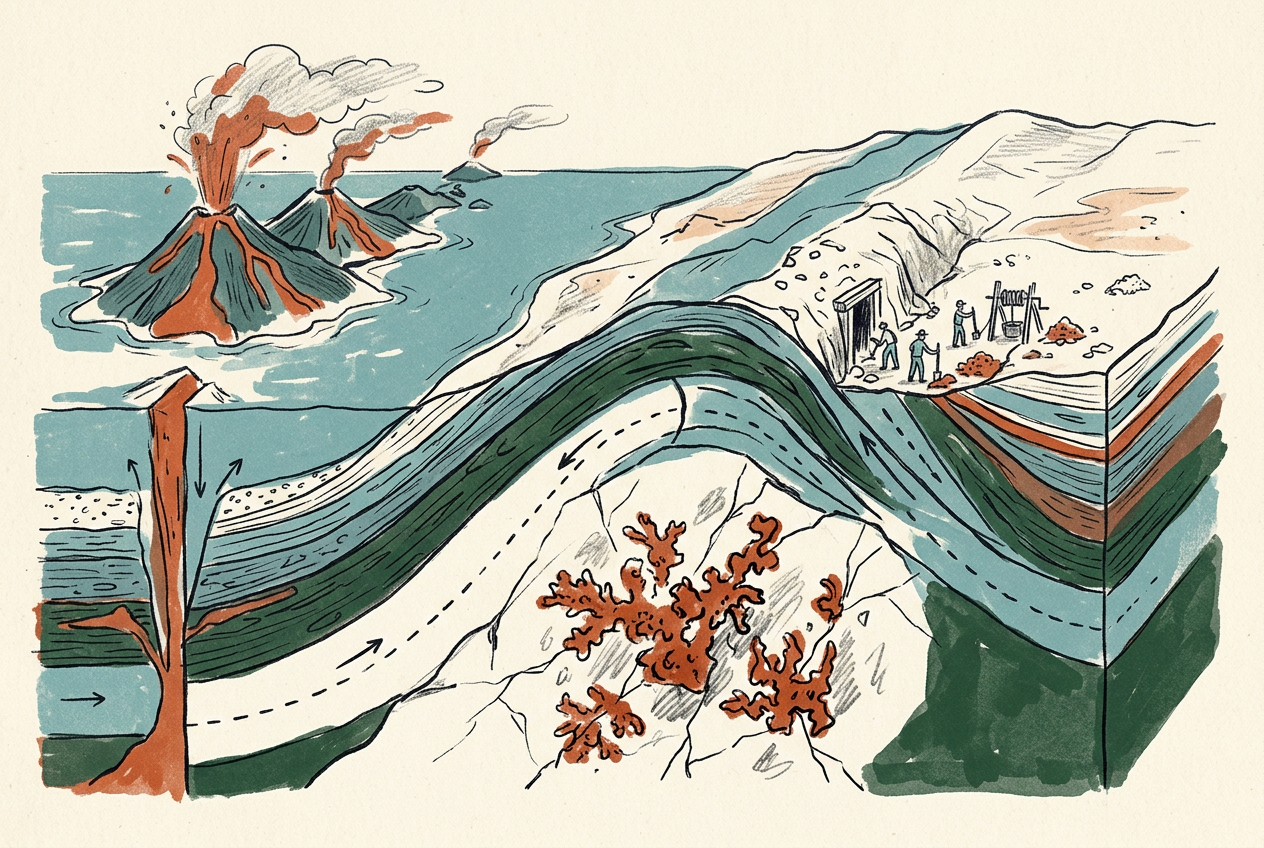
The Yorke Peninsula was once a chain of volcanic islands, similar to modern Indonesia, sitting in the Proterozoic ocean 1.6 billion years ago. Submarine volcanoes erupted iron-rich fluids onto the seafloor. Hydrothermal vents pumped copper and gold into the surrounding sediment.
Then the islands collided with the Australian continent. The collision folded the volcanic pile into tight recumbent folds, stacking kilometres of rock on top of itself. The heat and pressure recrystallised the ore into massive copper lodes.
The Inversion
Most mineral deposits stay buried. The Moonta-Wallaroo deposits were pushed upward by a second event 500 million years later—a regional compression that thrust the ancient seafloor over younger rocks. This is called a thrust stack: older rocks riding over younger ones, like a rug shoved against a wall.
The result is a geological oddity: a 1.6-billion-year-old copper deposit sitting at or near the surface, accessible to miners with picks and wheelbarrows in the 1860s. The Cornish miners who opened the Moonta mine in 1861 recognised the geology immediately—it reminded them of Cornwall's own copper-tin deposits.
"The ground looks like Cornwall," one wrote home. "Only richer."
The Copper That Built a Colony
Between 1861 and 1923, the Moonta-Wallaroo field produced 300,000 tonnes of copper, making South Australia the world's largest copper producer for a decade. The mines employed 6,000 people and built the port of Wallaroo. The smelters burned local wood until the peninsula was stripped of trees.
But the geology that made the district rich also made it confusing. The ore bodies were discontinuous—pods and lenses that pinched out without warning. Miners followed veins that disappeared into fault zones. The folding was so tight that shafts sometimes passed through the same ore body three times without realising it.
The Ghost in the Structure
Modern geologists now understand the Moonta-Wallaroo field as a classic volcanogenic massive sulfide deposit—copper and gold precipitated from hot seawater on the floor of an ancient ocean. But the deformation makes it nearly impossible to predict where the next ore body lies.
Exploration drilling in the 2000s found new copper below the old workings, but the structural complexity remains a problem. The rocks are so folded and faulted that seismic surveys produce noise, not images. The ore bodies are there, but they are scattered like raisins in a pudding that has been kneaded for a billion years.
The Yorke Peninsula copper field is a reminder that the richest deposits are not always the most orderly. Sometimes the metal is concentrated not by gentle accumulation, but by violent rearrangement—seafloor turned to mountain, buried, sheared, and finally exposed by the slow grind of erosion.
More like this
- The 5,000-Year-Old Volcanoes That Still Smoke in the SouthIn Victoria's Newer Volcanics Province, 400 volcanic vents erupted as recently as 5,000 years ago—the youngest volcanic field in mainland Australia, where craters still hold blue lakes and scoria cone
- The 300-Million-Year-Old Forest That Died Standing UpIn New South Wales, a 300-million-year-old fossil forest preserves dozens of trees buried upright by a Permian volcanic eruption—an entire ecosystem frozen in ash.
- The 1.85-Billion-Year-Old Caldera That Still Feeds the FurnaceIn South Australia's Middleback Ranges, a 1.85-billion-year-old volcanic caldera collapsed and later became one of the world's richest iron ore deposits.