14 July 2026 · 3 min read
The 3.5-Billion-Year-Old Crust That Never Got Recycled
In the Pilbara, 3.5-billion-year-old volcanic crust escaped destruction because it was too buoyant to subduct—preserving the only surviving fragment of Earth's primordial surface.
In the Pilbara region of Western Australia, there is a patch of ground that has never been swallowed by the mantle. While almost all of Earth's original crust has been dragged back into the interior and remelted, a single surviving fragment still sits at the surface, 3.5 billion years old, exposed in the East Pilbara Terrane.
No other place on Earth preserves crust this old as a coherent, intact block. Most ancient rocks survive only as small slivers caught between younger terranes. The Pilbara kept its original skin.
The Crust That Would Not Sink
The East Pilbara Terrane formed when a series of volcanic eruptions built a thick plateau on the seafloor. These were not the steep volcanoes of modern subduction zones. They were vast, shield-like basalt piles, erupted over millions of years from mantle plumes, similar to the way Hawaii builds its islands today.
What saved this crust from destruction was its chemistry. The basalts that built the Pilbara erupted through unusually hot mantle, which melted a greater proportion of the source rock. This produced a crust that was more magnesium-rich and less dense than typical oceanic crust. It simply could not sink.
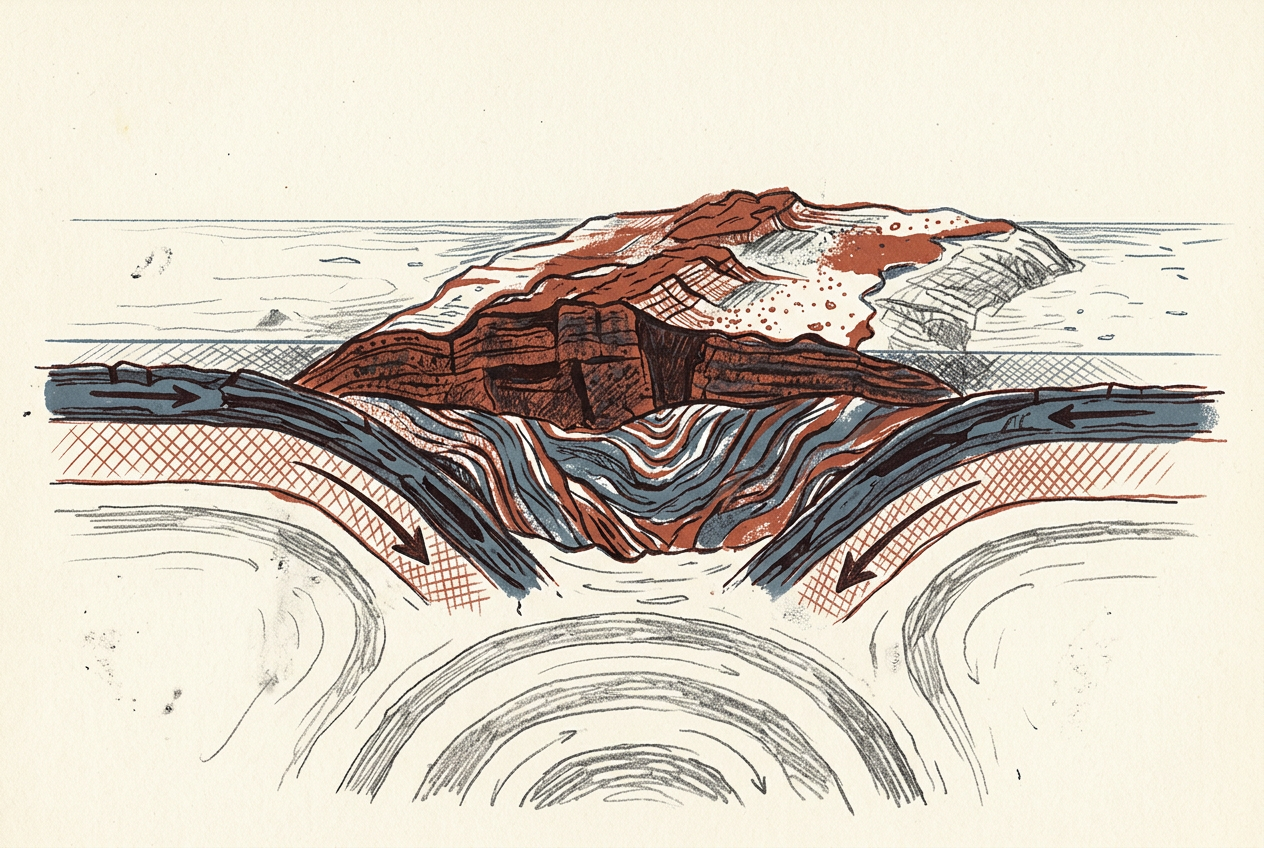
Modern oceanic crust is about seven kilometres thick and dense enough to subduct. The Pilbara crust is roughly twice that thickness and buoyant enough to float. When the first subduction zones began operating on Earth, this block refused to go down.
A Window Without Parallel
The Warrawoona Group, a sequence of volcanic and sedimentary rocks in the East Pilbara, contains the most complete record of early Earth surface processes anywhere on the planet. Pillow lavas show that water existed when these rocks formed. Rippled sandstone beds preserve the action of ancient tides.
The Pilbara crust is a time capsule from an Earth that no longer exists — a planet before plate tectonics took over the recycling of its surface.
The volcanic rocks also contain the world's oldest known stromatolites, layered microbial mats that built dome-shaped structures in shallow seas 3.5 billion years ago. These are preserved in the Dresser Formation, a set of rocks that accumulated in a volcanic caldera filled with hot, mineral-rich water.
What Almost Recycled It
The Pilbara block did not escape entirely unscathed. Around 3.4 billion years ago, a younger volcanic arc collided with its eastern edge, compressing and thickening the crust. This event, called the Prinsep Orogeny, folded and faulted the ancient rocks but did not destroy them.
Later, between 2.8 and 2.4 billion years ago, the craton experienced a series of granite intrusions that melted the lower crust and rose upward, doming the surface into the characteristic oval patterns visible in satellite images today. These granite domes are the reason the oldest rocks are exposed at the surface — they were pushed upward and the overlying material eroded away.
The rest of the world's earliest crust was less fortunate. Fragments in Greenland, Canada, and South Africa survive as small, deformed remnants. Only the Pilbara preserved a large, continuous sheet of its original volcanic surface.
The Lesson in the Stone
The survival of the East Pilbara Terrane tells geologists something surprising about the early Earth. For subduction to work, the crust must be dense enough to sink. The Pilbara shows that Earth's earliest volcanic crust was not. This means that plate tectonics, as we understand it today, could not have operated until the crust evolved to become denser.
Exactly when that transition happened remains an open question. The Pilbara suggests it may have been later than many models predict. The oldest surviving crust on Earth is not just a relic — it is evidence that the planet's early surface behaved fundamentally differently from the one we live on now.
The block still sits where it formed, unchanged in position for more than three billion years. It has outlasted every ocean that surrounded it, every mountain range that rose beside it, and every species that ever walked above it. There is no older ground on Earth.
More like this
- The 1.1-Billion-Year-Old Salt That Collapsed a ContinentIn the Amadeus Basin, 1.1-billion-year-old evaporite beds dissolved beneath Central Australia, triggering the collapse that formed the MacDonnell Ranges and opened pathways for mineral deposits.
- The 4.5-Million-Year-Old Volcanoes That Never Saw the SkyAustralia's flat-topped tuyas preserve the rare record of volcanoes that erupted beneath Pliocene glaciers, their basalt caps now standing as the oldest known examples of ice-confined eruptions on Ear
- The 1.6-Billion-Year-Old Sill That Cooked the Red CentreIn Central Australia, 1.6-billion-year-old Stuart Pass diabase sills intruded ancient sediments and cooked them into quartzite, creating the rocky spine of the MacDonnell Ranges.